Thursday, August 04, 2011

A Discussion of Quantification of Proof beyond a Reasonable Doubt


  • Jon O. Newman

Quantifying the standard of proof beyond a reasonable doubt: a comment on three comments

Law, Probability and Risk (2006) 5(3-4): 267-269 doi:10.1093/lpr/mgm010

&&&


The dynamic evidence page

It's here: the law of evidence on Spindle Law. See also this post and this post.

Computable Document Format in the Courtroom or the Law School Classroom?

I have written now and then about the possibility of using visual aids and crutches to make probabilistic evidence more intelligible to judges, lawyers, law teachers, law students, and jurors. I see that Wolfram has now created a type of document called computable document format. These are (clever!) interactive documents that allow the reader, or user, to manipulate mathematical relationships, expressions, equations, and the like. The mathematical and quantitative relationships etc. are depicted and manipulated visually. I wonder if CDFs might be used to enlighten or educate non-mathematicians. The CDF documents I have sampled are aimed mostly or exclusively at mathematicians and scientists: The accompanying prose is not easy to follow. But I wonder if the accompanying explanatory prose might sometimes be "dumbed down" (without distortion) for non-scientists and non-mathematicians.


&&&

The dynamic evidence page

It's here: the law of evidence on Spindle Law. See also this post and this post.

"Gene Robbing"

See Eriq Gardner Gene Swipe: Few DNA Labs Know Whether Chromosomes Are Yours or If You Stole Them ABA Journal [online] (August 1, 2011)


&&&


The dynamic evidence page

It's here: the law of evidence on Spindle Law. See also this post and this post.

Book about Judge Jack B. Weinstein

Judge Jack B. Weinstein has had a large influence on many areas of the law. He has had an immense amount of influence on the law of evidence, including (but not limited to) the law governing expert and scientific evidence as well as the law governing statistical evidence. I am pleased to report there is a new book about this renowned and thoughtful judge: Jeffrey B. Morris, THE CRAFT AND ACTIVISM OF JACK WEINSTEIN: LEADERSHIP ON THE FEDERAL BENCH (Oxford 2011). Having just gotten my hands on a copy of this book, I cannot definitively proclaim that it is a good book. But I have skimmed a few parts of the book and what I have read so far is very interesting.

The book grew out of what was originally envisioned as an oral history project. The interviews were conducted over a period of a decade! Transcripts of the interviews, the book proclaims, were to be deposited with the Columbia University libraries and the law library of the Touro Law School.

The blurb on the front flap of the book cover states (in part):
[The book] considers the ways a particularly gifted federal judge has seized the opportunities and tools available to federal trial judges to make policy which has had a national impact. ... Beginning with an explanation as to why Weinstein, as scholar and jurist, is entitled to an in-depth study, Morris then considers Weinstein's background before appointment to the bench and...offers many examples of how Weinstein's background has affected his decision making. ... A leader in the battle against harsh sentencing, Weinstein has endeavored to bring a "human face" to the law in a variety of ways.
&&&


The dynamic evidence page

It's here: the law of evidence on Spindle Law. See also this post and this post.

Wednesday, July 27, 2011

So-Called Empirical Testing of Hunches Underlying Legal Rules

Many empirical studies of legal rules are prone to complain and proclaim that this or that belief or hunch has not been tested "empirically." See, e.g., Behavioral Biases and Local Court Rules ("Many legal rules are based on hunches about human behavior that have not been tested empirically.") What these researchers often actually mean, of course, is that the beliefs and hunches they are interested in have not been tested in a fashion these researchers deem rigorous. For example, generations of students and scholars and police officers have tested the hunch that taking notes sometimes improves the note taker's "performance."


N.B. My strong hunch is that it would be unwise in the extreme to prohibit jurors from taking notes merely because one study (see above) suggests that note taking (under certain circumstances) exacerbates the "vividness effect." Some questions:
  • Does note taking improve the performance of some jurors but not others?
  • Does juror discussion -- discussion of the evidence by, e.g., 12 jurors -- dissipate the vividness effect?
  • Is note taking a substitute for the inability of jurors to see a full transcript of the proceedings?

A strong preference for "surprising" research results can be dangerous. See my Draft Reply to Mike Redmayne   

&&&

The dynamic evidence page

It's here: the law of evidence on Spindle Law. See also this post and this post.

Saturday, July 23, 2011

Draft Reply to Mike Redmayne

I am drafting a short reply to Mike Redmayne's short comment "Rationality and irrationality in evidence and proof," 10 Law, Probability and Risk 10 (2011) (comment on discussion paper The Structure and the Logic of Proof in Trials). Part of my reply may say the following (footnotes omitted):
... Mike Redmayne worries that I “sometimes veer too far towards … irrationality” in my views about the role of reason and logic in juridical proof. ...
... [But] I firmly believe that human beings (including lawyers, judges, and jurors) should – whenever possible – try to discipline and tame their unruly thoughts about evidence and factual questions by using the tools of logic, including, for example, probability theory. In general, I believe that disciplined deliberation about evidence is likely to improve inference. This is the "rationalist” premise from which I begin.
But I do not believe that human beings are capable of making explicit all of the premises, presuppositions, and beliefs that lead them to a conclusion about a question of fact (or about any other kind of question).
...
Although I believe that the human animal is dependent – necessarily and to a very large extent dependent – on submerged cognitive processes, I do not believe that it follows that the human animal is therefore "irrational." A vast body of literature in cognitive science, neuroscience, and similar fields almost conclusively demonstrates that the brain and its associated mechanisms are extraordinarily powerful "computing" devices – that what is astonishing is not how often the brain, sensory organs, and other biological mechanisms make mistakes and fall victim to illusions, but how well these mechanisms usually work and how rarely they make mistakes. (To put the point differently: The natural human brain, human sensory organs, and so on are extraordinarily "intelligent.") This is why I think we must be humble and respectful when we confront and examine our hunches and intuitions about evidence and factual issues and this is why I think we must think hard and long before we reject the conclusions, judgments, and inferences that our intuitions, hunches, and so on seem to counsel. By analogy (and possibly more than by analogy), I suspect we should also approach existing systems of juridical proof with respect and humility. It is possible that much wisdom and intelligence inhabit and drive such social systems for gathering evidence and answering factual questions.


&&&
 

The dynamic evidence page

It's here: the law of evidence on Spindle Law. See also this post and this post.

Sunday, July 17, 2011

Workshop on Formal Argument and Evidential Discovery

Giovanni Sartor, Scott Brewer, and I plan to organize a workshop on "formal argument and evidential discovery," a workshop to be held in conjunction with ICAIL 2013 [International Conference on AI & Law]. The workshop will be held either in Paris or in Portugal in June 2013.

The proposed workshop deals with whether and the extent to which factual discovery differs from factual proof. The topic invites discussion of matters such as (i) abductive inference, (ii) the role of intuition, hunch, and subjective judgment in the process of discovery; and (iii) the role if any of formal argument (including, e.g., statistical methods) in discovery.

If you are interested in the above topic and the workshop, please get in touch with Giovanni, Scott, or me.


&&&

The dynamic evidence page

It's here: the law of evidence on Spindle Law. See also this post and this post.

Saturday, July 02, 2011

Argument Maps versus Argument Infographics

The question of the use of visual aids to portray argument from and about evidence (e.g., evidentiary argument at trial or on appeal) is an important one. Timothy van Gelder has a post that is pertinent to this issue: Argument Maps versus Argument Infographics.


&&&


The dynamic evidence page

It's here: the law of evidence on Spindle Law. See also this post and this post.

Saturday, June 25, 2011

Urban Myths about the Relationship between Science and Medieval Catholicism

On an Evidence list, I have been challenging teachers of the law of evidence to abandon urban myths about the relationship between medieval Catholicism and science (e.g., the myth that the medieval Church taught that the earth is flat). But I guess my effort at basic education is hopeless. I say this because today I see this in the NYTimes: "About 300 years later, another Dominican friar, Giordano Bruno, proclaimed his belief that there were 'innumerable' suns, with each one having multiple Earths — a belief that, combined with other ideas deemed heretical at the time, led to his being burned at the stake in 1600." But see Ronald Numbers, ed., Galileo Goes to Jail and Other Myths about Science and Religion (Harvard 2009), "Myth 7. That Giordano Bruno Was the First Martyr of Modern Science."

Friday, June 24, 2011

History of Trials and Proof in the Occident

There is an interesting new article on the "convergence" between legal and scientific "decision making." See Michael J. Saks & Samantha L. Neufeld, "Convergent evolution in law and science: the structure of decision-making under uncertainty," 10 Law, Probability and Risk 133 (2011). The authors discuss the history of trials, proof, and legal decision making in the Occident. But there is nary a mention of Jim Franklin's Science and Conjecture: Evidence and Probability before Pascal (2001). This simply will not do. Franklin's book dramatically revises many aspects of the standard account of that history. (Joseph Stigler, who is cited by the authors, said of Franklin's book: "The Science of Conjecture is an extraordinary work, a clearly written history of the ideas of evidence and of uncertainty before Pascal. Franklin has mastered a vast literature over thousands of years, bringing it together in scholarly fashion, fully annotated.")


&&&

The dynamic evidence page

It's here: the law of evidence on Spindle Law. See also this post and this post.
A new form of academic prostitution?

A former president(!) of the University of New Mexico has been charged with running a prostitution ring.

The suspect is the author of PURSUING POWER (University of Notre Dame Press, 1997).


&&&


The dynamic evidence page

It's here: the law of evidence on Spindle Law. See also this post and this post.

Thursday, June 23, 2011

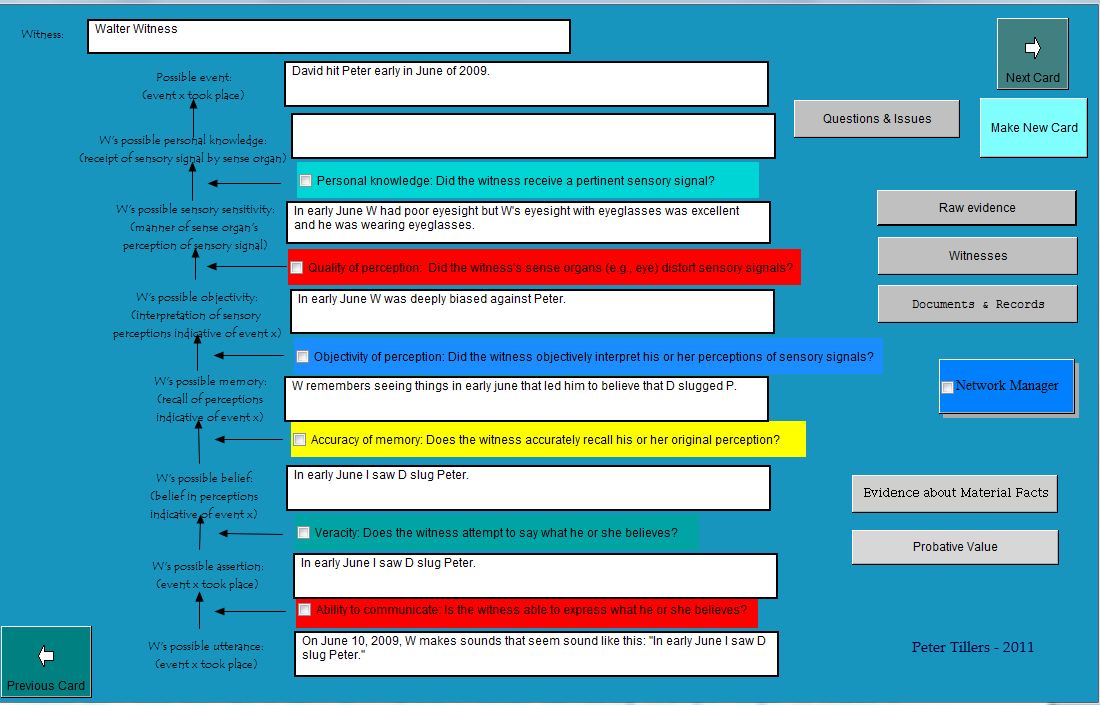
Charting Evidence Arguments in the Classroom

My course in fact investigation inevitably, and often very soon, turns to assessment of the probative force of the available evidence


and to

assessment of witness credibility based on evidence and assumptions about the witness' testimonial qualities.


Since the fact investigation course has now mercifully expanded into a two-semester course, Phil Segal and I have the luxury this year to take chains and webs of evidential inference seriously. This raises the question of the extent to which Phil and I will and should force students to engage in the painstaking process of developing inference networks (either in the form of Wigmore charts or Schum-style inference networks, which I now call NAGs). If students are to be won over, it is critical that they be provided with computer-based tools that make the chore of developing inference networks, if not easy, easier and less tedious than it can be. (Wigmore's classroom experiments with charting evidence arguments notoriously sank like the proverbial lead balloon.) We may enlist the help of Joseph Laronge, who has graciously (if foolishly) offered it to us.


&&&


The dynamic evidence page

It's here: the law of evidence on Spindle Law. See also this post and this post.

Monday, June 20, 2011

Inference, Experience, and Genetics

Some or many lessons learned through experience may be genetically encoded over time and this may be why infants can draw many valid inferences before they have any experience. Cf. Nicholas Wade, In Tiny Worm, Unlocking Secrets of the Brain, NYTimes (June 20, 2011):
Dr. Bargmann sees the arrangement in evolutionary terms. “The more reliable a piece of information is, the more it will be shifted into the genome,” she says. That way, an organism does not have to risk learning what is good or bad; the genes will dictate the right behavior by wiring it into the nervous system. Worms are wired up to know that diacetyl means good eating.
 
&&&
 

The dynamic evidence page

It's here: the law of evidence on Spindle Law. See also this post and this post.