Friday, May 17, 2013

Those Blinking Declarations!

Oh, real-world evidence problems are so messy! Consider the case in which the victim of a homicide - before his death - allegedly identified his killer by blinking his eyes three times. See Lisa Cornwell (AP reporter), Ohioan to appeal conviction in 'dying blinks' case Houston Chronicle (May 17, 2013). One thinks of Stephen Hawking.

There were "mundane" problems in the Ohio murder case.

For example, the paralyzed victim had been treated with drugs. The victim "failed to respond" to some questions. Sometimes it was "unclear" how often the victim blinked. During questioning, the victim was shown only one photograph, a photo of the defendant.
 The victim died about two weeks after he was questioned by the police.
 
Did the blinks amount to a "dying declaration"? (Did he think he was dying, did he think his death was imminent, etc.?)
 
If they did, were the victim's statements "testimonial" for purposes of contemporary Confrontation Clause jurisprudence? (I hesitate to call it "jurisprudence," but ..., oh well.)
 
Was the identification procedure so unduly suggestive that it violated the federal constitutional guarantee(s) of Due Process?
 
But, above all (I think), is this question: Did the jury have sufficient evidence to conclude beyond a reasonable doubt that the defendant was the killer?

&&&

The dynamic evidence page

Evidence marshaling software MarshalPlan


Thursday, May 16, 2013

Proposed new standards for expert witnesses in family court cases in England and Wales

New standards for expert evidence in family courts announced, Consultation launched on exclusion of ‘so-called experts who are not up to scratch’ Fanily Law Week (May 16, 2013?):
The Ministry of Justice has proposed introducing new standards for expert evidence adduced in family proceedings so that such evidence can be given only by qualified, experienced and recognised professionals. 

The government says that for too long there has been an increasing trend in England and Wales for expert witnesses to provide unnecessary and costly evidence – in the form of further written statements, clarifications and additional court appearances. This, continues the Ministry of Justice, can cause major delays in child care cases and in the worst examples this has led to cases being forced to start again.

Under the new plans, for which there will be a consultation lasting nine weeks, experts who are well-qualified and experienced will continue to provide their service in advising the family courts – but (what it terms) 'the so-called experts who provide evidence which is simply not up to scratch' will be excluded.

Family Justice Minister Lord McNally said:

"Poor quality expert evidence can lead to unacceptable delays for children and their families.

"By putting standards in place we will ensure only the highest calibre of evidence is permitted in family proceedings.

"We want to ensure that evidence being put forward is more robust and that cases are resolved more quickly. It is an opportunity we cannot afford to miss."

&&&&&

The article is short on details about how the proposed tightening of requirements for expert testimony will be achieved.

&&&

The dynamic evidence page

Evidence marshaling software MarshalPlan


Wednesday, May 15, 2013

Dan Kahan on Some Factors Affecting "Objectivity" (and the lack thereof)


Dan Kahan, Motivated reasoning & its cognates (blog post), Cultural Cognition Project  (May 15, 2013):

1.  Generally. Motivated reasoning refers to the unconscious tendency of individuals to process information in a manner that suits some end or goal extrinsic to the formation of accurate beliefs.  ...
[snip, snip]

The end or goal motivates cognition in the sense that it directs mental operations — in this case, sensory perceptions; in others, assessments of the weight and credibility of empirical evidence, or performance of mathematical or logical computation — that we expect to function independently of that goal or end.  Indeed, the normal connotation of “motive” as a conscious goal or reason for acting is actually out of place here.  ...
Although the students in this study [discussed by Kahan] probably would not have been distressed to learn that their perceptions had been covertly recruited by their desire to experience solidarity, there can be other contexts in which motivated cognition subverts an actor’s conscious ends.  This might be so, for example, when a person who genuinely desires to be make a fair or accurate judgment is unwittingly impelled to make a determination that favors some personal interest, pecuniary or social.
2.  Identity-Protective CognitionThe goals or needs that can motivate cognition are diverse.  They include fairly straightforward things, like a person’s financial or related interests.  But they reach more intangible stakes, too, such as one’s need to sustain a positive self-image or the desire to promote states of affairs or other goods that reflect one’s moral values.
Affirming one’s membership in an important reference group ... can encompass all of these ends simultaneously.  Individuals depend on select others — from families to university faculties, from religious denominations to political parties — for all manner of material and emotional support.  Propositions that impugn the character or competence of such groups, or that contradict the groups’ shared commitments, can thus jeopardize their individual members’ well-being.  Assenting to such a proposition him- or herself can sever an individual’s bonds with such a group.  The prospect that people outside the group might credit this proposition can also harm an individual by reducing the social standing or the self-esteem that person enjoys by virtue of his or her group’s reputation.  Individuals thus face psychic pressure to resist propositions of that sort, generating a species of motivated reasoning known as identity-protective cognition.
Identity-protective cognition, like other forms of motivated reasoning, operates through a variety of discrete psychological mechanisms.  Individuals are more likely to seek out information that supports than information that challenges positions associated with their group identity (biased search).  They are also likely selectively to credit or dismiss a form of evidence or argument based on its congeniality to their identity (biased assimilation).  They will tend to impute greater knowledge and trustworthiness and hence assign more credibility to individuals from within their group than from without.
These processes might take the form of rapid, heuristic-driven, even visceral judgments or perceptions, but they can influence more deliberate and reflective forms of judgment as well.  Indeed, far from being immune from identity-protective cognition, individuals who display a greater disposition to use reflective and deliberative (so-called “System 2”) forms of reasoning rather than intuitive, affective ones (“System 1”) can be expected to be even more adept at using technical information and complex analysis to bolster group-congenial beliefs.
3.  Naïve Realism. Identity-protective cognition predictably impedes deliberations, negotiations, and like forms of collective decisionmaking.  When collective decisionmaking turns on facts or other propositions that are understood to bear special significance for the interests, standing, or commitments of opposing groups (for example, those who identify with the respective sides in the Israel-Palestine conflict), identity-protective cognition will predictably exaggerate differences in their understandings of the evidence.  But even more importantly, as a result of a dynamic known as “naïve realism,” each side’s susceptibility to motivated reasoning will interact with and reinforce the other’s.
Naïve realism refers to an asymmetry in the ability of individuals to perceive the impact of identity-protective cognition.  Individuals tend to attribute the beliefs of those who disagree with them to the biasing impact of their opponents’ values.  Often they are right.  In this respect, then, people are psychological “realists.”  Nevertheless, in such situations individuals usually understand their own factual beliefs to reflect nothing more than “objective fact,” plain for anyone to see.  In this regard, they are psychologically naïve about the contribution that group commitments make to their own perceptions.
[snip, snip]
4.  “Objectivity.” As naïve realism presupposes, motivated reasoning is an instance of what we commonly recognize as rationalization.  We exhort others, and even ourselves, to overcome such lapses — to adopt an appropriate stance of detachment — in settings in which we believe impartial judgment is important, including deliberations or negotiations in which vulnerability to self-serving appraisals can interfere with reaching consensus.  What most people don’t know, however, is that such admonitions can actually have a perverse effect because of their interaction with identity-protective cognition.
[snip, snip]
5.  Cultural Cognition. Disputes set in motion by identity-protective cognition and fueled by naïve realism occupy a prominent place in our political life.  Such conflicts are the focus of the study of cultural cognition.
Cultural cognition refers to the tendency of individuals to conform their perceptions of risk and other policy-consequential facts to their cultural worldviews.  ...
Methods of cultural cognition have also been used to measure controversy over legally consequential facts.  Thus, mock jury studies have linked identity-protective cognition, motivated by the cultural worldviews, to conflicting perceptions of the risk posed by a motorist fleeing the police in a high-speed chase; of the consent of a date rape victim who said “no” but did not physically resist her assailant; of the volition of battered women who kill in self-defense; and of the use of intimidation by political protestors.  To date, however, no studies have directly tested the impact of cultural cognition on judges.
6.  Cognitive Illiberalism. Finally, cognitive illiberalism refers to the distinctive threat that cultural cognition poses to ideals of cultural pluralism and individual self-determination.  Americans are indeed fighting a “culture war,” but one over facts, not values.
[snip, snip]
As much as they agree about the ends of law, however, citizens are conspicuously — even spectacularly — factionalized over the means of attaining them.  Is the climate heating up as a result of human activity, and if so will it pose any dangers to us?  Will permitting citizens to carry concealed handguns in public increase violent crime — or reduce it?  Would a program of mandatory vaccination of schoolgirls against HPV promote their health by protecting them from cervical cancer — or undermine it by lulling them into unprotected sex, increasing their risk of contracting HIV?  Answers to questions like these tend to sharply polarize people of opposing cultural outlooks.
Divisions along these lines are not due to chance, of course; they are a consequence of identity-protective cognition.  ...
Far from counteracting this effect, deliberation among diverse groups is likely to accentuate polarization.  ...
[snip, snip]
Psychologically, however, the injunction to present culturally neutral empirical grounds for one’s position has the same effect as an “objectivity” admonition.  The prospect that one’s empirical arguments will be shown to be false creates the identity-threatening risk for her that she or others will come to form the belief that her group is deluded and, in fact, committed to propositions inimical to the public welfare.  In addition, the certitude that empirical arguments convey — “it’s simply a fact that . . . ”; “how can they deny the scientific evidence on . . . ?” — arouses suspicions of bad faith or blind partisanship on the part of the groups advancing them.  Yet when members of opposing groups attempt to rebut such arguments, they are likely to respond with the same certitude, and with the same lack of awareness that they are being impelled to credit empirical arguments to protect their identities.  This form of exchange — the signature of naïve realism — predictably generates cycles of recrimination and resentment.
[snip, snip]

&&&

The dynamic evidence page

Evidence marshaling software MarshalPlan


Saturday, May 11, 2013

The Trials of Father MacRae


Another chapter in the [Catholic] "clergy sex abuse scandal":

Dorothy Rabinowitz, The Trials of Father MacRae Wall Street Journal (May 10, 2013):

"Last Christmas Eve, his 18th behind bars, Catholic priest Gordon MacRae offered Mass in his cell at the New Hampshire state penitentiary. A quarter-ounce of unfermented wine and the host had been provided for the occasion, celebrated with the priest's cellmate in attendance. Sentenced to 33½-67 years following his 1994 conviction for sexual assault against a teenage male, Father MacRae has just turned 60.

"The path that led inexorably to that conviction would have been familiar to witnesses of the manufactured sex-abuse prosecutions that swept the nation in the 1980s and early 1990s and left an extraordinary number of ruined lives in its wake. Here once more, in the MacRae case, was a set of charges built by a determined sex-abuse investigator and an atmosphere in which accusation was, in effect, all the proof required to bring a guilty verdict. But now there was another factor: huge financial payouts for victims' claims.

"That a great many of the accusations against the priests were amply documented, that they involved the crimes of true predators all too often hidden or ignored, no one can doubt.

"Neither should anyone doubt the ripe opportunities there were for fraudulent abuse claims filed in the hope of a large payoff. Busy civil attorneys—working on behalf of clients suddenly alive to the possibilities of a molestation claim, or open to suggestions that they remembered having been molested—could and did reap handsome rewards for themselves and their clients. The Diocese of Manchester, where Father MacRae had served, had by 2004 paid out $22,210,400 in settlements to those who had accused its priests of abuse.

[snip, snip]

"... Among [the charges made by Mr. Grover was] that he had been sexually assaulted by Father MacRae when he was 15 during five successive counseling sessions. Why, after the first horrifying attack, had Mr. Grover willingly returned for four more sessions, in each of which he had been forcibly molested? Because, he explained, he had come to each new meeting with no memory of the previous attack. In addition, Mr. Grover said, he had experienced 'out of body' episodes that had blocked his recollection."

&&&

The dynamic evidence page

Evidence marshaling software MarshalPlan


Thursday, May 09, 2013

A Single Underlying Logic of "Intelligence"?

Consider the contrast between

(1) an article trumpeting the hoped-for development of artificial intelligence that is rooted in a single form of logic (allegedly) displayed by, or incorporated in, the physical architecture -- the neuronal physical architecture -- of the brain

with


(2) an article questioning a theory about intelligence (and more) that is rooted in a different kind of "grand unified theory" (a theory called "grand entropic forces").

Contrast


with


Gary Marcus & Ernest Davis, A Grand Unified Theory of Everything (Post on Blog "Elements"), New Yorker (May 6, 2013).


&&&
The dynamic evidence page

Evidence marshaling software MarshalPlan

Sunday, May 05, 2013

Darwinian Selection at Large Law Firms

Everett Bellamy, Review: Dirty secrets of legal profession (May 5, 2013):

"[Stephen J. Harper, LAWYER BUBBLE: A PROFESSION IN CRISIS (2013)] argues that the role top law schools play in putting their graduates in large law firms is misguided, particularly in light of the high turnover rate of associates at big firms (the fifth-year associate turnover rate exceeds 80%)."

&&&

Is it even clear that large law firms generally select the "fittest" associates for partnerships?

&&&

The dynamic evidence page

Evidence marshaling software MarshalPlan


Thursday, April 25, 2013

Notes on MarshalPlan: Theoretical Underpinnings

In my evidence marshaling software - MarshalPlan - I have a note that might be of general interest.  The note is called "A Note on the Theoretical Underpinnings and Purposes of MarshalPlan." I said this (sometime in 2012 or earlier):

A Note on the Structure of This Note

My motivations for developing MarshalPlan have been theoretical as much as practical. But I did not and I do not see a tension between my theoretical and practical ambitions. My neo-empiricist inclinations lead me to conclude that a sound theory of inference must be able to prove itself in the world. By developing MarshalPlan I wanted to both explore and illustrate some basic hypotheses about the nature of (wo)man's acquisition of knowledge about his (her) world.

Since my constructivist agenda was positive rather than negative, I have not used any part of the  other notes embedded in MarshalPlan to make arguments against views of evidential inference that I think are mistaken. My thought was that the success or failure of MarshalPlan would be the primary test of whether my own views are or are not mistaken. However, now that I have largely completed the outline of a working model of MarshalPlan, I think it might now be useful for me identify the theoretical premises and perspectives that I do not have and that do not undergird the MarshalPlan project. So I will do that. But I will describe (below) those rejected perspectives only in a shorthand way. This is why I use the word "dogma" below to refer to my view about this or that perspective that I find wanting.

After identifying some theoretical perspectives that I do not embrace, I describe (below) some of my key affirmative hunches about the nature and foundations of empirical human knowledge. These are theses that either have supported the development of MarshalPlan or they are theses that are supported by the development of MarshalPlan.
 
   Theoretical Dogma Number 1

There is a long-running debate in the American legal academy and elsewhere about the use of mathematics to analyze evidence in trials. This debate is a red herring; it misses the boat; it does not address the fundamental issues about evidential inference. This is not to say that questions about when mathematics might or should play a role in evidential argument in legal settings are uninteresting or unimportant; they are both interesting and important. I also do not claim that discussions that focus of the role of mathematics can or have said nothing about fundamental epistemological issues. That's not the case. Such discussions can and sometimes do touch on fundamental questions and in this way shed light on key facets of inference and reasoning from evidence.  But such a defense of the debate about mathematical analysis of evidence is a bit like saying that WWII was a good thing because it led to the development of V-2 rockets. The debate about mathematical analysis of evidence has caused more intellectual havoc than enlightenment.

   Theoretical Dogma Number 2

There have been arguments, both within the literature on evidential inference narrowly conceived and in the broader philosophical literature, that inference is fundamentally subjective. I have occasionally made such arguments myself.

The claim that human inference is subjective is true but trivial.

Human beings (and sharks and other organisms [see below]) do have some capacity to draw accurate inferences about the world. If they did not, they could not have survived as long as they have -- unless they had an extraordinary amount of dumb luck. In any case, accomplishments such as the development of the internal combustion engine, the development of nuclear weapons, the development of the microchip, and the construction of cathedrals that often manage to stand for decades and sometimes for centuries is evidence enough that accurate factual inference is sometimes possible. Complete epistemological or inferential relativism or skepticism is a non-starter for any serious student of human evidential inference.

   Theoretical Dogma Number 3

The opposing thesis -- the thesis that there are objective methods of drawing inferences about human behavior -- is, however, also incorrect. This thesis is incorrect if by the word "objective" we mean self-standing (or autonomous or largely-autonomous) methods of reasoning, artificial methods of reasoning that can replace ordinary, seemingly-sloppy, and commonsense human methods of reasoning about matters such as human behavior.

Usually such objective methods are not available. This is true even though it is also true that some problems or questions in our world are now configured in such a way that artificial and autonomous methods of ratiocination, rumination, or computation can yield solutions that are less likely to be wrong than those reached by unaided human common sense.

As you can see, this dogma -- Dogma Number 3 -- is closely related to Dogma Number 1, my dogma about the irrelevance of much of the longstanding debate about mathematical analysis of evidence and inference.

The brain -- or the neurobiological system -- or possibly we will have to call it the neuro-electro-magneto-biological system -- is a very complex mechanism. Some persons say that it is the most complex mechanism in the universe. They may be right about that. Whether they are or not right about that, it is unlikely that artificial methods of computation (such as computer-based computation) can replace the human brain anytime soon. True, as I said earlier, in some domains computers can outperform humans; for example, computers can now play chess and checkers better than even the most extraordinary humans can. But in most arenas computers do far less well than human beings do. That's likely to be the case for some time to come.

   Theoretical Dogma Number 4

Given Dogma Number 3, it does not follow that theorizing about inference is pointless. On the contrary: it is possible for theorizing about inference to have both theoretical value and cash-value: it is possible that theorizing about inference can lead to improvements in both our understanding of evidential inference and in the quality of real-world inference in legal settings.

Given our present understanding of evidential inference and given the limitations on our current understanding of evidential inference, there is reason to believe and hope that images of reasoning about evidence can improve human inference if such images are used ctogether with with ordinary reasoning and common sense logic. More precisely stated,  it is possible for images (or pictures) of inference to be a useful tool of common sense, it is possible for images of evidential inference to support, facilitate, and enhance natural, or pre-existing, methods of human reasoning about evidence. This is roughly the fundamental insight that Timothy van Gelder holds and purveys, and I align myself with him. (However, Tim bears no responsibility for the details of the MarshalPlan system or for its many defects and failings.)

(No more dogmas!)

&&&&&&&&&&&&&&&&&&&&&&&&&&&&&&&&&&&&&&&&&&&&&&&&&&

Those are some of my theoretical beliefs and dogmas. But now I must tackle a hard question rather than an easy one:

What sorts of images of inference, what sorts of cognitive tools, what sorts of models of inference are likely to be helpful?

I begin my attack on this question by making a few more comments about the general direction that theorizing about inference might take and why this general tack might turn out to be productive.

The brain -- or the human neurobiological system, or possibly the human electro-magneto-neuro-biological system -- is a computational mechanism of enormous complexity, subtlety, and power. A model of inference -- an artificial construct -- might try to capitalize on the power of this natural mechanism and make it function more effectively.

How could an image or images of inference do that?

Stated most abstractly, my answer is this: an image or model of evidential inference could improve the quality of human inferential performance if it could trigger natural computational mechanisms and processes (such as those in the brain) and make it possible for human beings to use their native, or inbred, computational mechanisms and processes more efficiently, more effectively, and more productively.

That artificial devices might be helpful or useful in this derivative way -- that images or models of evidential inference could serve as handmaidens of natural human reason -- that some artificial constructs depicting inference might be useful cognitive tools, or helpful cognitive crutches -- that appropriately-drawn images of inference might function as supports for native human reasoning -- is suggested by two considerations.

First, any particular line of reasoning about any real-world problem almost inevitably involves multiple steps. Properly designed artificial devices -- cognitive tools, heuristic devices, inference support tools, whatever they are called -- might well improve the ability of humans literally to keep in mind -- to keep in conscious thought, to be more aware of, to have more awareness of -- the steps in any train of reasoning that they decide to follow when considering any particular factual hypothesis.

Second, human beings reason about evidence and the world along multiple tracks, in a multitude of ways. Even though the brain is a very powerful mechanism, it is not an infallible one, and the different ways of thinking or reasoning or the different tracks the mind takes are difficult to keep in mind (so to speak) at the same time. But these different tracks, these different ways of thinking about a problem, influence each other. So keeping multiple lines of reasoning in mind at the same time is important; indeed, it is essential. Cognitive crutches can help mortals keep in mind the many different tracks along which their minds are running.

In sum, there is reason to think or hope that artificial tools (including, for example, simple diagrams and checklists drawn on paper) can make it easier for human beings to literally better keep in mind their various ways of thinking about a factual question and the numerous steps that human beings characteristically take and construct within each track of the many tracks of thinking that they follow.

The next question is what particular sorts of images or models of evidential inference are likely to be useful and necessary.

Overview of Evidence Marshaling Methods in MarshalPlan

Much recent theoretical work on inference centers on inference networks. Such work is very important and it must continue. However, MarshalPlan has relatively little to say about inference networks. It focuses on other methods or marshaling or organizing evidence. MarshalPlan emphasizes comparatively simple evidence marshaling strategies methods such as event time lines, scenarios, and marshaling of evidence by legal rules.

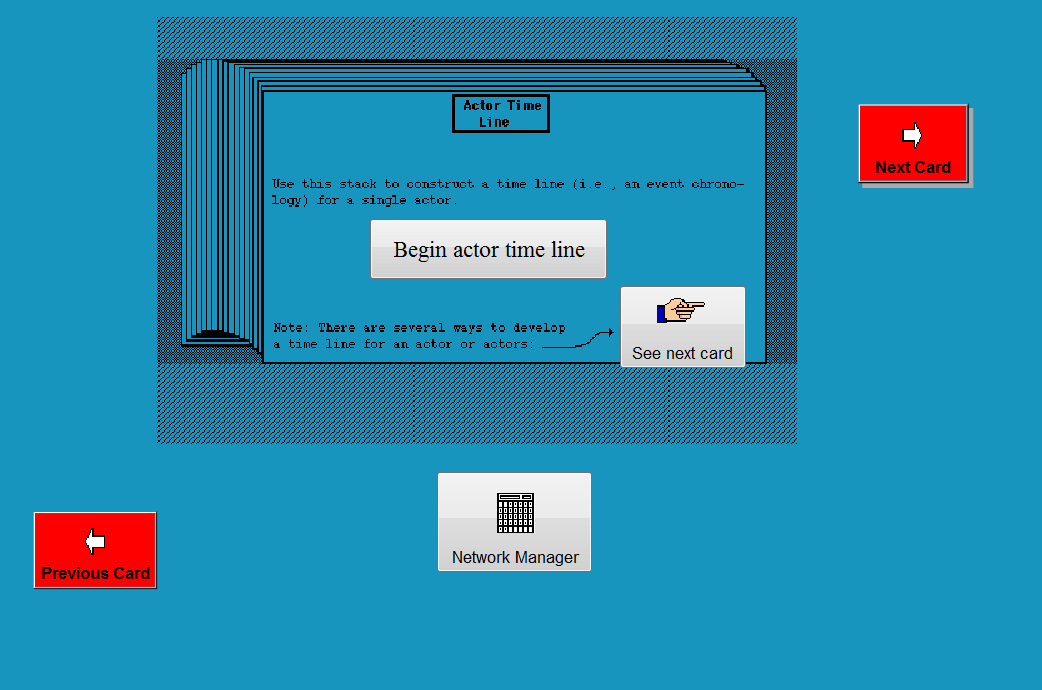
Card Number 2 of the stack Network Manager -- the card in which this notes is embedded -- serves in part as an outline of the evidence marshaling methods found in MarshalPlan.


Card 2

The evidence marshaling strategies pictured on Card Number 2 can be sorted into several broad categories.

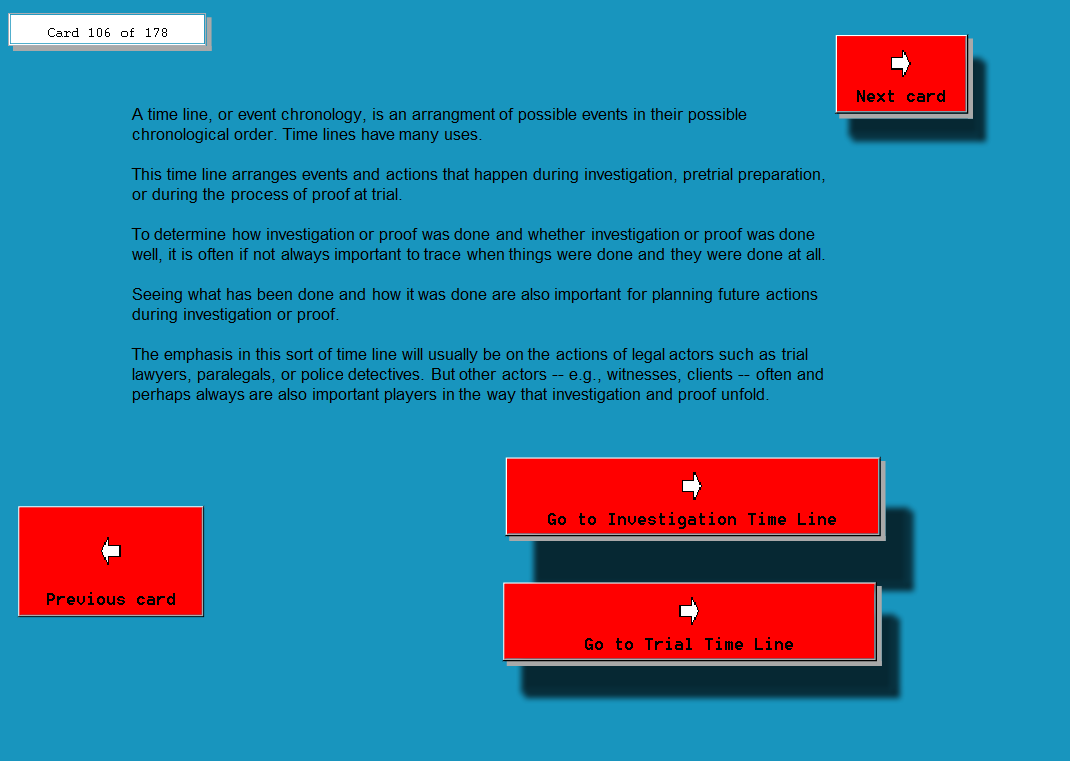
In one set of methods TIME plays a central role. This is is true of event chronologies, or time lines. It is true of scenarios. And it is true, in a more complicated way, of narrative and story-telling.

Nota Bene: There are several sub-categories of time lines: (1) time lines of the events at issue in a case, (2) time lines that show the history of sources of evidence (both so-called real evidence and human sources, or witnesses), (3) time lines showing the order in which evidence is collected, handled, and presented. Each of these categories can have subcategories or subdivisions: For example, time lines for events at issue include time lines showing the possible events over time related to possible actors in the possible events at issue.

Another set of evidence marshaling methods deals with the influence of legal doctrines and norms on evidence marshaling, analysis, collection, and assessment in legal settings. I am now referring, for example, to the red buttons (or links) called Legal Rules, Legal Argument, Legal Source Material, and Evidence and Material Facts. These and other stacks deal, in the aggregate, with "legal marshaling," which is my shorthand phrase for the way that legal doctrines and legal norms influence the gathering and assessment of evidence.

Another set of evidence marshaling methods amounts to little more than a system for filing evidence and information. These are the methods (or stacks) called Raw Evidence, Legal Source Material, Persons, Analysts, Legal Actors, and so on. It is probably true that the filing of information on the basis of such categories ordinarily does not require great intellectual labor. Nonetheless, the filing of evidence and information on the basis of such categories is not a trivial act. Evidence and information can be more easily accessed and recalled and evidence and information are also more suggestive and evocative if they are stored on the basis of meaningful concepts, i.e., according to categories or classifications that are meaningful to the user.

Another group of evidence marshaling strategies in MarshalPlan's collection of evidence marshaling strategies inches toward the development of inference networks. Thinking of inference as a network or web of inference is mainly but not exclusively useful when the factual questions are stable and the available evidence is know. In situations such as this -- in situations in which the facts in issue seem relatively stable -- a decision maker is most likely to want to focus on evidence sorting methods such as Evidence of Material Facts, Evidence for and against Material Facts, Witness Credibility, and Argument about Evidence, or Probative Value.

This above outline of types of evidence marshaling strategies two important strategies shown on Card Number 2 of Network Manager unaccounted for.

One important strategy not yet discussed is is the cognitive strategy or process here called Case Theory.

As it now stands, the stack Case Theory is less a picture of how this evidence marshaling strategy works than it is a general reminder that, first, there is a very important synthetic or constructive aspect to factfinding and evidential inference, second, the various evidence marshaling strategies identified and described by MarshalPlan influence each other and depend on each other, and,  third, the strength of a claim to have correctly or plausibly determined the important legally-material facts depends in large part on the extent to which the various evidence marshaling strategies that a decision maker uses are in harmony with each other and reinforce each other and, thus, on the the extent to which evidence marshaling strategies taken together generate a state of mind of epistemic equanimity, an epistemic reflective equilibrium. (If I were a brilliant programmer, which I am not, I could figure out how to develop a Case Theory stack that would allow the user to rotate through all of the evidence marshaling strategies shown in the Network Manager stack while still keeping, to some substantial degree, all evidence marshaling strategies in the mind's eye.)

Another group of stacks (or evidence marshaling strategies) lies at almost the opposite pole from the case theory stack (that is, at the opposite pole from thinking about the whole ball of wax). Case theory development involves synthetic thinking -- which in this instances involves the attempt to view the various parts of evidence marshaling in relationship to each other and the attempt to sense the degree to which the results of various evidence marshaling strategies are consistent with each other. This kind of synthetic and global thinking becomes tends to become most explicit once the key ingredients of an inferential puzzle have been identified and studied. But reasoning about evidence also involves and requires exploratory thinking. Several stacks in Network Manager are designed to facilitate and support imaginative thinking about possibilities. See, for example, the stack Possibilities and the stack Loose Thoughts.

&&&&&&&&&&&&&&&&&&&&&&&&&&&&&&&&&&&&&&&&&&&&&&&&&&

You have been presented with a general sketch of the evidence marshaling strategies that are collected in MarshalPlan. The collection of strategies I have described looks a bit like a network. But the collection of  strategies in MarshalPlan is not a true network; it is a quasi-network. This is not an accidental feature of MarshalPlan; it is a central feature of MarshalPlan.

In my picture of evidence marshaling, the results of any one kind of evidence marshaling -- for example, of marshaling by time line, legal rules, etc. -- the results of any one kind of marshaling do not have determinate, or computable, implications for any other type of evidence marshaling. For example, any specific time line is logically compatible with innumerable scenarios. However, it is my hypothesis that the evidence marshaling strategies in my collection nevertheless do influence each other. For example, an assessment of the plausibility of some scenario may be affected and is likely to be affected by my assessment of the credibility of this or that witness. This is why I call my network a quasi-network even though MarshalPlan is not a true network.

On this point, I entirely embrace David Schum's thesis (which he advanced in a different context) that marshaling evidence in one particular way may be evocative of or suggestive of evidence marshaling that has a different axis and follows a completely different logic.
 
I believe that a quasi-network better portrays how the mind -- the accessible part of the human mind, in any event --, how the mind works when it ruminates about evidence in legal settings (and, putting aside legal marshaling, how the mind works in other settings as well).

&&&&&&&&&&&&&&&&&&&&&&&&&&&&&&&&&&&&&&&&&&&&&&&&&&&

But how, you might ask, did I arrive at the evidence marshaling strategies and methods that are included in MarshalPlan, that are found in the catalogues of evidence marshaling operations or methods found in places such as Card Numbers 2 and 3 of Network Manager and in places such as the stack Loose Thoughts?

The answer is that a variety of considerations -- a bit of logic, a bit of philosophy, some personal legal experiences, and so on -- led me to the list of evidence marshaling strategies now found in MarshalPlan. But it is very important for me to say and forthrightly admit that subjective introspection was a critical source of my catalogue of evidence marshaling strategies; that is, I peered into my own mind and I tried to see how I think about evidence and how I organize evidence in legal contexts such as litigation; I tried to identify the different ways that I, Peter Tillers, think about evidence when I try to understand evidence and assess its implications.

So it is fair to say that in many respects MarshalPlan has an affinity with mind maps. However, a mind map isn't worth much if it's just a map of one person's idiosyncratic mind. You and I may think in different ways about evidence. The fact that I think one way may just demonstrate that I have an enormous capacity for self-delusion or that I am very stupid. It is also possible that things I do not understand or see drive me to think the way I do. But there is reason to think and hope that MarshalPlan is more than just a map of the way one particular human creature, Peter Tillers, thinks.

I do have an quasi-objective explanation or justification for some of the methods on my list of evidence marshaling strategies. For example, I believe that plausible ontological considerations support the thesis that almost every factual issue either explicitly or implicitly also presents a question about scenarios. I have similar quasi-objective explanations and justifications for several other evidence marshaling strategies. Beyond that, I appeal to common experience -- both your subjective sense of how you think when you think about evidence and how society (e.g., particular legal rules) tends to say that evidence should be marshaled and analyzed.
 
Conscious Logic (or Folk Logic) versus Subconscious Logic

But if I purport to be thinking rigorously, I cannot ignore the type of challenge laid down by some very serious students of artificial intelligence, brain science, and consciousness: What is my justification or explanation for focusing on conscious mental processes rather than the real logic that perhaps drives or might drive the workings of our brains?

My general answer is this: although I entirely agree that at least some subterranean brain processes may help to shape the way we think, it does not follow that conscious mental processes are nothing more than epiphenomena. In any case, we do not yet understand subterranean brain processes well enough to show in detail how they make us think as we do. So the thesis of the reality and potency of mental processes that are visible to our consciousness, to introspection, is, at a minimum, a good working hypothesis. (This working hypothesis might even turn out to be true in the long run and it might turn out to be the case that the influence of subterranean neural processes on human thinking has been exaggerated by critics of so-called folk logic.)

Multiplicity and Simplicity

The evidence marshaling methods found in MarshalPlan are both varied and relatively simple. In some quarters, these features of MarshalPlan might be considered defects because, first, it might be supposed that the process of drawing inferences cannot be that messy and inelegant and because, second, it might be supposed that the process of assessing evidence and drawing inferences from evidence really can't really be as simple as I seem to suggest or suppose.

My general answer would be that the real-world drawing of inferences about real-world factual questions is in fact a very messy business -- a process that involves a large variety of ways of thinking.

If some one were to ask me, What is the key to factual inference?, I might give a variety of answers. But my first response should be to say that there is no magic key to factual inference. I should begin by saying that drawing inferences requires the use of many keys. If someone were to say to me that one logic (e.g., Bayesian logic) animates or underlies all valid factual inference, I should then say, Even if that is true -- even granting your premise -- it does not follow that only that one logic is needed to do inference. It is as if you said to me, A trip to Mars requires the equation F = MA. In response, I would say, Yes, perhaps you're right, but making a trip to Mars requires a great many other things as well. In any event, although some of the things I must do to get to Mars -- for example, get astronauts to read dials carefully or get machines to record sensory signals to a certain degree of accuracy -- may well be governed by F = MA (or by some other universal equation or equations of your choice), I don't yet understand precisely how reading dials is governed by that equation and, until and unless I do, I will have to use something other than F = MA to teach astronauts (or machines) how to read dials carefully and accurately. So, you see, in addition to a rule such as Bayes' Theorem, I need procedures for storing legal rules, making legal arguments, constructing time lines, keeping track of persons, thinking about possibilities, and so on, and on, and on.

This point moves us to the second major feature of the evidence marshaling strategies found in in MarshalPlan: their seeming simplicity. Those methods seem to be little more than common sense. Is that a defect?

Not necessarily.

Common sense is, yes, aw shucks!, quite common. But it does not follow that common sense lacks intelligence. If common sense and intuitive sense were not intelligent, (wo)man would long since have perished from the earth. (I grant you that this argument suggests that sharks are quite intelligent. Yes, in certain respects, they are quite intelligent. That is one reason why they have existed -- apparently -- for hundreds of millions of years.)

The miracle of the human mind is some respects like the miracle of human life: we do not understand very well how we manage to think as well as we do but in fact our seemingly shoddy and shabby and sloppy and simple methods of thinking often work quite well, thank you. So if the evidence marshaling strategies found in MarshalPlan look and are relatively simple, that does not necessarily count against them. Those simple methods may be effective tools for evoking simple but intelligent, or effective, ways of thinking. Yes, I grant you, it almost surely must be the case that very complex processes produce, or underlie, these simple forms of conscious thinking and ordering, and it may also be the case that if we could grasp and explicitly describe those complex processes, we could think and infer much better than we do at present. But we cannot wait until heaven arrives. We must make our best guesses now.

I have often puzzled over fuzzy logic. Despite occasional claims to the contrary (see, e.g., the work of Susan Haack), I have the sense that fuzzy logic is sometimes a powerful tool for the management (control) of real-world processes. That this should be so may seem a mystery -- because fuzzy logic, to the extent that I understand it, is far more akin to a semantic theory than to a causal theory; that is, although fuzzy logic largely or entirely abjures causal accounts of natural processes, it often seems to control those selfsame natural processes quite nicely, thank you. How is this possible?

My guess is that the power of fuzzy logic in the world of nature is possible because (i) fuzzy logic is indeed at heart a semantic theory and (ii) our words and concepts (including our ordinary words and concepts) somehow harbor, in a way we do not understand, much knowledge about our world. An analogous notion may explain why the ordinary and commonsense procedures found in MarhalPlan work -- and why they work as well as they do (if, that is, they do indeed work well, which remains to be seen): carefully disassembling and then reassembling some of our common ways of making good guesses about our world may lead to important advances in our general understanding of how human beings manage to understand the world to the extent that they do.

 Postscript

I cannot claim sole credit for MarshalPlan. I have hesitated to identify my collaborators because I don't know if they want to take credit or blame (as the case may be) for the current version of MarshalPlan. But I do feel impelled to note that the current version of MarshalPlan grew out of a joint NSF reserach project that David Schum and I conducted years ago. We summarized many of the major results of our research in P. Tillers & D. Schum, "A Theory of Preliminary Fact Investigation," 24 University of California at Davis Law Review 931 (1991).

I may not know much about evidential inference or much about matters such as investigative discovery. But if I know anything worthwhile about such things, it is largely because I had a master teacher, David A. Schum. (I am also deeply indebted to William Twining, Richard Lempert, David Kaye, and many other luminous intellects and wonderful human beings. I hope they will forgive me for failing to name them here.)

&&&

The dynamic evidence page

Evidence marshaling software MarshalPlan


Tuesday, April 16, 2013

The Ideological and Intellectual Detritus of a Tragedy: premature judgments in investigations


There were two bomb explosions in Boston yesterday. Little if anything is known about the possible culprit or culprits. Nonetheless...

a commentator on a left-leaning public radio station in Boston said (s)he thought the most likely culprits were right-wing Minutemen

a commentator on a right-leaning radio station in New York City said (s)he thought the most likely culprits were radical Islamists

Both commentators are feckless idiots.


&&&


Monday, April 15, 2013

Brainless at the Office


Gregory Sorenson,  The White House Brain Initiative Hits a Tax Hurdle  (Op-Ed) Wall Street Journal (April 15, 2013):

"Robert Frost once wrote that 'The brain is a wonderful organ; it starts working the moment you get up in the morning and does not stop until you get into the office.'" 


&&&

The dynamic evidence page

Evidence marshaling software MarshalPlan


Saturday, April 13, 2013

"Deep Learning" versus Data Crunching?

This interesting article describes a China research venture that rests on the assumption that truly intelligent machines must engage in "deep learning" rather than (merely) data crunching: Daniela Hernandez, ‘Chinese Google’ Opens Artificial-Intelligence Lab in Silicon Valley Wired (April 12, 2013). Hernandez seems to assert that the China AI lab's research project rests on the assumption that conceptual structures, or representations, must be used to develop the most intelligent nonhuman machines possible, machines that are capable of "deep learning." But in at least part of this article Hernandez also seems to assert that the backers of this AI research project assume that such representations, or conceptual structures, can be identified simply by discovering and studying the physical structure and operations of the human brain (e.g., neural networks). It is not at all clear to me that this assumption (if it is in fact made by the AI lab) is warranted. The assumption does not follow merely from the plausible premise that the logical operations of human machines must be done in or through the brain.

&&&

The dynamic evidence page

Evidence marshaling software MarshalPlan


Wednesday, April 10, 2013

Open Source Live Code

RunRev has released the first version of its open source Live Code software. Go to this page for the announcement and details.

This free software -- called Live Code Community Edition -- is a very welcome development. I expect to make some use of it in my further tinkering with evidence marshaling software.

Live Code is an ideal vehicle for non-programmers: you can program without knowing much of anything about programming. That's why Live Code is very popular among the public at large.

&&&
The dynamic evidence page

Evidence marshaling software MarshalPlan


In Jersey City August may be the cruelest month...


No, in Jersey City August is more cruel than any other month: it is insufferably hot and humid in Jersey City in August. Time to move elsewhere? Probably so. (There is no real spring here: the seasons in Jersey City skip directly from winter to summer, spring is generally forgotten by the weather gods.)

&&&
The dynamic evidence page

Evidence marshaling software MarshalPlan


March?


Well, perhaps March is the cruelest month.

&&&
The dynamic evidence page

Evidence marshaling software MarshalPlan


April's Cruelty


April is the cruelest month.

&&&
The dynamic evidence page

Evidence marshaling software MarshalPlan


Monday, April 08, 2013

The Growth of Litigation Finance


This article discusses the growth of litigation finance: Jennifer Smith, Investors Put Up Millions of Dollars to Fund Lawsuits Wall Street Journal (April 7, 2013).

What does litigation finance portend for and reveal about the workings of proof in American litigation?

&&&

The dynamic evidence page

Evidence marshaling software MarshalPlan


Sunday, April 07, 2013

Right to Silence in Australia; New Limits


Harriet Alexander, Right to Silence reforms based on out-of-context British law Sydney Morning Herald (April 8, 2013):

"As the [New South Wales] government overturned one of the most tightly held principles of criminal law - the right to silence - it brandished two arguments in support.

"First, abolishing the right to silence had the support of the police. Second, it was far from the revolutionary move its critics claimed. Britain enacted the same legislation nearly 20 years ago.

"The ''evidence of silence'' laws passed last month were designed to make trials more efficient and stop the defence from springing surprises on the prosecution.

"They require the defence and prosecution to outline the key aspects of their cases weeks before trial, and allow the jury to draw an unfavourable inference if an unexpected defence is raised at trial.

"They also abolish the right to silence, so juries will be able to draw adverse conclusions if accused people choose not to participate in police interviews, but later rely on evidence that they could have brought up in the first place.

"But Britain's Justice and Public Order Act 1994, on which they were modelled, was formulated in an entirely different context.

"In Britain, duty solicitors are stationed at police stations 24 hours, and one of their roles is to advise the accused on the implications of remaining silent.

"In [New South Wales], there is no funding to place a duty solicitor in every police station around the clock, although the law will still only apply to people who have been cautioned in the presence of a lawyer.

"President of the NSW Bar Association Phillip Boulten also warns that while in Britain there is a culture of continuous disclosure, that does not exist in Australia."


&&&

Evidence marshaling software MarshalPlan


Wednesday, April 03, 2013

A Modest Proposal for a Solution to the Sexual Abuse Crisis (Crises?)


It seems to me this is a good time to reproduce my modest proposal of 2010 for a final solution to sex abuse scandals:

A Modest Proposal
What a dimwit I have been! I apologize. A light has dawned in my foggy noggin. I now realize what the solution to the problem is. (You do know what the problem is, don't you, dear Reader?)
The solution to the problem is this:
All organizations that harbor any sexual predators must be done away with.
This of course includes, not just the Roman Catholic Church, but also Protestant churches, Jewish synagogues, high schools, middle schools, junior high schools (and, of course, elementary schools), universities, research institutes, newspapers, TV and radio stations, courts, police departments, large corporations, all large associations & organizations of any description whatever, any small association or organization in which there has been child abuse (as a prophylactic measure, the institution of the family should be abolished since it is in the family that child abuse happens most often), Congress, and so on.

Yes, I know: the destruction of such organizations & associations is a high price to pay. But at least we could all go to sleep at night knowing that our children are safe. (They would be sleeping safely in schools run by the government. They would be safe there.)
Would hanging or shooting the leaders of such organizations and associations be an even more effective remedy? Perhaps such capital remedial measures should be considered (along with, in the U.S., an amendment to the Constitution). Monetary penalties may not be enough. Prison may not be not enough. Even flogging may not be enough.
In any event, it is clear, isn't it, that if the Catholic Church, Protestant churches, schools, universities, newspapers, etc, were abolished, we would be rid of the pestilence of child sexual abuse, yes?
Well, OK. Perhaps I am getting carried away just a bit: I acknowledge that abolition or destruction of such organizations or institutions might be a bit extreme in some cases. I see a possible alternative:
Organizations should be required to make sure that their members regularly engage in gratifying sexual intercourse or other satisfying sexual activity with other freely-consenting adults.
For example, perhaps organizations should be required to levy fines against any of their members who choose to remain celibate. This way we would know that the people who come into contact with our children are sexually gratified and have no reason to seek further gratification by molesting our children.
Short of this sensible remedy (i.e., the imposition of fines against sexually inactive people for being sexually inactive), organizations & associations of every stripe should be liable in spades (i.e., many dollars) for every sexual misdeed -- known or not, foreseen or not -- of every one of its members. That's clearly necessary. And, of course, such monetary penalties fall far short of lynching or shooting -- even though it must be admitted that in some instances monetary penalties could destroy or severely damage institutions such as schools, churches, and hospitals.
We can & should invert Kant's dictum about the horror of punishing the innocent thus:
It is better for the world to perish than for any institution (particularly a religious one) that harbors & succors -- whether wittingly or unwittingly -- even a single sexual miscreant to escape severe punishment.
This reformulated maxim is a fitting tribute to our modern sense of justice and proportion; it reflects the enlightened temper of our times. See Editorial, The Pope and the Pedophilia Scandal New York Times (March 24, 2010).


&&&
The dynamic evidence page

Evidence marshaling software MarshalPlan


Tuesday, April 02, 2013

"Private School Sex Abuse Scandal"

We had the "clergy sex abuse scandal." Now it seems that it's time for the "private school sex abuse sandal." See Jess Bidgood, Abuse Charge at Exclusive Boarding School [Deerfield Academy] Stirs Inquiry, NYTimes. (March 29, 2013). Other cases of this sort have (unsurprisingly) surfaced in recent months. See, e.g., the Horace Mann Case. Will the Deerfield Academy investigation and cases like it garner a journalist or a news organization a Pulitzer Prize? Will it and cases like it lead to the formation of of SNAPS ("survivors network of those abused by private schools"). Will such cases lead to a campaign to discredit and bankrupt private schools? Will such cases produce a new generation of multimillionaire tort lawyers? Will such cases lead to attacks on the religious organizations with which schools such as Horace Mann are affiliated? Will they lead to calls for faculty members who are sworn to celibacy? Compare:

Thursday, March 25, 2010


News Flash: The BBC and the New York Times Discover Sexual Sinners in the Roman Catholic Church!

Child sexual abuse is a horrible, grievous crime. Homosexual child abuse by priests is a terrible wrong.
But this non-Catholic (Lutheran) & heterosexual has a few questions:

...


6. It is often suggested that clerical celibacy is the root of the problem among the Catholic clergy. SNAP seems to think that celibacy is the root of the problem. See Comment of David Clohessy, National Director, SNAP ("Sometimes, sexually troubled young Catholic men will turn to the priesthood, hoping and praying that if they promise to be celibate, God will give them the gift of celibacy, and help them overcome the troubling sexual urges they feel. Obviously, often that doesn't happen.") Cf. Clifford J. Levy, A Flock Grows Right at Home for a Priest in Ukraine, New York Times (March 23, 2010).
But question: If celibacy of the Catholic clergy were abolished, would the problem of child sexual abuse go away or diminish? Or would the phenomenon just migrate?
Was I mistaken in believing that the most common instances of child sexual abuse are those committed by parents on their children?
Perhaps the rule should be: sex by clergy: OK; having children: not OK? Is this the idea here?
Is child sexual abuse by married adults less common than child sexual abuse by unmarried adults?
Should celibacy by Tibetan monks also be done away with? Or should we embrace celibacy there on the ground that celibacy in Tibet is quaint & admirable -- and an effective form of birth control in a part of the world that very much needs effective birth control, perhaps even more effective than the PRC's one child policy?
&&&
The dynamic evidence page

Evidence marshaling software MarshalPlan