Wednesday, November 30, 2005

Death at Night in New Jersey: On Habit and Character

I have a new paper:

The Death of a Youth and of a Drunkard:
A Remarkable Story of Habit and Character in New Jersey

The paper's abstract reads:

In many ways the case was unremarkable. It involved a traffic fatality that may have involved drunken driving, a tragic but common occurrence. This unremarkable case -- the criminal action of State of New Jersey v. Petro Radziwil, Indictment No. 1257-8-86 -- is nevertheless noteworthy. Radziwil raises important questions about an important part of the law of evidence: the relationship between habit evidence and character evidence. But the questions that Radziwil presents reach beyond the law of evidence. The criminal justice system is disproportionately populated with unsavory people, unpleasant people, stubborn people, and strong-willed people. Criminal defendants are frequently both unsavory and unpleasant, and many witnesses -- including prosecution witnesses -- share these traits. Prosecutors and criminal defense counsel, although not as a rule unsavory, can be unusually strong-willed and stubborn, and judges who preside in criminal cases may become hardened not just to the suffering of victims but also to the plight of those who cause harm. This combination of character traits has the making of a toxic brew. There is reason to worry about the capacity of strong-willed actors such as police officers and trial judges to make sound judgments about the unpleasant and unsavory people -- criminal defendants and witnesses -- that they routinely encounter while performing their assigned chores in the criminal justice system. The story of Petro Radziwil illustrates how personal likes and dislikes, and the prejudices of actors in the criminal process, can affect the outcomes of criminal proceedings. The story of Petro Radziwil also raises the question of whether much can be done to scrub the criminal process clean of the influence of the biases and emotions of the people who shape that process.

An Amicus Brief in the Bobby Holmes Case

Forty law professors -- all teachers of the law of evidence -- have joined in an amicus brief in the Bobby Holmes case. The amicus brief proceeds on the theory that the trial court's exclusion of exculpatory evidence deprived Bobby Holnes of his Sixth Amendment right to have a jury, not a court, decide his factual guilt or innocence.

Tuesday, November 29, 2005

J-Blogs: The Next Big Thing!

We may be entering a new phase in the history of judicial appeals, judicial dissents, judicial arguments, judicial (self-)justification, and judicial loquaciousness. I refer, of course, to judicial blogs -- or, more pithily (for those in the know), to j-blogs or, better yet, j-blawgs. That this -- j-blogging (or j-blawging) -- is the next big thing in the history of the American judicial system is plainly shown by the recent exchange in the New Yorker (October 31, 2005, and December 5, 2005). The first part of this extrajudicial judicial debate began via an intermediary, Jeffrey Toobin. Mr. Toobin interviewed Justice Breyer and reported some of Breyer's views about methods for settling constitutional disputes. See J. Toobin, "Breyer's Big Idea," New Yorker (October 31, 2005). Judge Lawrence K. Karlton, Senior Judge, U.S. District Court, E.D. California, was not pleased by what he saw there. In a letter in the December 5 issue of the same periodical he wrote:
The Supreme Court Justice Stephen Breyer's response to the quotation from my decision excluding the words "under God" from the Pledge of Allegiance seems to suggest that my complaint over the lack of guidance offered by the Supreme Court was a personal one. ... The intention [presumably J. Karlton's], however, was to note an institutional problem. [There is more. But I refrain from further quotation; buy the issue and read for yourselves.]
Now this exchange (between a high judicial luminary and one that inhabits the nether regions of the federal judiciary) in a periodical that is sometimes practically funereal may not strike you as revolutionary. But, my fellow bloggers, au contraire: It is only a matter of time before such extrajudicial judicial argument spills over into widely-read periodicals such as New York's Daily News and, ultimately [horrors!?], into the blogosphere. As one eminent poobah recently said, "What's the point of writing something that no one reads?" Well, as all bloggers know, the best way to reach a world-wide audience is via the world wide web. Hence: the phenomenon of the j-blog is nigh.
  • Yes, I know, I know: Judge Richard Posner has been blogging for some time (with his spiritual kith and kin, the Chicago economist Gary Becker). But Judge Posner, I believe, has refrained from using his blog to defend his judicial opinions. (Am I wrong? I haven't read every blog written by Posner. [In my defense: It is beyond any human being's capacity to read everything written by Posner: Posner's pen moves faster than the eye. Posner himself has supra-human eyes and rapidly-moving word-processing fingers; and the electrical impulses in Judge Posner's brain clearly outrun the speed of light. {The existence of Richard Posner disproves Einstein!}])
  • Thursday, November 24, 2005

    When Guilt or Innocence Hangs on a Hair

    Recently I blogged on the disturbing case(s) of Steven Avery: When Chances Collide; DNA & "Exoneration"; Suggestibility & Gullibility (Nov. 12, 2005) and More about Steven Avery (Nov. 13, 2005). Steven Avery is the Wisconsin man who (i) is now charged with the murder of Teresa Halbach in 2005 (just a few weeks ago), (ii) was convicted in 1985 for the rape and attempted murder of Penny Beerntsen earlier that year, and (iii) was officially exonerated in 2003 of the rape and attempted murder of Beernsten in 1985.

    The evidence against Avery for the 2005 murder of Halbach seems very strong. One question raised by the evidence of Avery's complicity in the 2005 murder is whether the exoneration of Avery for the rape and attempted murder of Beernsten was a mistake.

    I cannot answer this question; I do not know the evidence in either case well enough. But it is pertinent to note that Avery's exoneration of the 1985 rape and attempted murder rested -- so newspaper accounts suggest -- on a single hair. See Michelle Kubitz, Avery One Year Later, Herald Times Reporter (September 10, 2004):

    Sept. 10, 2003: State Crime Lab tests on 13 hairs recovered from the victim [Penny Beerntsen] at the crime scene indicates that one [emphasis added by P. Tillers] of them did not match Avery's. That sample of DNA matches that of Wisconsin inmate Gregory Allen, who is serving a 60-year sentence for a different sexual assault in Brown County.
    Question: If Steven Avery did indeed rape and try to kill Beernsten, how did one of Gregory Allen's hairs end up on Penny Beernsten?

    I surely don't know the answer. But, as I suggested in one of my earlier posts, one possibility should be investigated. Newspaper reports suggest that in 1985 Steven Avery and Gregory Allen lived in the same area or neighborhood. If that is the case, it might be useful to know (i) whether Avery and Allen knew each other in 1985; (ii) if they did, whether they spent time together in 1985 or whether they were perhaps even close chums; and (iii) if they did spend time with each other and were acquaintances in 1985, whether they engaged in activities (e.g., touch football games, other physical horseplay with each other, joint hunting trips, sitting on the same couch in Avery's house or Allen's house) that might have resulted in the transfer of one of Allen's hairs to Avery or to Avery's clothing.

    Wednesday, November 23, 2005

    Hypnosis & Witnesses & Subconscious Inference

    There is a considerable body of law, much of it dating from the 1980s, about the question of the admissibility or inadmissibility of the testimony of witnesses who have (allegedly) been hypnotized. A recent article in the New York Times describes recent studies of hypnosis by neuroscientists. See Sandra Blakeslee,This Is Your Brain Under Hypnosis, in SCIENCE, NYTimes Online (Nov. 22, 2005). One of the major conclusions of these recent studies parallels the general conclusion of many earlier studies of human perception and human memory: the mind is not a tabula rasa; the mind constitutes, or creates, perceptions (or conclusions based on perceptions) from the sensory signals that are fed into the human brain and the human organism. But there are important differences in detail between the older and newer studies of perception -- there are differences in theories about precisely how the brain processes sensory data and converts them into perceptions -- and the article describes some of the mechanisms that are, it is now thought, in play.

    Some of the recent studies described in the article involve the study of the brain activity during hypnosis. According to some current neuroscientific theory, "top-down" processing is very important in the brain's interpretation of sensory inputs:

    One area that it may have illuminated is the processing of sensory data. Information from the eyes, ears and body is carried to primary sensory regions in the brain. From there, it is carried to so-called higher regions where interpretation occurs.

    For example, photons bouncing off a flower first reach the eye, where they are turned into a pattern that is sent to the primary visual cortex. There, the rough shape of the flower is recognized. The pattern is next sent to a higher - in terms of function - region, where color is recognized, and then to a higher region, where the flower's identity is encoded along with other knowledge about the particular bloom.

    The same processing stream, from lower to higher regions, exists for sounds, touch and other sensory information. Researchers call this direction of flow feedforward. As raw sensory data is carried to a part of the brain that creates a comprehensible, conscious impression, the data is moving from bottom to top.

    Bundles of nerve cells dedicated to each sense carry sensory information. The surprise is the amount of traffic the other way, from top to bottom, called feedback. There are 10 times as many nerve fibers carrying information down as there are carrying it up.

    These extensive feedback circuits mean that consciousness, what people see, hear, feel and believe, is based on what neuroscientists call "top down processing." What you see is not always what you get, because what you see depends on a framework built by experience that stands ready to interpret the raw information - as a flower or a hammer or a face.

    Some of the studies described in the NYTimes article show that such top-down processing can be so powerful that it can make a human beings "see" the color red when in fact some other color is plainly before the human actor's eyes. This sort of one finding is one reason why students of the law of evidence should be interested in these recent neuroscientific studies. Such studies may have a bearing on controversies about the appropriate treatment of witnesses who have been hypnotized. But the studies may also have implications for the more general question of the "suggestibility" of witnesses and the implantation or development of false memories and beliefs. However, as always, whether such studies have any immediate practical implications depends very much on the details. The mere insight that the human mind is an active participant in perception -- like the insight, or conclusion, that expectations are capable of altering or falsifying perceptions (or conclusions based on perception) -- is not new. One needs to know, for example, under what circumstances various kinds of changes in (conclusions based on) perceptions occur, what the magnitude of such changes is, and so on.

    There is more in the article -- much more. I strongly suggest you read it -- and then dip into further literature in this area.

    AI (Computational Intelligence) and Law -- AI of the Uncertain Variety, That Is -- Should Not Be a Fad

    The meaning of legal rules -- such as rules of evidence -- depends only in part, but in essential part on how such rules work. To wit: You do not know the meaning of a legal rule of evidence unless and until you know how the rule works and the consequences that the rule (in its environment) produces. Given this, law professors should be devoting massive amounts of energy to study of scholarship in artificial intelligence a/k/a computational intelligence.

    I reiterate this preachy conclusion only because a recent UAI list call for papers [CFP] caught my eye and because this CFP, like many other UAI CFPs, reminded me of how little we law teachers (and, very probably, law and economics scholars) know about the meaning and workings of legal rules. [UAI is the acronym for "Uncertainty in Artificial Intelligence."] Take a gander at these extracts from a CFP for a forthcoming (May 8 & 9, 2006) program of CLIMA VII, Seventh International Workshop on Computational Logic in Multi-Agent Systems, at Future University, Hakodate, Japan, http://www.fun.ac.jp/aamas2006/:

    Multi-Agent Systems are communities of problem-solving entities that can perceive and act upon their environment to achieve their individual goals as well as joint goals. ...

    Computational logic provides a well-defined, general, and rigorous framework for studying syntax, semantics and procedures for various tasks by individual agents, as well as interaction amongst agents in multi-agent systems ....

    The process of litigation and proof involves "multiple agents", such agents (lawyers, clients, judges, other actors) are "problem-solving entities", such agents "can perceive and act upon their environment", they can act to "achieve ... individual as well as joint goals."
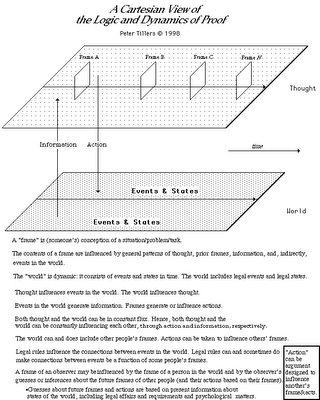
    Consider for a moment some of kinds of methods that are used to try to decipher multi-agent systems:

    * logical foundations of (multi-)agent systems
    * extensions of logic programming for (multi-)agent systems
    * modal logic approaches to (multi-)agent systems
    * logic-based programming languages for (multi-)agent systems
    * non-monotonic reasoning in (multi-)agent systems
    * decision theory for (multi-)agent systems
    * agent and multi-agent hypothetical reasoning and learning
    * theory and practice of argumentation for agent reasoning and interaction
    * knowledge and belief representation and updates in (multi-)agent systems
    * operational semantics and execution agent models
    * model checking algorithms, tools, and applications for (multi-) agent logics
    * semantics of interaction and agent communication languages
    * distributed constraint satisfaction in multi-agent systems
    * temporal reasoning for (multi-)agent systems
    * distributed theorem proving for multi-agent systems
    * logic-based implementations of (multi-)agent systems
    * specification and verification of formal properties of (multi-) agent systems
    Does the above list of topics suggest that legal scholars have something to learn from their brothers and sisters in computational intelligence and allied fields?

    Interdisciplinary work is hard. Interdisciplinary work is humbling. And interdisciplinary work demands humility. I often think that law teachers would do more and better interdisciplinary work if they (law teachers) were not so determined to show how smart they are. There are many intelligent people on earth, and many of them are in disciplines other than law, and some of those people know things law teachers don't. I have found that confessing ignorance while approaching smart people in other disciplines is a fruitful strategy. Your colleagues in foreign disciplines will be flattered by your interest and they will often take the time to explain things to you. Oh yes, remember this: you know some things they don't know, and you're not as stupid as you may sometimes feel you are.

    BTW, some law & economics literature seems determined to talk about decision but not about inference. Isn't this is a fundamental mistake? If some of the actors or agents in the environment that one wishes to understand and explain have inferential mechanisms or processes in their souls, isn't it clear that the behavior of such agents ordinarily cannot be predicted well if little or no account is taken of the agents' inferential processes? (And please note, you law & economics folk: those inferential mechanism and processes are extraordinarily complicated, and simplifying such processes "for the sake of argument" is often unjustified.)

    Sunday, November 13, 2005

    More about Steven Avery

    I blogged about the Steven Avery cases just a little while ago: When Chances Collide; DNA & "Exoneration"; Suggestibility & Gullibility

    Now I have a bit of additional information and one or two new random thoughts.

    Tom Kertscher, Avery to be charged on DNA, Milwaukee Journal Sentinel (Nov. 12, 2005):
    DNA evidence, which freed Steven Avery after he spent 18 years in prison for a rape he didn't commit, will now be used to charge him with a crime that could return him to prison for the rest of his life.

    Friday's announcement that Avery will be charged with killing Teresa Halbach also means Avery will likely become the first person in the nation charged with a homicide after being exonerated by DNA.
    Halbach's vehicle, spattered with blood, was found a week ago in the Manitowoc County auto salvage yard owned by Avery's family. On Friday, authorities said tests confirmed that Avery's DNA was in the vehicle and on the ignition key, which was found hidden in Avery's home on the property.

    ***

    Avery, 43, became the marquee case for the Wisconsin Innocence Project two years ago when the University of Wisconsin Law School program proved with DNA evidence that he did not commit a 1985 sexual assault in Manitowoc County.

    ***

    Investigators say Halbach was last seen the afternoon of Oct. 31 when she visited Avery's home to take a photo for Auto Trader of a vehicle he was selling. ...

    ***

    Asked about Halbach by the Journal Sentinel on Monday, Avery said she was "not my type" because he liked women who weren't as slim.

    ***

    Calumet County District Attorney Ken Kratz, the special prosecutor in the Halbach case [because of Avery's lawsuit against Manitowoc County for wrongful imprisonment on the 20 year-old rape case], said he believes [Halbach] was killed the same day that she visited Avery's home, a trailer that is adjacent to the family's auto salvage yard. ...
    . ... [I]nvestigators said in obtaining search warrants that they believed Halbach was sexually assaulted.

    The investigators searched the auto salvage yard, Avery's trailer, a garage and other parts of the sprawling family property. Court records show they found what appeared to be blood on Avery's home, in his bathroom, in the garage and on "a number" of vehicles in the salvage yard.

    The records also show that the searchers found, on unspecified parts of the property, remains of a woman, remnants of clothing and what appeared to be a cell phone and camera, all of which had been burned, as well as handcuffs, leg irons, sexual devices and pornographic materials.

    Avery's mother, Dolores Avery, maintained that her son is innocent.

    "I don't know why the hell they do that stuff," she said of the plan to charge Avery with killing Halbach. "They must like wrecking people's lives."

    ***

    Sheriff's Department records show that shortly after a woman was sexually assaulted on a beach in July 1985, Manitowoc police raised Gregory Allen as a potential suspect. It was Allen's DNA that was found in 2003 in testing of evidence found on the victim.

    ***

    Findley, of the Wisconsin Innocence Project, said Avery's being charged with Halbach's killing, while tragic, does not change the fact that a judge declared him innocent of the sexual assault. ...


    &&&&&&&&&&&&&&&&&

    Gregory Allen's DNA was found on the 1985 rape victim. In 1985 Allen, who was later imprisoned for sexual offenses against other women, lived in the same area that Steven Avery did. I wonder if Allen and Avery knew each other. If so, I wonder if they spent time together. If so, I wonder ....
    Gregory Allen was not tried for the 1985 rape of Penny Beerntsen because, a prosecutor said, Ms. Beernsten did not want to press charges against Allen. In 2003, when Avery was released from prison, Allen was still in imprisoned; he had been sentenced to prison for 60 years for sex crimes against other women. I wonder if Allen and Avery met while they were both imprisoned in Wisconsin.


    &&&&&&&&&&&&&&&

    Do you agree that Steven Avery's 2003 exoneration is not placed in doubt even if it is established (to your satisfaction) that Steven Avery murdered and raped Halbach in 2005?

    I greatly admire the work of the various Innocence Projects around the country. What troubles me is the occasional proclivity of participants in such Projects to assert that the DNA evidence they have unearthed conclusively establishes the innocence of the clients that they say they have "exonerated." This is dangerously hyperbolic talk -- and this sort of hyperbolic talk has the ability to bite back.


    Saturday, November 12, 2005

    The Absence of the Appurtenances of a Process of Proof, and the Shell of a System of Adversary Ajudication

    Jim Yardley, Desperate Search for Justice: One Man vs. China, NYTimes Online (November 12, 2005):

    A quarter century ago, after the chaos of Mao's Cultural Revolution, China essentially had no legal system. In that context, it has made significant strides. The 1996 reforms were intended to shift toward an adversarial trial process, modeled in part after the American system. Instead, the reforms have become most notable for what was left out.

    "They didn't put in rules of evidence," said Jonathan Hecht, deputy director of the China Law Center at Yale University. "They didn't put in requirements that witnesses appear at trial. Lawyers weren't given the ability to really prepare a case. They kind of created the shell of an adversarial process, but they didn't create the guts of it."

    When Chances Collide; DNA & "Exoneration"; Suggestibility & Gullibility

    WORLD & NATION BRIEFS, Newsday (November 12, 2005) p. A17:
    A Wisconsin man who spent 18 years in prison for rape until being exonerated by DNA evidence in 2003 will be charged with killing a woman whose vehicle was found near his home, a prosecutor said Friday. Steven Avery's blood was found inside Teresa Halbach's sport utility vehicle, said Calumet County District Attorney Ken Kratz, who plans to charge Avery by Tuesday. Avery has denied involvement in the disappearance of Halbach, 25, who was last seen Oct. 31. The freelance photographer had three appointments that day to take pictures of vehicles for sale, including one at a salvage yard owned by Avery's family in Manitowoc County, about 25 miles south of Green Bay.
    Transcript from Nancy Grace Show, "Prosecutors Zero in on Suspect in Murder of Teresa Halbach," (November 11, 2005):
    RICHARD HERMAN, DEFENSE ATTORNEY [for Avery]: Well, Harris, I have to pick myself off the floor here because Wendy [Murphy] just blew me away. I got to tell you something. There`s not going to be a new trial in the old case because he was completely vindicated. Vindicated! It was reversed. The conviction was reversed. He was wrongfully imprisoned for 18 years.
    The Innocence Projects do wonderful work. But perhaps this case shows (again) that great care should be taken before claims are made that this or that DNA "proves" this or that man's (or woman's) innocence. There is no conclusive proof of innocence (or guilt). See P. Tillers, DNA Redux to the Fourth Power: Thoughts Inspired by -- but Not necessarily Faithful to the Facts and Recent Developments in the Central Park Jogger "Wilding" Case, in Tillers on Evidence and Inference (blog), September 8, 2002.
    P.S. Headline: Steven Avery Receives Standing Ovation from Wisconsin's Assembly and Senate Judiciary Committee. Steven Avery and the woman he was (wrongfully?) convicted of raping 20 years ago -- Penny Beerntsen -- testified before the Assembly and Senate Judiciary Committee of the Wisconsin legislature. Avery's case was apparently a kind of cause celebre in Wisconsin and it apparently became a fulcrum for an effort there to pass legislation to improve pretrial identification procedures. After they testified, both Avery and the woman whom he had been (wrongfully?) charged with raping "received standing ovations from the committee members and others in attendance." David Ziemer, Legislature holds hearing on Avery Task Force reforms in Wisconsin, WISCONSIN LAW JOURNAL (September 14, 2005).

  • I can't help wondering if the truly-unfortunate Ms. Penny Beerntsen still thinks that the lineup identifications used in her case mistakenly led her to identify Avery as the culprit. Ms. Beernsten was apparently persuaded that her initial recollection and belief that Avery was the rapist was wrong. The Wisconsin Law Journal, id., reported, "Yet even though [Ms. Beernsten] knows that Avery was not the one, she still sees his image when she recalls the attack, so suggestive were the identification procedures then in place, and still in place throughout the state." The Avery-Beernsten case may yet demonstrate that suggestive procedures may lead witnesses to incorrect conclusions -- but, if so, the lesson here may be that well-intentioned and passionate reformers are also capable of implanting false thoughts in the minds of witnesses. This case really may prove to be a terrible twist of fate -- and of human gullibility (in many places).
  • P.P.S. The malefactor who killed Teresa Halbach apparently burned her body in an effort to destroy the evidence. But the effort at evidence destruction was not entirely successful -- burned bone, teeth, and blood were found in Halbach's car -- and the body parts and fluids that remained after the fire were apparently such that at least some DNA testing could be done on them. DNA apparently plays a role in the Avery-Halbach homicide case in another way: DNA testing strongly suggests that Avery was the source of some of the blood found in Teresa Halbach's car. This evidence suggests that sometimes it may be appropriate to say:

    If you live by DNA, you may also die by DNA

    Wednesday, November 09, 2005

    The Right of Divine Monarchs: The President's Power to Detain, Charge, Prosecute, Create Law, Adjudicate, Sentence, and Execute & Put to Death

    This blawg generally sticks to topics in the law of evidence, proof, and fact investigation. But not always. And not now, after my eye was caught by the breathtaking extent of the authority claimed by the President in the name of the "war" on terror. Consider Petition for Writ of Certiorari, Salim Ahmed Hamdan v. Donald H. Rumsfeld et al. (August 8, 2005):
    Almost four years ago, Petitioner Hamdan was captured by indigenous forces while attempting to flee Afghanistan and return his family to Yemen. After being turned over to American forces, he was taken in June 2002 to Guantanamo Bay Naval Base, where he was placed with the general detainee population at Camp Delta. ... In July 2003, the President found that Petitioner was eligible for trial by commission. Accordingly, he was placed in solitary confinement from December 2003 until late October 2004 ....

    "[The United States District Court for the District of Columbia] ruled that [military] commissions [appointed by the President] may be used only to hear offenses that are triable under the laws of war, including the Geneva Conventions; that the Geneva Convention Relative to the Treatment of Prisoners of War ... is judicially enforceable; and that, as long as [Hamdan's] prisoner-of-war (POW) status is in doubt, Petitioner [Hamdan] must be tried by court-martial. ...

    ...

    ... [T]he court of appeals reversed the district court in an opinion written by Judge Randolph and joined by Judge Roberts [now Chief Justice of the Supreme Court of the United States] in full and Judge Williams (in part). [footnote omitted] ...

    ....

    ...[T]he court of appeals largely based its ruling on [the Supreme Court's] Eisentrager decision, accepting the President's claim of power to convene a commission to try most any offense, against any offender (including a United States citizen or nationals of any country in the world), in any place (including the United States). The President was allowed that power not for a fixed time, such as a war declared against a specific nation-state, but rather for perpetuity against an amorphous enemy that could include nationals of every country in the world. In these tribunals, the President was given the power to disregard not only American common-law and military law, but international law--despite the fact that the raison d'etre of commissions is to enforce international law.

    ...

    In the end, the court of appeals held that the President has the power to decide how a detainee is classified ..., how he is treated, what criminal process he will face, what rights he will have, who will judge him, how he will be judged, upon what crimes he will be sentenced, and how the sentence will be carried out. The President is [allegedly] entitled to "pas[s] sentences and ... carr[y] out ... executions" through commissions, even if they do not "afford[d] all the judicial guarantees which are recognized as indispensable by a civilized people." ...

    This reversal of the district court cannot be correct. The Revolution was fought to ensure that no man, or branch of government, could be so powerful. In a system of checks and balances, there can never be a time when the rule of law does not circumscribe power as fundamental as adjudicating culpability and punishment. Our forefathers paid a heavy price in blood to establish these principles, and it is our duty to defend them from all threats, foreign or domestic.

    The Brennan-Warren Court may have made mistakes. But in one respect that Court was not mistaken: We must fear any government that imprisons or executes people without any semblance of due process of law. Public perception that a great public emergency exists is distressingly easy to manufacture. But a bit of perspective is in order. Our times are not more threatening than was the era of the Cold War, a time when the threat of nuclear annihilation loomed. The Presidency did not claim the power then that it does now. There is not more reason to suspend fundamental civil liberties now than there was in the 1950s and 1960s.

    Tuesday, November 01, 2005

    Leisurely and Productive Contemplation in ... the U.S. Academic World?

    Howard W. French, China Luring Scholars to Make Universities Great, NYTimes Online (October 31, 2005):
    Mr. Yang, who leads a small experimental university in Ningbo, also criticized the lack of autonomy given to many Chinese researchers.

    "At Princeton one mathematician spent nine years without publishing a paper, and then solved a problem that had been around for 360 years," Mr. Yang said, a reference to Andrew J. Wiles and his solution to Fermat's last theorem in the early 1990's. "No one minded that, because they appreciate the dedication to hard work there. We don't have that spirit yet in China."

    This happens at Princeton, you say?

    Does it happen anywhere else in these dear United States?

    Thursday, October 20, 2005

    Expertise in Iceland

    Editors, Justice in Iceland (Interview with Judge Tomas Magnusson), 8 Green Bag (2d Series) 393, 395 (2005):
    Do you have juries?

    We have no jury at all. Most cases are heard by one judge, but we can also have three judges. ... In complex civil and criminal cases there are three judges, and two of them can be specialists -- for example, plumbers, engineers, or medical doctors. These expert judges are not lawyers.

    These people serve as expert witnesses?

    No, they aren't expert witnesses in the American sense -- we have no expert witnesses per se. These specialists are called by the court, and they play almost the same role in the procedure as the full-time judges.

    Friday, October 14, 2005

    Probabilistic Computational Intelligence: The World Is Gray, Not Black and White

    John Markoff, Behind Artificial Intelligence, a Squadron of Bright Real People, NYTimes Online (Oct. 14 2005):
    While artificial intelligence technology is already in use in telephone answering systems with speech recognition and in popular household gadgets like the iRobot vacuum cleaner, none of the existing systems have been as ambitious as Darpa's Grand Challenge road race.

    This leap was possible, in large part, because researchers are moving from an approach that relied principally on logic and rule-based systems to more probability or statistics-oriented software technologies.

    "In the past A.I. has been dominated by symbolic systems and now the world is gray," said Terrence J. Sejnowski, head of the computational neurobiology laboratory at the Salk Institute in La Jolla, Calif. "That's what it's like to deal with the real world."

    N.B. Probability theory is essential. But it's not the whole story. And probability theory may not be the only coherent and effective mathematical strategy for dealing with uncertainty and shades of gray.

    Wednesday, October 12, 2005

    Canine Personality, Canine Character, Canine Science & Canine Value

    Brown v. Eberly, 2002 U.S. Dist. LEXIS 22012 (E.D.Pa. 2002) grew out of a civil action by a couple against a police officer for shooting their dog, a female Rottweiler. The trial judge, Thomas N. O'Neill, considered various motions. His memorandum opinion states in part:
    3. Defendant's motion to preclude all testimony and exhibits that seek to attribute human qualities or attributes to plaintiff's dog

    The issue to be tried is whether defendant's actions on April 8, 1998, violated plaintiffs' constitutional and state law rights. Evidence that would seek to attribute human characteristics to the dog is not relevant and will be excluded.

    The pictures attached to defendant's motion must be examined under a Rule 403 analysis. The first picture, of the parking lot at the location of the incident, is clearly admissible. The picture of the dog and the child on the couch with the child thinking "we're best buddies" is excluded under Rule 403. The third picture attached to the motion shows one of plaintiffs' children leaning on the dog, who is [lying] on the floor. It is admissible because it is evidence of how well behaved the dog was with people and is not unfairly prejudicial to the defendant. The fourth picture shows the dog by herself wearing a large bow around her neck. Unless the dog was wearing this collar when shot on April 8, 1998, the picture is excluded under Rule 403.

    4. Defendant's motion in limine to preclude all character testimony related to plaintiff's dog

    Plaintiffs seek to introduce testimony establishing the friendly nature of their dog in an attempt to refute defendant's claim that she lunged at him. Defendant argues that such testimony is inadmissible character evidence under Federal Rule of Evidence 404.

    We have not found any Pennsylvania or Third Circuit cases addressing whether evidence of past behavior of an animal should be excluded under Rule 404, however, the highest courts of several states have admitted such evidence. See Hood v. Hagler, 1979 OK 163, 606 P.2d 548, 551-52 (Okla. 1979); Forsythe v. Kluckhohn, 161 Iowa 267, 271, 142 N.W. 225 (Iowa 1913); Stone v. Pendleton, 21 R.I. 332, 43 A. 643, 643-44 (R.I. 1899); see also 1A Wigmore, Evidence § 68a (Tillers rev. 1983). I will not exclude evidence concerning Immi's disposition as inadmissible character evidence.

    ...

    8. Defendant's motion in limine to preclude the expert report of Andrew Bensing

    Plaintiffs seek to have Andrew Bensing testify as an expert on the behavior of Rottweilers. He would testify to the behavior of female Rottweilers as a breed and the behavior of Immi in particular. Defendant challenges the testimony on three grounds: (1) that it would be inadmissible character evidence; (2) that Mr. Bensing's experience with the dog would be irrelevant because it ended over a year before the shooting; and (3) that it does not satisfy the prong of the Daubert analysis that requires a "fit" between the expert testimony and the facts of the case.

    The objection to the testimony as inadmissible character evidence is taken care of by my ruling on character testimony in general. Testimony about Immi's past behavior is admissible.

    That Mr. Bensing's frequent contact with the dog ended a year before the incident does not render his testimony irrelevant. Mr. Bensing had extended contact with Immi for over two years and then occasional contact with her until her death. Defendant may point out to the jury that Mr. Bensing's time with the dog was only occasional for a year before her death, but he cannot preclude his testimony entirely.

    Defendant's argument about the "fit" step of the Daubert analysis will be considered at a Daubert hearing.

    9. Defendant's motion in limine to limit testimony regarding the valuation of plaintiff's dog

    Under Pennsylvania law a dog is personal property. 3 P.S. § 459-601 (2002); Desanctis v. Pritchard, 2002 PA Super 221, 803 A.2d 230, 232 (Pa. Super. 2002) 3 P.S. § 459-601 (2002). It is proper as regards the section 1983 claim, therefore, to limit testimony regarding the value of the dog to that addressing its value as a piece of personal property. No testimony regarding the value of Immi to the plaintiffs in particular will be admitted as evidence regarding the valuation of the dog.

    Sunday, October 09, 2005

    Imprecise Language and Imprecise Perceptions

    Consider the following statement by Professor Lotfi Zadeh in his recent abstract Computation with Information Described in Natural Language—The Concept of Generalized-Constraint-Based Computation (October 5, 2005):
    Computation with information described in natural language cannot be dealt with through the use of machinery of natural language processing. The problem is semantic imprecision of natural languages. More specifically, a natural language is basically a system for describing perceptions. Perceptions are intrinsically imprecise, reflecting the bounded ability of sensory organs, and ultimately the brain, to resolve detail and store information. Semantic imprecision of natural languages is a concomitant of imprecision of perceptions.
    Legal theorists, students of legal reasoning, and aficionados of factual inference in legal settings: What say you?

    Deprivation of US & NJ Right of Confrontation because Trial Court Barred Defense from Cross-Examining Prosecution Witness about Polygraph Test Results

    State v. Castagna, 376 N.J. Super. 323, 870 A.2d 653 (April 12, 2005), cert. granted, 185 N.J. 35, 878 A.2d 852, (July 7, 2005):
    Our decision to reverse is based on an erroneous legal ruling that operated to deprive all three defendants of their right to confront the witnesses against them, as guaranteed by the Sixth Amendment of the Constitution of the United States, as applied to the states by the provisions of the Fourteenth Amendment, and as independently embodied in Article I, Paragraph 10 of the New Jersey Constitution. This constitutional deprivation came about when the trial court precluded defense counsel from cross-examining a key prosecution witness on the results of a stipulated polygraph examination, because these defendants were not parties to the stipulation.

    We hold that when the State enters into an agreement with a witness, stipulating to the admissibility of the results of that witness's polygraph examination, a defendant has a constitutional right to confront that witness, in cross-examination, with the results of the polygraph, as a means of impeaching that witness's credibility. As a matter of fundamental fairness, we also hold that, under these circumstances, the State is precluded from disavowing the reliability of the polygraph results.

    Wednesday, October 05, 2005

    Liberal Politics & Cronyism & Persuasive Legal Interpretation

    It is interesting, revealing, discouraging, and, yes, disgraceful to see that even liberal, tub-thumping, and moralizing politicians such as Senator Schumer seem not to mind that Miers is an undistinguished nominee to the Supreme Court. In his initial press conference Schumer effectively said it matters not that Miers is Bush's crony. All that matters to Schumer, it seems, is that Miers vote the "right" way as often as possible.

    Fie on both of your houses, on (some of) you Democrats and on Republican Bush-sycophants! Whether we like it or not, in our constitutional scheme a Supreme Court Justice must have some of the qualities of both a philosopher king and a Biblical scholar. The Supreme Court leads not only and not even primarily by reason of its coercive legal authority. The Supreme Court leads in very significant part by reason of the lucidity and the persuasiveness of its pronouncements.

    Although Miers cannot be called one of the country's preeminent private lawyers, she did have an impressive record in private practice. But nothing in her record attests to her ability to explain her vision of American constitutional principles to other people, either to lawyers or to the country as a whole. (Indeed, nothing in her record suggests even her ability to divine, or infer, plausible constitutional principles from the text, history, and philosophy of the U.S. Constitution.)

    Harriet Miers is not a street cleaner. She is unquestionably intelligent. It also appears that she has been a zealous and effective advocate for her clients. But, my dear Senators, the question now is the composition of the Supreme Court. Not every intelligent person, not every canny person, and not every successful legal practitioner is qualified to prescribe and explain the legal rules that constitute the foundation of the American system of government.

    Tuesday, October 04, 2005

    A Small Circle of Friends

    The Hon. Harriet Miers once described George Bush as the most intelligent man she had ever met. One presumes that Ms. Miers has a very small circle of friends and acquaintances.

    The Judicial Philosophy of the Hon. Harriet Miers

    Harriet Miers' judicial philosophy is plain. When introduced by the President, she said she is in favor of strict construction of the law. The meaning of "strict construction" is plain. Isn't it?

    Well, perhaps not.

    Let's see if we can clarify her position. Let's apply Miers' interpretive strategy to "strict construction." Isn't that fair?

    The first step is to take the words "strict" and "construction" as written (or spoken?).

    The second step is (isn't it?) to take words in their ordinary sense -- their common sense sense, so to speak.

    Well, then, the third step is clear: If judges are to avoid putting themselves into the words of the law -- and they are to follow the words of their law rather than their personal and subjective views of the meanings of those words --, they should turn to dictionaries and thesauruses (thesauri?) to ascertain the ordinary meaning of words. Right?

    Well, then, let's use that method now.

    [I leaf through my thesaurus.]

    Can "strict" mean "harsh" and "construction," "fabrication"? So Miers favors harsh fabrication of the law? Mmm, I don't want to use her private intentions to construe her words, but, still, this -- "harsh fabrication" -- doesn't sound quite right.

    [I leaf through my thesaurus again.]

    Aha! I have it! By "construction" she means "interpretation" and by "strict," she means "crabbed." So Miers favors a crabbed interpretation of the law. A strict construction of her comments proves this.

    &&&&

    While blogging here, I just heard President Bush say (in a news conference) that Miers shares his judicial philosophy. I confess I didn't realize that Bush has a judicial philosophy. Is it originalism? Does he favor the Court's use of the evolving standards of civilized nations to interpret the Constitution? Is Bush in favor of a natural law approach to the Bill of Rights? Well, time will tell, more or less. Yes? No?

    Miers: Harold Carswell Reincarnate?

    Senator Roman Hruska, a Phi Beta Kappa graduate of Creighton University, said:
    Even if he [Carswell] was mediocre, there are a lot of mediocre judges and people and lawyers. They are entitled to a little representation, aren't they, and a little chance? We can't have all Brandeises and Cardozos and Frankfurters and stuff like that there.
    Warren Weaver, Jr., Carswell Attacked and Defended as Senate Opens Debate on Nomination, N.Y. TIMES, March 17, 1970, at 21.