Thursday, August 10, 2006

A Close Encounter with a Prominent Celestial Phenomenon


I was a faithful member of the Columbus Astronomical Society. The time was the mid-1950s. I was 12 or 13 years old. The third Saturday of every month was the day for amateur observing at the McMillan Observatory on the Ohio State campus. On one such Saturday it was raining cats and dogs in the afternoon. Nonetheless, I took my trusty bicycle and rode from my home on the south side of Columbus to Ohio State University, which was far away on the north side. On arriving at the observatory I met two men, who were huddled over a calculator. They told me, naturally, that observing with the telescope was cancelled that night. I asked them what they were doing. They told me they had been making observations of a particular star and they were doing calculations that night to confirm that the star had the greatest apparent motion of any star that had thus far been observed. They wished me well in my study of astronomy. One them was, he said, J. Allen Hynek. See biographical note . For years -- until today – I thought I had met James A. van Allen, the discoverer of the Van Allen Belts, who just died. See NYTimes obituary. I’m glad to see that J. Allen Hynek had a distinguished career of his own. In addition to teaching at Harvard for a few years (after leaving Ohio State University) and becoming the head of the astronomy department at Northwestern University (in 1960), Hynek became become a prominent (and reputable) investigator of UFOs and was a consultant for Close Encounters of the Third Kind. See 1985 interview.


Does this story about my brush with fame have anything to do with evidence or the law of evidence?

Probably not. But perhaps -- with some effort -- it could serve as an object lesson about the frailty of human memory -- and then about our ability to uncover evidence that nonetheless gets the historical story straight.

The Death of a Youth and of a Drunkard


P. Tillers, The Death of a Youth and of a Drunkard


2005 preprint, published in R. Lempert, Evidence Stories (Foundation Press 2006)

Trial by Numbers?

Announcement:


A Paper about the Quantifiability or Non-Quantifiability of Proof beyond a Reasonable Doubt

Sunday, August 06, 2006

A New MarshalPlan!

There is now available a standalone version of MarshalPlan. This computer-generated gizmo -- and the words that follow are carefully chosen -- is a software representation of an approach to evidential inference that emerged out of my collaboration with David Schum in the late 1980s and early 1990s. This software -- one might call it MarshalPlan 2.0 -- is not exactly a "concept" of a software tool. It is a bit closer to being a "proof of concept"; i.e., MarshalPlan illustrates how my approach to inference works -- and that it does work. In any event, MarshalPlan is very clunky technologically speaking -- for example, some of the "buttons" in the various "stacks" that comprise my evidence marshaling system do not work; some or all of the color schemes I use are, at best, aesthetically unappealing; and the layout of fields, buttons, and other objects on the visual fields is inefficient.
  • The original version of MarshalPlan was created with HyperCard. The current version of MarshalPlan was created with Revolution Enterprise, a sophisticated successor to HyperCard. The sophistication of Revolution, however, is not matched by any sophistication that Tillers has in programming or scripting. Indeed, even though Revolution makes it easy for even an idiot to develop software, the author of MarshalPlan 2.0 is less than an idiot.
  • This clunky software, moreover, comes without commentary. You will not even find many explanatory notes. The only software manual you will find takes the form of published literature that lays out some (but not all) of the theoretical underpinnings for MarshalPlan. See, first, P. Tillers & D. Schum, A Theory of Preliminary Fact Investigation; and, second, David Schum, The Evidential Foundations of Probabilistic Reasoning 491-504 (Wiley & Sons, 1994; paperback reprint, Northwestern University Press, 2001). If you wish to have explanations, you will have to invite me to give a talk (and you will have to pay my expenses) or you will have to attend Professor Edward Cheng's Evidence Colloquium at Brooklyn Law School on November 21, 2006 -- my general topic will be "Reasoning about Evidence." Alternatively, come to the Cardozo Law School conference on Graphic and Visual Representations of Evidence and Inference in Legal Settings. It is possible that I will talk a bit about MarshalPlan 2.0 then.

    If you would like to download MarshalPlan from the web, please send me an e-mail request (at peter@tillers.net) and, if your purposes are benign, I will send you the URL for the download page and a username and a password.

    Today I added one (but just one) word of explanation in MarshalPlan 2.0. I inserted the following comment in a field in an otherwise empty stack called "Probative Value & Credibility Assessment":

    MarshalPlan has no stack that lays out a strategy for assessing the probative value of evidence. This is only because I have nothing much to add to the extensive and exciting work that has been done and continues to be done on various kinds of inference networks. The leaders in this field are people such as Henry Prakken, Douglas Walton, Timothy van Gelder, and David Schum. (Judea Pearl has a very important theory of inference networks. But his theoretical commitment to the notion that there is no good inference without judgments about causal links sharply limits the utility of his theory for present purposes.)

    Credibility assessment is a special form of weight-of-evidence-assessment; i.e., it involves a special form of inference network logic; i.e., reasoning about testimonial credibility involves a special form of hierarchical evidential inference. The most elaborate and sophisticated theory of witness credibility assessment is the one developed by David Schum. (A gap in his theory -- the only significant gap I can find -- is the absence of much of anything about "linguistic uncertainty," the uncertainty one may have about a testimonial report because of the limitations in the speaker's ability to use language and, more generally, because of the inherent imprecision and ambiguity of language.)

    The absence of a stack [in MarshalPlan] for weighing the probative value of evidence (including testimonial evidence) proves that weighing evidence involves more than weighing evidence: The weighing of evidence requires discovering evidence, imagining hypotheses, developing arguments, and a host of other mental activities, some of which are identified by the stacks in MarshalPlan. All of these activities involve imagination and constructive mental activity. (But these mental processes are not limited to imagination and mental fabrication: They also involve the EVIDENCE, which is an essential constraining force on human imagination and judgment.)

    A Very Import Acknowledgment: If MarshalPlan 2.0 has any virtues, the credit belongs much more to David Schum than it does to me. Correlatively, if MarshalPlan 2.0 has any vices (and I think it has many), the fault is literally entirely mine.

    Wednesday, July 26, 2006

    Here We Go Again: Hearsay, Shmearsay -- Any Good Old Hearsay Is Good Enough for the Commissions

    Hearsay has it that the administration won't be denied its hearsay:
    David S. Cloud & Sheryl G. Stolberg, White House Bill Proposes System to Try Detainees (July 26, 2006).
    A justification sometimes seen & heard on C-Span: "They're criminal terrorists and they don't deserve anything more." Some folks need a refresher course on the purpose of adjudication.

    The New York Times is condemned now and then for reporting stories from anonymous sources. But it's o.k., I guess, to condemn detainees on the basis of anonymous hearsay reports. It would be so much trouble and expense to track down available hearsay declarants. Just trust that hearsay stuff and imprison (further) those detainees -- or just shoot (hang?) them. We have to protect ourselves, don't we?

    Although it may not be a good idea to exclude all hearsay, the notion that hearsay is generally just as good as first-hand accounts is a myth.

    I'll bet that some triers of fact on commissions would do a decent job of evaluating hearsay. But it would be a bit better if those triers had some experience and training in evaluating hearsay. And all the training and experience in the world won't do much good if the triers of fact have next-to-no information about the hearsay declarants.

    The evaluation of such hearsay accounts by human sources in Afghanistan and elsewhere is greatly complicated by the fact that much of it probably consists of tiers of hearsay (and probably little or nothing is known about many of the intermediate links in such hearsay chains) and that in many cases the abilities (and memories) of the translators (out there in Afghanistan and possibly also in Guantanamo) are questionable.

    Yes, justice is sometimes inconvenient and expensive. But perhaps paying, say, 1/10 the cost of an aircraft carrier for better fact-finding for the detainees at Guantanamo (and elsewhere?) would be worthwhile. The rest of the world probably thinks so and it might respect us more if we showed that we are willing to spend time and money to make proceedings fair and fairly accurate even for people who we think meant us serious harm. And do remember that sometimes mistakes are made {Don't you love the passive voice?}: some of the people who we think tried to do us harm did not try to do so; they were instead, e.g., goatherds who were caught up in an indiscriminate sweep or were taken into custody as a result of misjudgments resulting from heightened fears and suspicions in times of military conflict.

    If we really believe in principles, we must be prepared to pay a price for them.

    Saturday, July 22, 2006

    Simple Justice

    In the very early 1990s, just as the Baltic States were gaining their independence, I took a Soros-funded trip to Latvia with a group of American and European law teachers. There was a debate in Riga among the visitors about the vices and virtues of trial by jury. Before the debate I had had a conversation with a "first instance" Latvian judge, the equivalent of a trial judge. She told me that witnesses would often fail to appear for trial because the penalty for failure to appear was only a few inflation-reduced Rubles and there was (then) no procedure for arresting witnesses to secure their presence at trial. At the debate over jury trial -- the protagonists were John Langbein and Richard Lempert -- I told the assembled group that, jury trial or no, nothing much mattered if witnesses could not be made to appear for trial. But getting witnesses to show up is sometimes also a big problem in the United States. See Avi Salzman, "Judge Dismisses a Connecticut Murder Case After Those Who Saw Shooting Disappear," NYTimes Online (July 22, 2006):
    Rafael Gomez was shot through the jaw and neck in front of at least six people on a street corner in Bridgeport, Conn.'?s rough East End about 4:45 in the morning on Oct. 17, 2003. Bleeding profusely, he staggered 165 feet before collapsing in a pool of his own blood. He was pronounced dead at a local hospital.

    Nearly three years later, the case came to trial this week in Superior Court in Bridgeport. But as the prosecutor prepared to put his three star witnesses on the stand on the fourth day of the trial, he ran into a problem. None of them could be found.

    As a result, Judge Lawrence L. Hauser dismissed the case against Arlyn Williams, 25, who is in state prison on a drug conviction. He is scheduled to be released in September and cannot be tried again on the murder charge.

    Joseph T. Corradino, a senior assistant state'?s attorney for the Fairfield Judicial District who tried the case, said he became concerned early in the week that his witnesses would not show up after the police were unable to find them. He said he "?tap-danced for the first few days to give us more time" to locate them.

    But when Thursday came and the witnesses were still missing, he told Judge Hauser that he could no longer prosecute the case.

    "In this city we've got an amazing problem with not just witness apathy, but with witness fear,"? Mr. Corradino said.

    Prosecutors also struggle nationwide to persuade frightened witnesses to testify. The fears are not unfounded. In New York City, for instance, at least 20 witnesses to crimes have been killed since 1980.

    Saturday, July 15, 2006

    Causality, Responsibility, and Blame

    I have found no references in LEXIS or WESTLAW to the interesting paper Responsibility and Blame: A Structural-Model Approach (Nov. 6, 2003) by Hana Chockler & Joseph Y. Halpern.

    Granted, the mathematical notation and symbolic logic are very difficult for amateurs like me. But this can't be the entire explanation for the seeming indifference of the legal academy: many law teachers now have advanced degrees. Furthermore, Chockler and Halpern use ordinary English and nifty examples to describe the gist of their thesis. So why the deafening silence in the legal academy? Consider: Halpern is one smart cookie. (The same is very probably true of Chockler!)

    Perhaps the explanation is simple lack of serendipity: although the paper by Chockler and Halpern resides on Halpern's web site and has been in circulation for several years, it apparently has not yet been published in a peer review journal.

    P.S. This post does not constitute an endorsement (or repudiation) of Halpern's theory of causality, explanation, responsibility, and blame. I am insufficiently familiar with Halpern's views either to endorse or reject them. But I would like to hear what thoughtful legal scholars think of Halpern's views of questions that seem to have a bearing on law.

    Thursday, July 13, 2006

    Lowering the Bar

    In People v. Ibarra, 2001 WL 1330296 (Cal.App. 2001) (not certified for publication) the prosecutor had an interesting view of the meaning of the government's burden of persuasion in criminal trials. Using a bar graph, she asserted that
    proof beyond a reasonable doubt requires at least a 60 percent probability of guilt

    proof beyond a shadow of a doubt puts the bar at 70 percent

    proof beyond beyond all doubt sets the bar at 80 percent, and

    proof to an absolute certainty raises the bar to 90 percent.

    Perhaps proof to an utterly conclusive and absolutely certain certainty with no suspicion of a hint of a shadow of a doubt would require that the probability of guilt be shown to be 100%?

    But given the prosecutor's view of matters it hardly matters which formulation of the prosecution's burden of proof would require that the trier believe that the chances of a defendant's guilt are 100% -- because on the prosecutor's view of the reasonable doubt standard a trier of of fact can find a defendant guilty of a crime such as murder even though the trier thinks there is a 40% chance that the defendant is innocent. (The prosecutor quite evidently -- dare I say certainly? -- thinks that it is important not to set the bar too high.)

    The prosecutor's view of the meaning of reasonable doubt is somewhat at variance with the view of the medieval philosopher Maimonides, who declared "it is better and more desirable to free a thousand sinners, than ever to kill one innocent." United States v. Fatico, 458 F. Supp. 388, 410 (E.D.N.Y., 1978) (quoting N.L. Rabinowitz, Probability and Statistical Inference in Ancient and Medieval Jewish Literature 111 (1973). Compare Justice Harlan's concurring opinion in In re Winship, 397 U.S. 358, 368 (1970), where he said that the reasonable doubt standard is "bottomed on a fundamental value determination of our society that it is far worse to convict an innocent man than to let a guilty man go free." Id. at 380.

    Tuesday, July 11, 2006

    Conference: Graphic and Visual Representations of Evidence and Inference in Legal Settings

    Cardozo School of Law will host a conference on

    Graphic and Visual Representations of Evidence and Inference in Legal Settings


    Dates: January 28-29, 2007.

    Venue: Cardozo Law School, Yeshiva University, 55 Fifth Avenue (5th Ave. & 12th St.), New York (Manhattan), New York


    Description of conference:

    One of the largest problems faced by crime investigators, litigators, paralegals, judges, triers of fact, and other actors interested in disputes about factual questions in legal settings is the sheer mass of available evidence in many cases. It is often difficult to remember, retrieve, and interpret evidential information, so that patterns, relations, and inconsistencies often go unnoticed. Tools that support the storage, retrieval, and interpretation of masses of evidence could therefore be of great use.

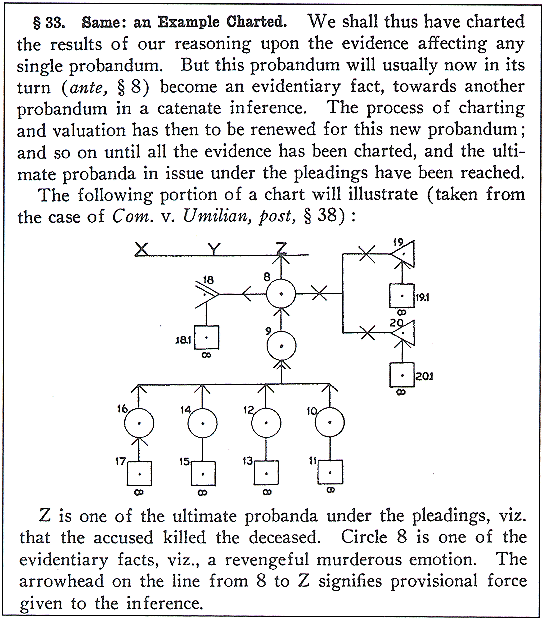
    Psychological studies have shown that people's ability to remember, retrieve, and interpret information is greatly enhanced if they organize information in a way that is meaningful to them. Scholars of the law of evidence have long suggested that graphical representations of evidential arguments and inferences could support humans in making sense of masses of evidence. As early as 1913, John Henry Wigmore claimed that his charting method promoted rational thinking about legal evidence. While Wigmore had only pencil and paper to draw his cumbersome graphs, today the computer could make his ideas practically feasible for everyone. Software could be used to draw graphical representations of arguments and inferences about masses of evidence. Moreover, such software could be combined with existing database, document management, and search technology so that collections of evidentiary documents could be stored and retrieved in terms of the user's thinking about a case. Such software would also facilitate transfer of case files to others by increasing the transparency of the files, so that subsequent investigators, prosecutors, and fact finders could gain a quicker and better understanding of the case.

    Such software is currently being investigated for use in various domains. Argument visualization software has been designed, for instance, to support the teaching of scientific reasoning or critical thinking skills (Belvedere, Reasonable, Araucaria, Convince Me), to support intelligence analysis, and to facilitate individual or collaborative problem solving (Questmap, SEAS). Moreover, current artificial intelligence research offers precise accounts of evidential reasoning and thus provides a clear semantics of graphical notations as well as ways to compute with them.

    In the legal domain, fact investigators and litigators increasingly use software that supports the storage and retrieval of information in terms of conceptual and relational networks (Holmes 2, Analyst's Notebook). However, as yet, such tools offer little or no support for the structuring of human thinking about thus stored information. This software allows users to store evidentiary data in terms of events, objects, actors, and the relations among these things, but it does not allow users to represent how such data support or undermine hypotheses about what has happened.

    This interdisciplinary conference brings together scholars and practitioners from such fields as law, philosophy, computer science, artificial intelligence, cognitive psychology, and linguistics who are interested in the graphic visualization of legal evidentiary inference and its support by software tools. The following issues will be addressed:

  • Current and new graphical means to visualize factual inference and proof
  • Semantics of such graphical notations: what are the underlying theories of evidential reasoning? (jurisprudential, philosophical, psychological, rhetorical, logical, or mathematical)
  • Which software tools for graphical representations of factual inference and proof are currently available or being developed?
  • What are the potential contexts for the use of such software and what are the potential benefits of such software? (crime investigation, litigation, trial, law teaching, etc.)
  • To what extent can graphic representation of evidential arguments support the automatic evaluation of hypotheses?
  • How can current insights about human-computer interaction be exploited to increase the usefulness of such software? (e.g., how can visual complexity created by the size of the available mass of evidence be managed?)
  • Are empirical results available on usability and effects of use of charting methods (whether manual or digital) in legal or other contexts?
  • What are the practical constraints faced by crime investigators or legal professionals who want to use such software?
  • Conference officials:
    Peter Tillers (Cardozo Law School): Conference chair e-mail address: peter@tillers.net
    Henry Prakken (Universiteit Utrecht / University of Groningen): Program chair e-mail address: henry@cs.uu.nl
    Thomas D. Cobb (University of Washington, Seattle): Deputy program chair e-mail address: tomcobb@u.washington.edu

    Panelists:

  • Thomas D. Cobb (University of Washington School of Law)
  • Philip Dawid (U. College London)
  • Neal Feigenson (Quinnipiac University School of Law)
  • Branden Fitelson (U. of California at Berkeley)
  • Tim van Gelder (U. of Melbourne)
  • Thomas F. Gordon (FOKUS [Frauenhofer Institut fuer Offene Kommunikationssysteme]); web log
  • John Josephson (Ohio State University)
  • Marc Lauritsen (CEO, Capstone Practice Systems)
  • Richard Lempert (U. of Michigan Law School)
  • Ronald P. Loui (Washington University, St. Louis; Computer Science)
  • John D. Lowrance (Program Director, Artificial Intelligence Center, SRI International)
  • Jennifer Mnookin (UCLA School of Law)
  • Dale Nance (Case School of Law)
  • Priit Parmakson (Tallinn University, Tallinn, Estonia)
  • John L. Pollock (U. of Arizona)
  • Henry Prakken (Utrecht University & U. Groningen)
  • Chris Reed (U. of Dundee)
  • Burkhard Schafer (U. of Edinburgh, Law School)
  • David Schum (George Mason U.)
  • Richard Sherwin (New York Law School)
  • Samuel Solomon (CEO of DOAR, Inc.)
  • Peter Tillers (Cardozo Law School, Yeshiva University)
  • William Twining (U. College London, Law Faculty & U. of Miami, School of Law)
  • Bart Verheij (U. Groningen, Dept. of Artificial Intelligence; ALICE Institute)
  • Vern Walker (Hofstra U. School of Law)
  • Douglas Walton (U. of Winnipeg)

    Program details will be provided later.


    Drafts and abstracts of some or all papers will be made available online at http://tillers.net/conference.html shortly before the conference begins. Final versions of the papers will be published in Law, Probability and Risk in 2007 and 2008.


    The public is warmly encouraged to attend the conference. Advance registration is not required and there is no registration fee. However, there will be a charge for any lunches or dinners that attendees elect to take at the site of the conference, at Cardozo Law School. If you are not a panelist and would like to join us for any lunches or dinners at Cardozo, please RSVP to the address shown below by January 15, 2007, and indicate which meals you wish to purchase, enclosing payment of $35 for each. Please make checks payable to Cardozo School of Law. Send payment to

    Alisa Norr
    Legal Secretary
    Friedman Kaplan Seiler & Adelman LLP
    1633 Broadway, 46th floor
    New York, NY 10019
    United States


    Hotel and flight arrangements may be made through the conference travel agency:

    Morris Park Travel Bureau
    1745 Wiliamsbridge Road
    Bronx, NY 10461
    1-718-792-9850 or toll free 1-877-526-8844
    Fax: 1-718-863-7121
    Email: MPTVL@AOL.COM
  • Sunday, July 02, 2006

    Graphic and Visual Representations of Evidence and Inference in Legal Settings

    Cardozo School of Law will host a conference on

    Graphic and Visual Representations of Evidence and Inference in Legal Settings


    Dates: January 28-29, 2007.

    Venue: Cardozo Law School, Yeshiva University, 55 Fifth Avenue (5th Ave. & 12th St.), New York (Manhattan), New York


    Description of conference:

    One of the largest problems faced by crime investigators, litigators, paralegals, judges, triers of fact, and other actors interested in disputes about factual questions in legal settings is the sheer mass of available evidence in many cases. It is often difficult to remember, retrieve, and interpret evidential information, so that patterns, relations, and inconsistencies often go unnoticed. Tools that support the storage, retrieval, and interpretation of masses of evidence could therefore be of great use.

    Psychological studies have shown that people's ability to remember, retrieve, and interpret information is greatly enhanced if they organize information in a way that is meaningful to them. Scholars of the law of evidence have long suggested that graphical representations of evidential arguments and inferences could support humans in making sense of masses of evidence. As early as 1913, John Henry Wigmore claimed that his charting method promoted rational thinking about legal evidence. While Wigmore had only pencil and paper to draw his cumbersome graphs, today the computer could make his ideas practically feasible for everyone. Software could be used to draw graphical representations of arguments and inferences about masses of evidence. Moreover, such software could be combined with existing database, document management, and search technology so that collections of evidentiary documents could be stored and retrieved in terms of the user's thinking about a case. Such software would also facilitate transfer of case files to others by increasing the transparency of the files, so that subsequent investigators, prosecutors, and fact finders could gain a quicker and better understanding of the case.

    Such software is currently being investigated for use in various domains. Argument visualization software has been designed, for instance, to support the teaching of scientific reasoning or critical thinking skills (Belvedere, Reasonable, Araucaria, Convince Me), to support intelligence analysis, and to facilitate individual or collaborative problem solving (Questmap, SEAS). Moreover, current artificial intelligence research offers precise accounts of evidential reasoning and thus provides a clear semantics of graphical notations as well as ways to compute with them.

    In the legal domain, fact investigators and litigators increasingly use software that supports the storage and retrieval of information in terms of conceptual and relational networks (Holmes 2, Analyst's Notebook). However, as yet, such tools offer little or no support for the structuring of human thinking about thus stored information. This software allows users to store evidentiary data in terms of events, objects, actors, and the relations among these things, but it does not allow users to represent how such data support or undermine hypotheses about what has happened.

    This interdisciplinary conference brings together scholars and practitioners from such fields as law, philosophy, computer science, artificial intelligence, cognitive psychology, and linguistics who are interested in the graphic visualization of legal evidentiary inference and its support by software tools. The following issues will be addressed:

  • Current and new graphical means to visualize factual inference and proof
  • Semantics of such graphical notations: what are the underlying theories of evidential reasoning? (jurisprudential, philosophical, psychological, rhetorical, logical, or mathematical)
  • Which software tools for graphical representations of factual inference and proof are currently available or being developed?
  • What are the potential contexts for the use of such software and what are the potential benefits of such software? (crime investigation, litigation, trial, law teaching, etc.)
  • To what extent can graphic representation of evidential arguments support the automatic evaluation of hypotheses?
  • How can current insights about human-computer interaction be exploited to increase the usefulness of such software? (e.g., how can visual complexity created by the size of the available mass of evidence be managed?)
  • Are empirical results available on usability and effects of use of charting methods (whether manual or digital) in legal or other contexts?
  • What are the practical constraints faced by crime investigators or legal professionals who want to use such software?
  • Conference officials:
    Peter Tillers (Cardozo Law School): Conference chair e-mail address: peter@tillers.net
    Henry Prakken (Universiteit Utrecht / University of Groningen): Program chair e-mail address: henry@cs.uu.nl
    Thomas D. Cobb (University of Washington, Seattle): Deputy program chair e-mail address: tomcobb@u.washington.edu

    Panelists:

  • Thomas D. Cobb (University of Washington School of Law)
  • Philip Dawid (U. College London)
  • Neal Feigenson (Quinnipiac University School of Law)
  • Branden Fitelson (U. of California at Berkeley)
  • Tim van Gelder (U. of Melbourne)
  • Thomas F. Gordon (FOKUS [Frauenhofer Institut fuer Offene Kommunikationssysteme]); web log
  • John Josephson (Ohio State University)
  • Marc Lauritsen (CEO, Capstone Practice Systems)
  • Richard Lempert (U. of Michigan Law School & National Science Foundation)
  • Ronald P. Loui (Washington University, St. Louis; Computer Science)
  • John D. Lowrance (Program Director, Artificial Intelligence Center, SRI International)
  • Jennifer Mnookin (UCLA School of Law)
  • Dale Nance (Case School of Law)
  • Andrew Palmer (U. of Melbourne, Law)(unconfirmed)
  • Priit Parmakson (Tallinn University, Tallinn, Estonia)
  • John L. Pollock (U. of Arizona)
  • Henry Prakken (Utrecht University & U. Groningen)
  • Chris Reed (U. of Dundee)
  • Burkhard Schafer (U. of Edinburgh, Law School)
  • David Schum (George Mason U.)
  • Richard Sherwin (New York Law School)
  • Samuel Solomon (CEO of DOAR, Inc.)
  • Peter Tillers (Cardozo Law School, Yeshiva University)
  • William Twining (U. College London, Law Faculty & U. of Miami, School of Law)
  • Bart Verheij (U. Groningen, Dept. of Artificial Intelligence; ALICE Institute)
  • Vern Walker (Hofstra U. School of Law)
  • Douglas Walton (U. of Winnipeg)


    Drafts and abstracts of some or all papers will be made available online at http://tillers.net/conference.html shortly before the conference begins. Final versions of the papers will be published in Law, Probability and Risk in 2007 and 2008.


    The public is warmly encouraged to attend the conference. Advance registration is not required and there is no registration fee. However, there will be a charge for any lunches or dinners that attendees elect to take at the site of the conference, at Cardozo Law School. If you are not a panelist and would like to join us for any lunches or dinners at Cardozo, please RSVP to the address shown below by January 15, 2007, and indicate which meals you wish to purchase, enclosing payment of $35 for each. Please make checks payable to Cardozo School of Law. Send payment to

    Alisa Norr
    Legal Secretary
    Friedman Kaplan Seiler & Adelman LLP
    1633 Broadway, 46th floor
    New York, NY 10019
    United States


    Hotel and flight arrangements may be made through the conference travel agency:

    Morris Park Travel Bureau
    1745 Wiliamsbridge Road
    Bronx, NY 10461
    1-718-792-9850 or toll free 1-877-526-8844
    Fax: 1-718-863-7121
    Email: MPTVL@AOL.COM
  • Friday, June 30, 2006

    The Importance of Technical Principles of Evidence

    Decades ago the renowned administrative law scholar Kenneth Culp Davis began a campaign, which he continued until his death in 2003, for the elimination of "technical" rules of evidence -- such as the hearsay rule -- in administrative proceedings and in bench trials -- nonjury trials -- in ordinary courts. Davis' campaign met with some success -- though, in the end, not with as much success as some observers claim or Davis hoped -- in ridding administrative ajdudication of rules such as the hearsay rule, authentication, the best evidence rule, and similar rules. See John Henry Wigmore, 1 Evidence in Trials at Common Law Section 4c (P. Tillers rev. 1983). The challenge to technical evidence rules in bench trials was much less successful. Id. Section 4d. And now Hamdan has struck down, at least temporarily, the complete abandonment of technical evidence rules in military commission trials for the detainees at Guantanamo.

    Opposition to the abandonment of technical rules of evidence in administrative adjudication and in other nonjury proceedings has sometimes been ascribed to the power of interest groups such as trial lawyers and regulated industries. However, as Hamdan and the experience with the Guantanamo commissions suggests, more than professional prejudice or interest group politics is necessary to explain the durability of technical rules of evidence such as the hearsay rule. It is true that the question of how the risk of factual error can be best minimized at an acceptable price is difficult to resolve, but what is not reasonably debatable is that the probative value of evidence and the risk of inaccurate factfinding are influenced, and often profoundly so, by matters such as the number of people through which a testimonial report is relayed before it reaches the trier of fact and by the availability or unavailability of good evidence about the authenticity of tangible things such as documents. A rule that triers of fact may consider all "reasonably probative" evidence does not address the question of how hearsay evidence should be handled or evaluated or the question of how risks of forgery should be mitigated. Even more plainly such a seemingly reasonable rule -- you are free to consider all probative evidence -- says nothing at all about how the risks of factual error attendant upon the manner which evidence is collected should be handled. Hamdan doesn't have any fancy theorizing about evidence and inference but the Court's opinion reflects sound instincts about evidence and inference, instincts that no one, including a member of the Supreme Court, should be ashamed of.

    Thursday, June 29, 2006

    Rules of Evidence Are Important to the Supreme Court and to the United States Even in Times of Military Conflict

    In Hamdan v. Rumsfeld, 2006 U.S. LEXIS 5185 (June 29, 2006) Justice Stevens, speaking for the Court, wrote (most footnotes omitted):

    Whether or not the Government has charged Hamdan with an offense against the law of war cognizable by military commission, the commission lacks power to proceed. The UCMJ conditions the President's use of military commissions on compliance not only with the American common law of war, but also with the rest of the UCMJ itself, insofar as applicable, and with the "rules and precepts of the law of nations," Quirin, 317 U.S., at 28 -- including, inter alia, the four Geneva Conventions signed in 1949. See Yamashita, 327 U.S., at 20-21, 23-24. The procedures that the Government has decreed will govern Hamdan's trial by commission violate these laws.

    ...

    Another striking feature of the rules governing Hamdan's commission is that they permit the admission of any evidence that, in the opinion of the presiding officer, "would have probative value to a reasonable person." § 6(D)(1). Under this test, not only is testimonial hearsay and evidence obtained through coercion fully admissible, but neither live testimony nor witnesses' written statements need be sworn. See §§ 6(D)(2)(b), (3). Moreover, the accused and his civilian counsel may be denied access to evidence in the form of "protected information" (which includes classified information as well as "information protected by law or rule from unauthorized disclosure" and "information concerning other national security interests," §§ 6(B)(3), 6(D)(5)(a)(v)), so long as the presiding officer concludes that the evidence is "probative" under § 6(D)(1) and that its admission without the accused's knowledge would not "result in the denial of a full and fair trial." § 6(D)(5)(b). n43 Finally, a presiding officer's determination that evidence "would not have probative value to a reasonable person" may be overridden by a majority of the other commission members. § 6(D)(1).

    - - - - - - - - - - - - - - Footnote - - - - - - - - - - - - - - -

    n43 As the District Court observed, this section apparently permits reception of testimony from a confidential informant in circumstances where "Hamdan will not be permitted to hear the testimony, see the witness's face, or learn his name. If the government has information developed by interrogation of witnesses in Afghanistan or elsewhere, it can offer such evidence in transcript form, or even as summaries of transcripts." 344 F. Supp. 2d 152, 168 (DC 2004).

    - - - - - - - - - - - - End Footnote- - - - - - - - - - - - - -

    Once all the evidence is in, the commission members (not including the presiding officer) must vote on the accused's guilt. A two-thirds vote will suffice for both a verdict of guilty and for imposition of any sentence not including death (the imposition of which requires a unanimous vote). § 6(F). Any appeal is taken to a three-member review panel composed of military officers and designated by the Secretary of Defense, only one member of which need have experience as a judge. § 6(H)(4). The review panel is directed to "disregard any variance from procedures specified in this Order or elsewhere that would not materially have affected the outcome of the trial before the Commission." Ibid. Once the panel makes its recommendation to the Secretary of Defense, the Secretary can either remand for further proceedings or forward the record to the President with his recommendation as to final disposition. § 6(H)(5). The President then, unless he has delegated the task to the Secretary, makes the "final decision." § 6(H)(6). He may change the commission's findings or sentence only in a manner favorable to the accused. Ibid.

    ...

    ... Chief among [Hamdan's] particular objections are that he may, under the Commission Order, be convicted based on evidence he has not seen or heard, and that any evidence admitted against him need not comply with the admissibility or relevance rules typically applicable in criminal trials and court-martial proceedings.

    ...

    In part because the difference between military commissions and courts-martial originally was a difference of jurisdiction alone, and in part to protect against abuse and ensure evenhandedness under the pressures of war, the procedures governing trials by military commission historically have been the same as those governing courts-martial. ...

    ...

    There is a glaring historical exception to this general rule. The procedures and evidentiary rules used to try General Yamashita near the end of World War II deviated in significant respects from those then governing courts-martial. See 327 U.S. 1. The force of that precedent, however, has been seriously undermined by post-World War II developments.

    Yamashita, from late 1944 until September 1945, was Commanding General of the Fourteenth Army Group of the Imperial Japanese Army, which had exercised control over the Philippine Islands. On September 3, 1945, after American forces regained control of the Philippines, Yamashita surrendered. Three weeks later, he was charged with violations of the law of war. A few weeks after that, he was arraigned before a military commission convened in the Philippines. He pleaded not guilty, and his trial lasted for two months. On December 7, 1945, Yamashita was convicted and sentenced to hang. ... This Court upheld the denial of his petition for a writ of habeas corpus.

    The procedures and rules of evidence employed during Yamashita's trial departed so far from those used in courts-martial that they generated an unusually long and vociferous critique from two Members of this Court. See id., at 41-81 (Rutledge, J., joined by Murphy, J., dissenting). n46 Among the dissenters' primary concerns was that the commission had free rein to consider all evidence "which in the commission's opinion 'would be of assistance in proving or disproving the charge,' without any of the usual modes of authentication." Id., at 49 (Rutledge, J.).

    - - - - - - - - - - - - - - Footnote - - - - - - - - - - - - - - -

    n46 The dissenters' views are summarized in the following passage:

    "It is outside our basic scheme to condemn men without giving reasonable opportunity for preparing defense; in capital or other serious crimes to convict on 'official documents . . .; affidavits; . . . documents or translations thereof; diaries . . ., photographs, motion picture films, and . . . newspapers" or on hearsay, once, twice or thrice removed, more particularly when the documentary evidence or some of it is prepared ex parte by the prosecuting authority and includes not only opinion but conclusions of guilt. Nor in such cases do we deny the rights of confrontation of witnesses and cross-examination." Yamashita, 327 U.S., at 44 (footnotes omitted).

    - - - - - - - - - - - - End Footnote- - - - - - - - - - - - - -

    The majority, however, did not pass on the merits of Yamashita's procedural challenges....

    At least partially in response to subsequent criticism of General Yamashita's trial, the UCMJ's codification of the Articles of War after World War II expanded the category of persons subject thereto to include defendants in Yamashita's (and Hamdan's) position, n47 and the Third Geneva Convention of 1949 extended prisoner-of-war protections to individuals tried for crimes committed before their capture. See 3 Int'l Comm. of Red Cross, n48 Commentary: Geneva Convention Relative to the Treatment of Prisoners of War 413 (1960) (hereinafter GCIII Commentary) (explaining that Article 85, which extends the Convention's protections to "prisoners of war prosecuted under the laws of the Detaining Power for acts committed prior to capture," was adopted in response to judicial interpretations of the 1929 Convention, including this Court's decision in Yamashita). The most notorious exception to the principle of uniformity, then, has been stripped of its precedential value.

    ...

    The uniformity principle is not an inflexible one; it does not preclude all departures from the procedures dictated for use by courts-martial. But any departure must be tailored to the exigency that necessitates it. See Winthrop 835, n. 81. That understanding is reflected in Article 36 of the UCMJ, which provides:

    "(a) The procedure, including modes of proof, in cases before courts-martial, courts of inquiry, military commissions, and other military tribunals may be prescribed by the President by regulations which shall, so far as he considers practicable, apply the principles of law and the rules of evidence generally recognized in the trial of criminal cases in the United States district courts, but which may not be contrary to or inconsistent with this chapter.

    "(b) All rules and regulations made under this article shall be uniform insofar as practicable and shall be reported to Congress." 70A Stat. 50.

    Article 36 places two restrictions on the President's power to promulgate rules of procedure for courts-martial and military commissions alike. First, no procedural rule he adopts may be "contrary to or inconsistent with" the UCMJ -- however practical it may seem. Second, the rules adopted must be "uniform insofar as practicable." That is, the rules applied to military commissions must be the same as those applied to courts-martial unless such uniformity proves impracticable.

    Hamdan argues that Commission Order No. 1 violates both of these restrictions; he maintains that the procedures described in the Commission Order are inconsistent with the UCMJ and that the Government has offered no explanation for their deviation from the procedures governing courts-martial, which are set forth in the Manual for Courts-Martial, United States (2005 ed.) (Manual for Courts-Martial). Among the inconsistencies Hamdan identifies is that between § 6 of the Commission Order, which permits exclusion of the accused from proceedings and denial of his access to evidence in certain circumstances, and the UCMJ's requirement that "all . . . proceedings" other than votes and deliberations by courts-martial "shall be made a part of the record and shall be in the presence of the accused." 10 U.S.C. A. § 839(c) (Supp. 2006). Hamdan also observes that the Commission Order dispenses with virtually all evidentiary rules applicable in courts-martial.

    ... Without reaching the question whether any provision of Commission Order No. 1 is strictly "contrary to or inconsistent with" other provisions of the UCMJ, we conclude that the "practicability" determination the President has made is insufficient to justify variances from the procedures governing courts-martial. Subsection (b) of Article 36 was added after World War II, and requires a different showing of impracticability from the one required by subsection (a). Subsection (a) requires that the rules the President promulgates for courts-martial, provost courts, and military commissions alike conform to those that govern procedures in Article III courts, "so far as he considers practicable." 10 U.S.C. § 836(a) (emphasis added). Subsection (b), by contrast, demands that the rules applied in courts-martial, provost courts, and military commissions -- whether or not they conform with the Federal Rules of Evidence -- be "uniform insofar as practicable." § 836(b) (emphasis added). Under the latter provision, then, the rules set forth in the Manual for Courts-Martial must apply to military commissions unless impracticable. n50

    ...

    The President here has determined, pursuant to subsection (a), that it is impracticable to apply the rules and principles of law that govern "the trial of criminal cases in the United States district courts," § 836(a), to Hamdan's commission. We assume that complete deference is owed that determination. The President has not, however, made a similar official determination that it is impracticable to apply the rules for courts-martial. n51 And even if subsection (b)'s requirements may be satisfied without such an official determination, the requirements of that subsection are not satisfied here.

    ...

    Nothing in the record before us demonstrates that it would be impracticable to apply court-martial rules in this case. There is no suggestion, for example, of any logistical difficulty in securing properly sworn and authenticated evidence or in applying the usual principles of relevance and admissibility. Assuming arguendo that the reasons articulated in the President's Article 36(a) determination ought to be considered in evaluating the impracticability of applying court-martial rules, the only reason offered in support of that determination is the danger posed by international terrorism. n52 Without for one moment underestimating that danger, it is not evident to us why it should require, in the case of Hamdan's trial, any variance from the rules that govern courts-martial. ...

    The absence of any showing of impracticability is particularly disturbing when considered in light of the clear and admitted failure to apply one of the most fundamental protections afforded not just by the Manual for Courts-Martial but also by the UCMJ itself: the right to be present. See 10 U.S.C. A. § 839(c) (Supp. 2006). Whether or not that departure technically is "contrary to or inconsistent with" the terms of the UCMJ, 10 U.S.C. § 836(a), the jettisoning of so basic a right cannot lightly be excused as "practicable."

    Under the circumstances, then, the rules applicable in courts-martial must apply. Since it is undisputed that Commission Order No. 1 deviates in many significant respects from those rules, it necessarily violates Article 36(b).

    The Government's objection that requiring compliance with the court-martial rules imposes an undue burden both ignores the plain meaning of Article 36(b) and misunderstands the purpose and the history of military commissions. The military commission was not born of a desire to dispense a more summary form of justice than is afforded by courts-martial; it developed, rather, as a tribunal of necessity to be employed when courts-martial lacked jurisdiction over either the accused or the subject matter. See Winthrop 831. Exigency lent the commission its legitimacy, but did not further justify the wholesale jettisoning of procedural protections. That history explains why the military commission's procedures typically have been the ones used by courts-martial. That the jurisdiction of the two tribunals today may sometimes overlap, see Madsen, 343 U.S., at 354, does not detract from the force of this history; n53 Article 21 did not transform the military commission from a tribunal of true exigency into a more convenient adjudicatory tool. Article 36, confirming as much, strikes a careful balance between uniform procedure and the need to accommodate exigencies that may sometimes arise in a theater of war. That Article not having been complied with here, the rules specified for Hamdan's trial are illegal. n54

    Wednesday, June 28, 2006

    Being in the Classroom Intentionally

    About two weeks ago the Association of American Law Schools held an extended workshop (in Canada) called "Teaching Intentionally."

    The title of the workshop reflects the precision with which law teachers characteristically use language.

    P.S. One year I actually tried teaching unintentionally. It didn't work. I usually ended up in some neighborhood cafe or in the Bahamas rather than at my law school. So there's no doubt about it: being intentional is good.

    Thursday, June 22, 2006

    A Familiar but Unresolved(?) Puzzle: Substantive Definitions of Crimes versus Proof Beyond Reasonable Doubt

    A very recent Supreme Court decision -- Dixon v. United States, No. 05-7503 (June 22, 2006) -- serves as a reminder that three principles are well-entrenched in U.S. constitutional jurisprudence:
    1. The prosecution must prove all essential elements of the crime charged beyond a reasonable doubt. This is required by due process.

    2. It is constitutionally permissible for a State or the U.S. Government to make a criminal defendant bear the burden of proving that an affirmative defense applies: due process does not require that the government prove beyond a reasonable doubt that an affirmative defense to a criminal charge does not apply.

    3. Legislative bodies (including Congress) have the authority to define crimes. Legislative bodies are therefore free to decide which elements are essential elements of a given crime. Similarly, legislative bodies are free to proclaim that the truth or falsity of a given element -- a given type of fact -- is part of an affirmative defense rather than part of the definition of a given crime.

    Propositions #2 and #3 perhaps reflect the notion that legislative bodies are free to choose how a concern for public security and the concern for the role of blame in criminal justice are to be balanced. But if legislative bodies are to have this prerogative, why are they not also free to proclaim that conviction of crime can be had even if the essential elements of crimes -- crimes that those same legislative bodies have defined -- have not been established beyond a reasonable doubt? If the constitution recognizes that legislative bodies are entities that have the constitutional authority to balance the concern for public safety and the concern for protection of the innocent, why aren't those same legislative bodies free to decide how much proof there must be of the essential elements that those legislative bodies have decided should be part of the definition of the crime in question?

    I doubt that legislative authority over legal definitions of criminal culpability is compatible with the principle or rule that criminal guilt must be established beyond a reasonable doubt. (In Dixon the Court seems to assume that an accused's mere [pre-existing] knowledge of the illegality of the conduct undertaken ["perpetrated"?] by the accused is sufficient to establish whatever degree of criminal culpability the constitution may demand. But I cannot imagine that even the most hard-hearted member of the Supreme Court will adhere to this harsh principle when push comes to shove -- when, for example, the knowledge of the accused is accompanied by extreme extenuating circumstances such as duress on the accused in the form of extreme physical torture.)

  • The riddle I have sketched above remains fundamentally unchanged if courts (as well as legislative bodies) are thought to have authority to define crimes and affirmative defenses.
  • The tension between the reasonable doubt principle and legislative power to define crimes reawakens in my mind the suspicion that the reasonable doubt principle is more show than substance. I have the suspicion that the reasonable doubt standard is more show than substance because I simply do not understand why the reasonable doubt standard does not itself imply or generate a constitutional obligation on the part of government to structure the entire criminal process (including police investigation) in a way that provides reasonable assurance that convictions will be had only when there is a very high probability of guilt.

    Sunday, June 18, 2006

    Bayesian Spam

    The cleverness of spammers knows no bounds. Today I received an e-mail message from the following sender:

    Bays H. Network

    P.S. I regret to say that the message did not contain a network. What a fraud!

    What Does That Darned Picture Mean?

    Is the following statement true or (better yet!) when is it true (and not true)?:
    If a mental picture is used to represent a thought, it needs to be accompanied by a caption, by a set of instructions for how to interpret the picture--what to pay attention to and ignore.
    Steven Pinker, How the Mind Works pp. 297 (1997).

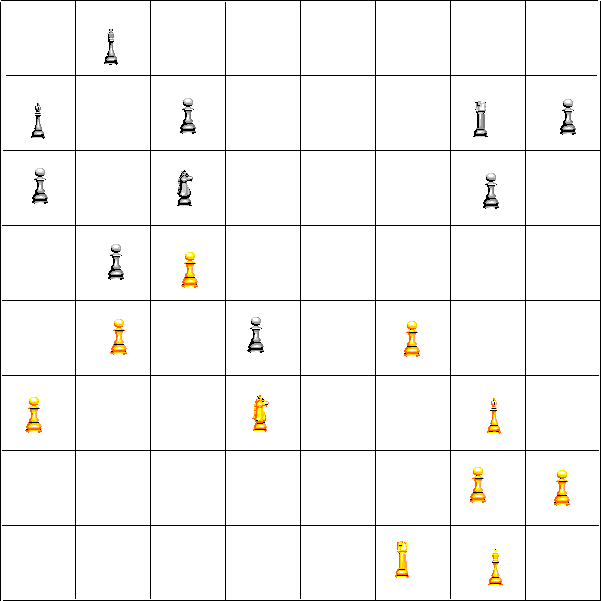
    It is the case, of course, that instructions for use can be remembered and that people can learn to recall almost instantaneously -- very quickly -- the intended use or meaning of at least some images. Consider (some) highway signs containing pictures. Or, chess players, consider a diagram of a chess position (with icons representing the King, Bishop, etc.).

  • Indeed, my friends, are physical chess pieces different in any pertinent way from "immaterial" icons representing chess pieces? "Real" chess pieces and "real" chess boards also don't usually carry captions describing how chess pieces can be played.
  • Pictures and Thinking

    "My computer screen is festooned with little cartoons that do various things when selected by a click of the mouse. For the life of me I can't remember what the tiny binoculars, eyedropper, and silver platter are supposed to do. A picture is worth a thousand words, but that is not always such a good thing. At some point between gazing and thinking, images must give way to ideas." Steven Pinker, Chapter 4 ("The Mind's Eye"), How the Mind Works p. 298 (1997).

    This thought has many implications for visualizing evidence. One implication is the following:

    The mental labor required by a method of picturing evidence and inference ordinarily should not outweigh the cognitive benefits of using such that method.
    Compare the following lead balloon produced by the ordinarily-superlative John Henry Wigmore: Even though Wigmore's method of picturing inference was far from user-friendly, it is good that Wigmore created his leaden method of charting evidence and inference. For example, his effort helped to get some legal professionals to start thinking about inference networks and it eventually helped to get probabilists to think more carefully about cascaded probabilistic inference and about the peculiar and interesting properties of complex evidential inference.

    Once Again: What Is "Visualization" of Evidence and Inference?

    Oliver Sacks, A Neurologist's Notebook: To See and Not See, THE NEW YORKER (May 10, 1993, posted online June 12, 2006):
    The seventeenth-century philosopher William Molyneux, whose wife was blind, posed the following question to his friend John Locke: “Suppose a man born blind, and now adult, and taught by his touch to distinguish between a cube and a sphere [be] made to see: [could he now] by his sight, before he touched them . . . distinguish and tell which was the globe and which the cube?” Locke considers this in his “Essay Concerning Human Understanding” (1690) and decides that the answer is no. In 1709, examining the problem in more detail, and the whole relation between sight and touch, in “A New Theory of Vision,” George Berkeley concluded that there was no necessary connection between a tactile world and a sight world—that a connection between them could be established only on the basis of experience.

    Barely twenty years elapsed before these considerations were put to the test—when, in 1728, an English surgeon named William Cheselden removed the cataracts from the eyes of a thirteen-year-old boy born blind. Despite his high intelligence and youth, the boy encountered profound difficulties with the simplest visual perceptions. He had no idea of distance. He had no idea of space or size. And he was bizarrely confused by drawings and paintings, by the idea of a two-dimensional representation of reality. As Berkeley had anticipated, he was able to make sense of what he saw only gradually, and insofar as he was able to connect visual experiences with tactile ones. It had been similar with many other patients in the two hundred and fifty years since Cheselden’s operation: nearly all had experienced the most profound, Lockean confusion and bewilderment.

    And yet, I was informed, as soon as the bandages were removed from Virgil’s eye he saw his doctor and his fiancée, and laughed. Doubtless he saw something—but what did he see? What did “seeing” for this previously not-seeing man mean? What sort of world had he been launched into?

    This tale has implications for the conference on Graphic and Visual Representations of Evidence and Inference in Legal Settings.

    Friday, June 16, 2006

    Deporting the Evidence

    John P. Martin, Judge wants 11 deported Hundurans back in N.J., The Star-Ledger p. 1 (June 14, 2006):
    A federal [trial] judge [Joel Pisano] took the unusual step of ordering the government to locate 11 Hundurans it deported last year and arrange for their return, ruling they should not have been expelled because they might vindicate a Hudson County bar owner accused of running a human trafficking ring. ...

    ...

    "There is no question that had the agents focused on their obligations to preserve evidence in the case, it might have been advisable for them to invoke the material witness statute, and we wouldn't be in the situation we are today," Pisano said.

    ...

    The ... detainees from the raids -- eight women and three men -- ... told agents Medrano [the accused] did not arrange their smuggling and never pressured anyone, and that the women voluntarily lived and worked together.

    Those witnesses were deported.

    Saturday, June 10, 2006

    Quirky Behavior Frustrates Rational Inference

    Steve Coll, Citizens, The New Yorker p. 27 (June 5, 2006):

    On that summer morning [of June 7, 2005], three young Muslim men blew themselves up on Underground cars, and a fourth immolated himself on a double-decker bus....

    The four men depicted in the report are in some respects unfathomable. When Shezad Tanweer, a talented athlete who was twenty-two years old, bought snacks at a highway convenience store four hours before his death, he haggled over the change. ...