Sunday, June 12, 2011

Fans of Evidence Do Not (always) Bowl Alone


No bowling alone at Wasserman's Evidence!


&&&


The dynamic evidence page

It's here: the law of evidence on Spindle Law. See also this post and this post
.

Proclamation

I hereby proclaim that the workshop on AI & Evidential Inference in Pittsburgh was a success. Kudos to the panelists.

The workshop papers will be published in Law, Probability and Risk. The images found below, however, will not be published there.

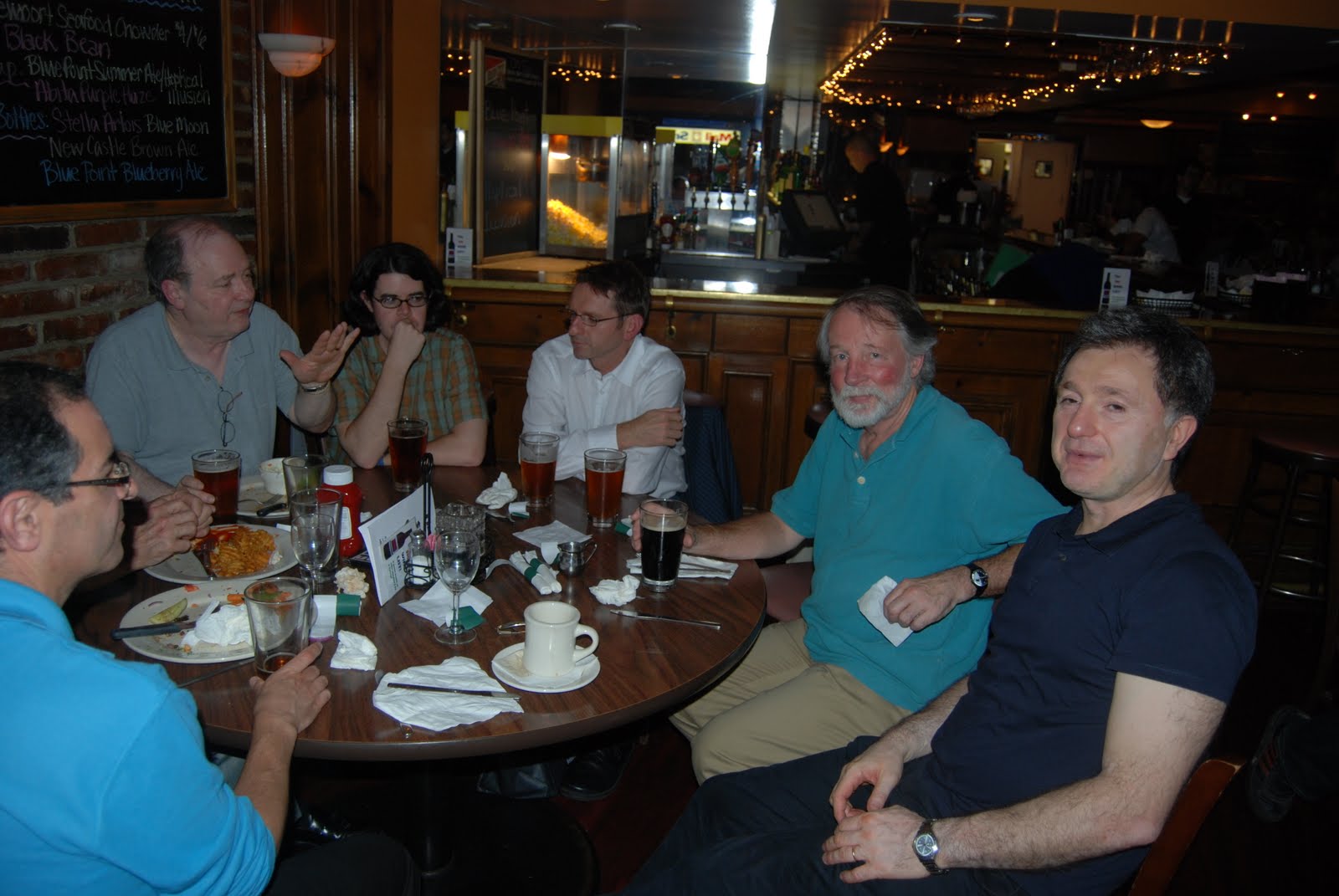
Left to right: Boaz Sangero, Michael Risinger, Michael Pardo, David Hamer, Thorne McCarty, and Giovanni Sartor

Left to right: Michael Pardo, David Hamer & Federico Picinali


Clockwise from foreground: Boaz Sangero, Jim Franklin, Ron Allen, Michael Risinger, Michael Pardo & David Hamer


&&&


The dynamic evidence page

It's here: the law of evidence on Spindle Law. See also this post and this post.

Monday, June 06, 2011

Will fingerprint evidence become the new DNA?

Perhaps new technology (nanotechnology) will dramatically improve the ability to retrieve fingerprints from difficult surfaces and also to retrieve them even when fingerprint impressions were left years or decades ago. See Nanotechnology is key to recovering usable fingerprints from old evidence
.


&&&
 

The dynamic evidence page

It's here: the law of evidence on Spindle Law. See also this post and this post.

Monday, May 30, 2011

Restyled Federal Rules of Evidence Approved by the Supreme Court


On April 26, 2011, the U.S. Supreme Court approved the restyled Federal Rules of Evidence and transmitted them to Congress. If Congress takes no action, the Rules will go into effect on December 1, 2011.  

28 U.S.C. Section 2074. Rules of procedure and evidence; submission to Congress; effective date 
(a) The Supreme Court shall transmit to the Congress not later than May 1 of the year in which a rule prescribed under section 2072 is to become effective a copy of the proposed rule. Such rule shall take effect no earlier than December 1 of the year in which such rule is so transmitted unless otherwise provided by law. The Supreme Court may fix the extent such rule shall apply to proceedings then pending, except that the Supreme Court shall not require the application of such rule to further proceedings then pending to the extent that, in the opinion of the court in which such proceedings are pending, the application of such rule in such proceedings would not be feasible or would work injustice, in which event the former rule applies. 
(b) Any such rule creating, abolishing, or modifying an evidentiary privilege shall have no force or effect unless approved by Act of Congress.


&&&

The dynamic evidence page

It's here: the law of evidence on Spindle Law. See also this post and this post.

Saturday, May 28, 2011

The Logic of Fact Investigation versus the Logic of Factual Proof?

In philosophical discourse there is some talk about the difference (or the supposed difference) between the "logic of discovery" and the "logic of justification." Is there a parallel or analogous difference between the discovery of facts and the proof of facts in legal settings? Does one type of logic govern the investigation of factual questions and another type of logic govern the proof of factual hypotheses in legal settings such as trials?

I think the answer is both yes and no: Although the forms of mental structuring that play a role in settings such as the process of proof at trial also influence fact investigation that is conducted with an eye to the possibility of a legal event such as a trial -- for example, substantive legal rules influence pretrial investigation as well as proof at trial, and investigators as well as trial lawyers sometimes have to think about the credibility of witnesses --, some forms of mental structuring (or evidence marshaling) tend to be more prominent in later phases of proof (broadly understood) than in earlier phases of proof. This is the way that I formulated this thesis in the most recent iteration of the syllabus for my course Fact Investigation I:
Fact Investigation II, offered in the spring semester, is a continuation of Fact Investigation I, which is given in the fall semester. In the spring semester, teams of students attempt to bring to a conclusion one or more of the investigations they began the previous semester. Although the fall semester course and the spring semester course have some of the same objectives and themes, the spring semester course differs in important ways from its predecessor. In the spring semester there is more emphasis on sources of evidence beyond databases and public records; for example, there is a greater emphasis on witness interviews. More generally, in the spring semester there is less emphasis on exploratory investigation and there is more emphasis on bringing an investigation to a successful conclusion. For this reason, in the spring semester substantially more attention is devoted to the relationship between the steps taken during investigation and matters such as (a) the legal requirements governing the admissibility of evidence in settings such as trials; (b) the extent and the range of the evidence bearing on legally-material factual issues and hypotheses; (c) assessment of the probative value of evidence and the credibility of witnesses; and (d) the persuasiveness of the evidence that may be submitted to a trier of fact or audience such as a judge, a jury, a legislative committee, a corporate executive, or the public.
See The General Nature, Purposes & Scope of the Course in Fact Investigation


&&&


The dynamic evidence page

It's here: the law of evidence on Spindle Law. See also this post and this post.

Friday, May 27, 2011

What Is a Polygraph?

It isn't what you probably think it is.

Thomas Jefferson -- yes, that Thomas Jefferson -- used a polygraph. If you don't believe me, go here.


&&&


The dynamic evidence page

It's here: the law of evidence on Spindle Law. See also this post and this post.

Thursday, May 26, 2011

A Weathered but Still-Tasty ... but also Misshapen? -- Morsel by Judge Posner

Judge Richard Posner once said, "As one of our finest academic public intellectuals, Jean Bethke Elshtain, has put it, 'The problem with being a public intellectual is you get more and more public and less and less intellectual.'" Diary, Entry 5 Slate (Jan. 18, 2002) (see bottom of page).

But there is a slight (trivial?) problem with Judge Posner's logic. In the passage quoted above Posner endorses the proposition that there is an inverse relationship between the degree to which one is a public intellectual and the the degree to which one is an intellectual. But two sentences before the one I quoted above, Posner states that in his book Public Intellectuals: A Study of Decline he studied the relationship between "media prominence" and "academic prominence" (emphasis mine). Perhaps Posner should have explicitly said that in his mind the degree to which an academic is "intellectual" is the degree to which the academic is seen to be intellectual by his or her academic colleagues. (Of course, if he had done that, the bon mot -- or whatever we might wish to call it -- would have lost its charm and its bite.)

So the question arises: Can we validly say of an academic that he or she is "intellectual" even if the academic in question garners little praise, admiration, or attention from his or her colleagues?
I wonder how Judge Posner grades the performance of the students in his unorthodox but interesting Evidence course? Does he consult the opinions of academics or the opinions of the students' colleagues before he awards a student a grade? And if he does that, do they in turn ask Posner what he thinks? (Do you detect a vicious circle here? [But the paradox is solved if we have an academic pope -- such as Judge Posner.])
Perhaps Judge Posner proves once again that people tend to prefer the measures of merit - the "merit metrics" - that make them look best.


&&&

The dynamic evidence page
It's here: the law of evidence on Spindle Law. See also this post and this post.

Wednesday, May 25, 2011

Spindle Law Interview: Erwin Chemerinsky

Spindle Law interview of Erwin Chemerinsky.

&&&

The dynamic evidence page
It's here: the law of evidence on Spindle Law. See also this post and this post.

Death Penalty in China

The BBC reports that the People's Supreme Court of the PRC has taken a further step toward reducing the frequency of the death penalty:
China has introduced a number of measures over recent years to cut down the number of executions.
This latest development appeared in the annual report of the supreme court.
"Suspend the death sentence for two years for all cases that don't require immediate execution," read the report.
The court does not say why some cases might need to be carried out immediately, although in the past the government has instructed judges to be more severe in cases that involved crimes it was targeting.
Those benefiting from the changes will probably never be executed.
Criminals given a suspended death penalty usually have their sentences commuted to life imprisonment.
China does not reveal the number of executions it carries out each year, but it is thought to kill more people than any other country.
Four years ago the Supreme People's Court took back the right to review every death sentence handed out by lower courts.
The result has been fewer executions.
Earlier this year China reduced the number of crimes that carry the death penalty by 13 to 55.


&&&
 

The dynamic evidence page

It's here: the law of evidence on Spindle Law. See also this post and this post.

Wednesday, May 18, 2011

The "Clergy Sex Abuse Scandal" in Context: The May 2011 John Jay Report

From the very first day I began this blog -- August 25, 2002 -- I have posted -- intermittently -- about the "clergy sex abuse scandal," which has often been used as a synonym for the Roman Catholic clergy sex abuse scandal. Along the way I raised various questions about the scandal. I wondered, for example, why the Boston Globe, which won a Pulitzer Prize for its reporting, was interested only in sex abuse by members of the Catholic clergy. I was disturbed by the use of questionable evidence -- such as repressed memory -- in many of the legal actions brought against alleged offenders. I wondered whether sex abuse was more prevalent among the Catholic clergy than in, say, families or schools. I worried that the financial interests of potential plaintiffs and their lawyers were leading to distortions of evidence. I worried that the zealotry of victims' groups and their lawyers were leading to worrisome shifts in the balance between the interests and rights of victims and the interests and rights of civil and criminal defendants.

All of the questions I raised depended to some degree on empirical propositions. Now a report has been released that may shed light on many of those questions of fact: John Jay College Research Team, The Causes and Context of Sexual Abuse of Minors by Catholic Priests in the United States, 1950-2010: A Report Presented to the United States Conference of Catholic Bishops (First Printing, May, 2011).

Although impressive steps were taken to preserve the independence of the John Jay investigators (Karen J. Terry, Principal Investigator; Margaret Leland Smith, Data Analyst; Katarina Schuth, O.S.F., Consultant; James R. Kelly, Consultant; Brenda Vollman, Research Associate; and Christina Massey, Research Associate), the report will almost certainly not satisfy many constituencies, including groups that have a stake in advancing legal claims against Catholic organizations in America. Nonetheless, I do hope -- perhaps in vain -- that the report will lead to more balanced reporting in the mass media and that some attacks -- for example, on the celibacy rule -- will now be seen for what they probably are, attacks based on little more than prejudice and anti-Catholic animus.


&&&

The dynamic evidence page
It's here: the law of evidence on Spindle Law. See also this post and this post.

Tuesday, May 17, 2011

Sunday, May 15, 2011

A Problem of Criminal Procedure -- and American Liberty

I am watching a C-Span program "2011 Virginia Festival of the Book." Bruce Fein, author of American Empire Before the Fall, is one of the speakers. The discussion put me in mind of a problem I posed to the students in my seminar Constitutional Criminal Procedure:


April 13, 2011
Constitutional Criminal Procedure
Discussion Problem


On July 1, 2010, Officer Marlene Davis of the Sexual Crimes Unit of the City of Ames Police Department, State of Blackacre, visits the Heavenly Day Care Center in Ames. There she gives a talk to the children at Heavenly to warn them not to let grownups touch their genitals and to tell their parents if anyone does. Immediately after the talk, Amy Johnson, a five-year-old girl at Heavenly, rushes up to Officer Davis and whispers in her ear, “A big man at school played with my wee-wee today.'' Officer Davis replies, “Who did that, Amy?” However, Amy starts crying hysterically and refuses to say anything more. Officer Davis establishes that four men work at the Heavenly Day Care Center. Officer Davis immediately interviews all four men in Heavenly's cafeteria. Three of those men deny any wrongdoing. However, the fourth man, Adolf Carter, responds by saying, “I don't have to talk to you and I'm not going to,” and then walks away. Officer Davis, however, follows Carter, takes him into custody, and drives him in her patrol car to the offices of the Sexual Crimes Unit. There another police officer, Officer Walton Wanton, a male officer, straps Carter into a chair and subjects him to a penile plethysmograph test, which is is a procedure that involves placing a pressure-sensitive device around a man's penis, presenting him with an array of sexually stimulating images, and determining his level of sexual attraction by measuring minute changes in his erectile responses. Officer Wanton reports to Officer Davis that Adolf Carter exhibited an extraordinarily high level of sexual arousal on being shown images of young nude female children. Officer Davis informs Adolf Carter, who is still strapped in the chair, “I'm afraid you flunked the test, Mr. Carter.” Carter responds, “OK. So I touched the kid. So what? That's not a crime.” Adolf Carter is indicted for sexual abuse of a minor. At Carter's trial the prosecutor offers in evidence Carter's statement “OK. So I touched the kid. So what? That's not a crime.” Carter's counsel states, “I object, your Honor. The evidence is barred by the Self-Incrimination Clause of the Fifth Amendment and by the Fourth Amendment's Search and Seizure Clause. Moreover, the forcible use of that test was a gross imposition on Mr. Carter's constitutionally-protected liberty and privacy.”


Please evaluate the admissibility of Carter's statement under the Fourth Amendment's Search and Seizure Clause, under the Fifth Amendment's prohibition against compulsory self-incrimination, and under any other federal constitutional principles we have discussed in this seminar.


&&&


Does the procedure described above strike you as nothing more than the product of the fevered imagination of a pointy-headed academic? If so, consider


United States v. Cope, 527 F.3d 944 n. 1 (9th Cir. 2008):
As we explained in detail in United States v. Weber, 451 F.3d 552 (9th Cir. 2006), penile plethysmograph testing involves placing a device on a man's penis to "measure[ ] its circumference and thus the level of the subject's arousal as he is shown sexually explicit slides or listens to sexually explicit audio scenes," id. at 562 (internal quotation marks omitted). Plethysmograph testing has become a fairly common component of sex offender treatment programs. Id.

United States v. Weber, 451 F.3d 552 (9th Cir. 2006):


Plethysmograph testing is a procedure that "involves placing a pressuresensitive device around a man's penis, presenting him with an array of sexually stimulating images, and determining his level of sexual attraction by measuring minute changes in his erectile responses." Jason R. Odeshoo, Of Penology and Perversity: The Use of Penile Plethysmography on Convicted Child Sex Offenders, 14 TEMP. POL. & CIV. RTS. L. REV. 1, 2 (2004). Although one would expect to find a description of such a procedure gracing the pages of a George Orwell novel rather than the Federal Reporter, plethysmograph testing[1]has become routine in the treatment of sexual offenders and is often imposed as a condition of supervised release.


&&&

We don't subject the entire American adult male population to the penile plethysmograph test. But we do plan to subject all air travelers to a device -- a full-body backscatter x-ray unit -- that exposes travelers' genitals to the operator of the device. There are said to be plans to use the device on some subway lines and perhaps elsewhere.


&&&


The dynamic evidence page
It's here: the law of evidence on Spindle Law. See also this post and this post.

Tuesday, May 10, 2011

Schedule of Events at Workshop on AI & Evidential Inference, June 10, 2011


One-Day Workshop on AI & Evidential Inference
(in memory of Craig Callen)
in Conjunction with
ICAIL 2011, Pittsburgh, Pennsylvania, June 10, 2011


Schedule of Workshop Talks & Events, Friday, June 10, 2011

8:50 – 9:00
Giovanni Sartor & Peter Tillers
Welcome, greetings
9:00 – 9:30
James Franklin
How much of commonsense and legal reasoning is formalizable? A review
9:30 – 10:00
D. Michael Risinger
Against Symbolization—Some reflections on the limits of formal systems in the description of inferential reasoning and legal argumentation
10:00 – 10:30
Federico Picinali
Structuring inferential reasoning in criminal cases. An analogical approach
10:30 – 11:00
Coffee
Coffee
11:00 – 11:30
Michael Pardo
Relevance, Sufficiency, and Defeasible Inferences: Comments on Modeling Legal Proof
11:30 – 12:00
David Hamer
A probabilistic model of the relationship between the quantity (weight) of evidence, and its strength
12:00 – 12:30
Joseph Laronge
Evaluating Universal Sufficiency of a Single Logical Form for Inference in Court
12:30 – 1:00
Rainhard Bengez
On the Computable Structure of the Logocratic Method and Analyses Specific to Evidence Law
1:00 – 2:00
Lunch
Lunch
2:00 – 2:30
Bruce Hay
Roughly Two Conceptions of the Trial
2:20 – 3:00
Ronald J. Allen
Taming Complexity: Rationality, the Law of Evidence, and the Nature of the Legal System
3:00 – 3:30
Scott Brewer
Representing Legal Arguments: The Centrality of Abduction
3:30 – 4:00
Coffee
Coffee
4:00 – 4:30
Douglas Walton & Floris Bex
Combining Evidential and Legal Reasoning with Burdens and Standards of Proof
4:30 – 5:00
Bart Verheij
Can the argumentative, narrative and statistical perspectives on legal evidence and proof be integrated?
5:00 – 5:30
Henry Prakken
Can non-probabilistic models of legal evidential inference learn from probability theory?
5:30 – 6:00
Giovanni Sartor & Giuseppe Contissa
Evidence arguments in air traffic safety. A model for the law?
6:00 – 6:30
Boaz Sangero
Proposal to Reverse the View of a Confession: From Key Evidence Requiring Corroboration to Corroboration for Key Evidence

Monday, May 09, 2011

Not an Arcane Issue?: The Modularity or Non-Modularity of the Brain (Mind)

In a recent book review in the London Review of Books the witty and irreverent Rutgers philosopher Jerry Fodor again attacks the thesis of the "massive modularity" of the mind. See Fodor, "Massively Modular Minds," 33 LRB No. 9 (April 28, 2011). This controversy may seem arcane -- and it is -- but the question of whether the mind amounts to nothing more than a clump of distinct adaptive parts -- parts produced only by Darwinian natural selection -- has a bearing on the question of the extent to which explicit rational deliberation -- or what passes for rational deliberation -- can influence the inferences that human beings ought to draw from evidence. Cf. the blog post:
Do You Believe in Sociobiology and the Law? - Chapter II (October 21, 2007)
See also the brief discussion associated with Figure 3 of the following blog post:

Friday, October 16, 2009


Brain Science: A Meditation on Mechanical Lie Detection

Drawing Inferences about "Deception" from Observed Events in the Brain:
Of fMRI and Similar Purported Tools for Observing or Inferring States of the Human Mind and Heart


&&&

The dynamic evidence page
It's here: the law of evidence on Spindle Law. See also this post and this post.

A Two-Part Course in Fact Investigation: Tentative Descriptions


Fact Investigation I  (Fall 2011)
Professor: Tillers/Segal
Credits: 3 (2 academic, 1 clinical) 
Pre/Corequisite: None

Effective pretrial investigation requires not only imagination, but also careful marshaling of evidence and careful organization of thinking about evidence. It frequently requires the application of a variety of distinct marshaling and analytical methods such as the development of time lines, the formation of scenarios, orderly assessment of the credibility of testimonial evidence, and the marshaling of evidence on the basis of legal rules and their elements. Students in the course are introduced to a toolkit of evidence marshaling strategies for investigation. Students also become familiar with important databases and public records. Students work in teams and conduct actual investigations of real-world problems. Consult the following web site for a more detailed description of the course: http://tillers.net/fi-course/fi-home.html. 

Fact Investigation II  (Spring 2012)
Professor: Tillers/Segal
Credits: 2
Pre/Corequisite: Fact Investigation I

This course is a continuation of Fact Investigation I. In this course, teams of students carry forward and bring to a conclusion one or more of the investigations launched by the members of the previous semester's course in fact investigation. Although this course and the previous semester's course in fact investigation have some common objectives and themes, this course differs in important ways from its predecessor. In this course, there is a greater emphasis on sources of evidence apart from databases and public records; for example, there is a greater emphasis on witness interviews. More generally, this semester there is less emphasis on exploratory investigation and more emphasis on bringing an investigation to a successful conclusion. For this reason, close attention is given to the relationship between (i) decisions and steps during investigation and (ii) matters such as (a) the legal requirements governing the admissibility of evidence in settings such as trials and (b) the persuasiveness of evidence submitted to a trier of fact or audience such as a judge, a jury, a legislative committee, a corporate executive, or the public.

Saturday, May 07, 2011

A New Phase in the Teaching of Fact Investigation - or An Old Dog Can Teach New Investigation Tricks

My course in fact investigation now moves into a different phase. This course, which I teach with Phil Segal, becomes a two-semester course next year. This is important because (i) more time can now be devoted to theory (in the first semester) and (ii) more time can be devoted (in the second semester) to gathering and packaging evidence so that (a) it will meet the legal requirements for admissibility in a forum such as a trial and (ii) it will be intelligible and as persuasive as possible to a trier of fact such as a judge or a jury.

As before, students in the course will conduct investigations of real-world matters. (There are no simulated investigation problems in our course.) However, some of the investigations in the second semester will lead to the preparation of public reports, reports that will be released to the public.

The topic of fact investigation is crucial for both philosophy and law. As every trial lawyer knows (or should know), fact investigation is crucial for successful litigation and advocacy. Furthermore, the study of fact investigation inevitably raises the question of how human beings manage to acquire knowledge about the world. In short, few topics are more fundamental than fact investigation!


&&&

The dynamic evidence page
It's here: the law of evidence on Spindle Law. See also this post and this post.

Monday, May 02, 2011

The Meaning(s) of "Exoneration"

The Innocence Projects do God's work -- but I have long thought that the Projects use the word "exoneration" much too loosely and thereby frequently claim far more than the evidence shows. Cf., e.g., parts of my blog posts

Saturday, November 12, 2005

When Chances Collide; DNA & "Exoneration"; Suggestibility & Gullibility at http://tillerstillers.blogspot.com/2005/11/when-chances-collide-dna.html


and

Tuesday, August 27, 2002


DNA in the News: Imperfect Evidence and Imperfect Justice, at http://tillerstillers.blogspot.com/2002/08/dna-in-news-imperfect-evidence-and.htm
new article by Keith A. Findley apparently makes an analogous point. But Findley draws a starkly different moral than I do: He thinks the Innocence Projects define "exoneration" and "innocence" too narrowly rather than too broadly.

  • I think that some guilty people are wrongly convicted and that when we think that a wrongful conviction of a probably guilty person has been properly set aside, we should not refer to such an event as an "exoneration." We should call a spade a spade. We should say, simply, that the conviction was properly set aside, and we should not pretend (unless we have reason to think that such is the case) that an innocent person has been exonerated.
  • Under many circumstances, of course, the wrongful action (or inaction) of some public official makes it difficult or impossible to make a reasonable judgment about the guilt or innocence of some person. When that is the case, that is what we should say is the case.

Thursday, April 28, 2011

James H. Chadboun, Deans, Roscoe Pound, Loyalty Oaths, and UCLA in the 1950s

James Chadbourn in the 1950s


From the Wikipedia entry for James H. Chadbourn:

Peter Tillers recounts...:

I did research for James H. Chadbourn for a number of years while he taught at Harvard Law School. ... Chadbourn hated deans -- without exception. ... I don't know what lay at the root of Chadbourn's contempt for deans. Part of the reason may have been philosophical and temperamental: he was a curmudgeon -- a gentle curmudgeon -- and a skeptic, and he was generally distrustful of authority. Another part of the reason may have been his experiences with authority while he taught at UCLA: the story has it that he fought bitterly against a McCarthyite attempt to purge two junior faculty members who were accused of being Communist sympathizers. ...

Peter Tillers reports that he heard from Chadbourn's friends or family, not only that Chadbourn came to detest the dean that he initially served under at UCLA, but also that Chadbourn, after declining to become one of the law school's founding faculty members, agreed to join the law school in 1950. Chadbourn, who had been teaching at the University of Pennsylvania, thought he would become one of the senior faculty members at UCLA. But on arriving at UCLA, he discovered, to his horror, that Roscoe Pound had become a faculty member at UCLA's new law school. Chadbourn - for some reason - detested Roscoe Pound.

It turned out that Chadbourn had ample reason to detest both Roscoe Pound and the first dean of UCLA Law School, L. Dale Coffman. The wave of the post-World War II anti-communist fervor had reached California by 1950. The board of regents of the University of California resolved that all faculty members had to take loyalty oaths. Dean Coffman and Roscoe Pound agreed that law faculty members should also be required to do so.[1]
----
1. Renee Y. Rastorfer, "THOMAS S. DABAGH AND THE INSTITUTIONAL BEGINNINGS OF THE UCLA LAW LIBRARY: A CAUTIONARY TALE," 95 Law Library Journal 347, 357 (2003) ("[T[he dean of the law school, L. Dale Coffman, became a vocal supporter of the loyalty oath. In later years, he recalled that Regent Edward Dickson was unhappy about the controversy embroiling the system. 'Indeed so. As a matter of fact, that's why he came to me to see if [Roscoe] Pound and I and other members of the faculty would make public statements in that regard. I did to the Examiner. Pound did, too .... I stated publicly that I'm not a communist, I never have been, I never expect to be, and I don't see where in it interferes with my academic freedom to say so.')

See generally, N.E.H. Hull, Chapter 6 ("Pound Moves to the Right and Llewellyn Applies Himself") in Roscoe Pound and Karl Llewellyn: searching for an American jurisprudence (Chicago, 1997).


&&&

The dynamic evidence page
It's here: the law of evidence on Spindle Law. See also this post and this post.


Add to the Wikipedia Entry for James H. Chadbourn!

This is an order: add to the Wikipedia Entry for James H. Chadbourn, the renowned, wry, and modest Evidence teacher of yore.

I don't know if Wikipedia tolerates anecdotes -- but if it does, please add any jokes or cracks that you recall Chadbourn making.

At the moment, the Wikipedia entry has an impersonal tone. This is unfortunate.

Perhaps some of you can recount some of Chadbourn's long-distant political and academic battles when he was at UCLA.

Perhaps some of you have stories about Chadbourn's days at Harvard.

&&&

The dynamic evidence page

It's here: the law of evidence on Spindle Law. See also this post and this post.