Tuesday, July 24, 2012

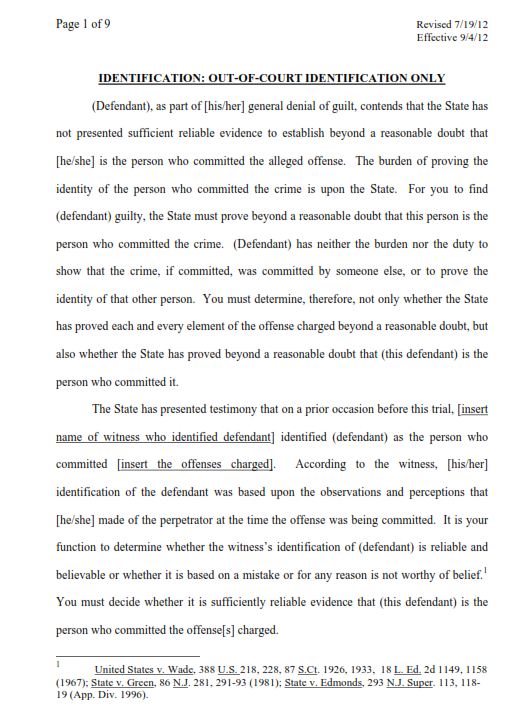
July 2012 NJ Jury Instructions on Eyewitness Evidence


&&&
Evidence marshaling software MarshalPlan

NJ Chief Justice Comments on Eyewitness Identification Guidelines


Mary Ann Spoto N.J. Supreme Court imposing sweeping changes in crime witness testimony Star-Ledger (July 23, 2012).


Snippets from the article:

After Labor Day, judges will be required to give jurors plenty of precautions before they consider the testimony they heard during trials.
For example, jurors will be told: "Human memory is not foolproof. Research has revealed that human memory is not like a video recording that a witness need only replay to remember what happened. Memory is far more complex ... Eyewitness identification must be scrutinized carefully."
Chief Justice Stuart Rabner said the new instructions to jurors will discourage actions that could help put the wrong person behind bars.
"These charges will deter practices that can lead to misidentification," Rabner told The Star-Ledger. "The charges are critically important to the eyewitness identification process and give detailed guidance to juries that will allow them to assess the evidence and decide how much weight to give the evidence they heard."


&&&

The dynamic evidence page
Evidence marshaling software MarshalPlan

Monday, July 23, 2012

Eyewitness Identification

There have been interesting developments in the legal treatment of eyewitness identification evidence and I hope to discuss them here shortly. In the meantime keep several things in mind:

1. Although bad news is more striking than good news, keep in mind that eyewitness identifications are sometimes correct. In fancier parlance: the frequency of "hits" as well as of false positives is germane to the question of the appropriate legal treatment of eyewitness identifications.

2. A generation or two ago Dean McCormick said that a brick is not a wall. As far as I know, this remains true. Hence, to make a case for exclusion of eyewitness identification evidence in a specific case it is not sufficient to say or show that the challenged evidence has little probative value. There may be other evidence in the case and the other evidence may have probative value; and when the eyewitness identification evidence is added to the other evidence in the case about identity, all of the evidence taken together it may amount to quite a lot.

3. Some of the ailments of the criminal process may be traced to the usual lack of financial resources of the defense. One question to consider -- a difficult question -- is whether and to what extent the flaws generated by this lack of resources can be compensated for by rules of evidence requiring exclusion of evidence at trial or other trial remedies such as jury instructions.

4. We generally do not identify people only by their facial appearance. We also rely on matters such as gait.

5. Is it possible to empirically verify all of the factors that affect the accuracy of eyewitness identifications and the magnitude of the effect of such factors? If not, so what?  What follows?


&&&

The dynamic evidence page
Evidence marshaling software MarshalPlan

Perlovsky on Music and Knowledge (and More)

Leonid Perlovsky - Wikipedia, the free encyclopedia »
Leo Perlovsky

Knowledge instinct. The term knowledge instinct is used by Leonid Perlovsky in his book Neural Networks and Intellect: Using Model-Based Concepts and other publications. In his works the knowle...

Me speaking:

Ya just gotta love a guy who believes -- who may believe -- that the aesthetic instinct - something like the desire for things such as harmonious music -- is the most fundamental instinct or close to the most fundamental instinct, or yearning, of the human animal. Perhaps LP sees the Knowledge Instinct as essentially an aesthetic instinct? I don't yet know if that's where LP wants to take us -- but I intend to find out. (LP appeals to my neo-Aristotelian inclinations. I think it may be time for academic legal folk and folk in related fields -- decision theorists, choice theorists, fans of heuristics, etc. -- to become acquainted with this fellow. I think I may end up launching one of my mini-campaigns. Stay tuned.)

Some luscious tidbits from Leonid Perlovsky's EMOTIONAL COGNITIVE NEURAL ALGORITHMS WITH ENGINEERING APPLICATIONS (2011):

p. 142: "Here we present a theory or hypothesis based on previous arguments in this chapter suggesting that music serves the most important and concrete function in [the] evolution of the mind and cultures. We discuss this function, neural mechanisms, and suggest experimental verification of this hypothesis."

pp. 152-156: LP repeats and amplifies an earlier claim about the critical role of differentiation and synthesis. p. 153: "Here [Section 4.12.6] we discuss the main hypothesis in this section: what constitutes the fundamental role of musical emotions in [the] evolution of consciousness, cognition, and culture. [Par.] As discussed, the balance between differentiation and synthesis is crucial for the development of cultures and for [the] emergence of contemporary consciousness."

p. 156: "The referenced literature suggests that music has two interrelated purposes fundamental to the functioning of individual minds and to evolution of the mind and culture. The first purpose is to differentiate aesthetic emotions. Music creates differentiated emotions required to reconcile conceptual contradictions. [!] The second purpose is to connect concepts to conceptual needs (including KI [the Knowledge Instinct].) Whereas language separates conceptual knowledge from instincts and emotions, music reconnects these ties."


&&&
 

The dynamic evidence page
Evidence marshaling software MarshalPlan

Monday, July 16, 2012

Perlovsky in contrast to Kahneman et al.: Knowledge Instinct in contrast to Heuristics

Why Adam Was Expelled From Paradise, Cognitive Science View

(From Levine and Perlovsky 2007)

From the work of the pioneering 18th century mathematicians Jakob Bernoulli and Thomas Bayes through the late 20th century, the dominant notion in the psychology of human decision making was based on rational optimization. This was similar to the knowledge instinct discussed above. But all that changed with the work, starting in the late 1960s, of Daniel Kahneman, winner of the 2003 Nobel Prize in economics, and Amos Tversky, who would have shared that prize had he been alive (Tversky and Kahneman 1974, 1981).

Tversky and Kahneman found that in many choices relating to gain and loss estimation, preferences run counter to rational optimization and lack self-consistency over different linguistic framings of the choice. For example, subjects asked to consider two programs to combat an Asian disease expected to kill 600 people tend to prefer the certain saving of 200 people to a 1/3 probability of saving all 600 with 2/3 probability of saving none. However, subjects also tend to prefer a 1/3 probability of nobody dying with a 2/3 probability of 600 dying to the certainty of 400 dying. The choices are identical in actual effect, but are perceived differently because of differences in frame of reference (comparing hypothetical states in one case with the state of all being alive, in the other case with the state of all dying). Tversky and Kahneman explain their data by noting that “choices involving gains are often risk averse while choices involving losses are often risk taking” (Tversky and Kahneman, 1981, 453). Tversky and Kahneman were led to descriptions of a large repertoire of simplifying heuristics that decision makers characteristically employ.

Most psychologists believe that heuristics have evolutionary value despite sometimes leading to errors and information losses. Heuristic simplification is particularly useful when a decision must be made rapidly on incomplete information, or when the stakes of the decision are not high enough to justify the effort of thorough deliberation.  An example is buying a box of cereal in a supermarket (Levine 1997). The use of heuristics has been explained as cognitive effort minimization, EM (Montgomery and Svenson 1976).
 
The origin of the controversy between the KI and EM can be traced to the first pages of the Bible, to the story of Adam and Eve.
[Note by Tillers: "KI" is Perlovsky's acronym for the "Knowledge Instinct," which Perlovsky describes thus: "The knowledge instinct is described mathematically as maximization of a similarity measure. In the process of learning and understanding input signals, models are adapted for better representation of the input signals so that similarity between the models and signals increases. This increase in similarity satisfies the knowledge instinct and is felt as aesthetic emotions."]
In the 12th century Moses Maimonides, in his “Guide for the Perplexed” (Maimonides 1190/1956) analyzed the relationship between KI and heuristics. He was asked by his student: “Why did God, on one hand, give Adam the mind and free will, while on the other, forbid him to eat of the tree of knowledge? Did God not want Adam to use his mind?” Maimonides answered that God gave Adam the mind to think for himself what is good and what is bad (we associate this ability with the KI). But Adam succumbed to temptation and ate from the tree of knowledge. Adam thereby took a "shortcut” and acquired ready-made heuristics, that is, rule-of-thumb knowledge to guide him so his choices did not require hard thinking.  In conclusion, Maimonides explained that Adam's story described our predicament. Whereas God’s ultimate commandment is to use the KI, it is difficult and we are not completely capable of doing it, especially when thinking about the highest values. Adam’s story described the workings of our mind: struggle between the KI and EM. EM provides the surety of millennial cultural support, but may not suit your individual circumstances. EM does not cause direction in evolution; it is a random force, averaged out over millennia. The KI may lead to doubts and uncertainties, but if successfully used, leads to the satisfaction of being more conscious about your choices. The KI is the mechanism of cultural evolution of humanity, equating dynamics with purposeful evolution.

Maimonides’ interpretation of the Biblical story adds another dimension to the previously discussed differences between the KI and EM.  Mathematically, it is possible to formulate a minds’ utility function so that the KI and EM are brought close to each other.  This utility function can account for the survival value of quick decisions and also for the limited amount of any individual experience, for uncertainty in observation of data, and for minimizing the worst-case losses (such as preventing death) versus maximizing average gain. The utility function even can account for the fact that future is unknown and therefore individual experience should be integrated with culturally accumulated knowledge. But Maimonides hints at something different, something more fundamental than correct formulation of a utility function. He suggests that “original sin” determining the basic imperfectness of humankind is related to how we do or do not use our ability for knowledge and for making conscious choices.

We will now relate this Biblical account to theoretical understanding and experimental data about the mind and brain, consider neural mechanisms of the KI and EM, relate them to conceptual and emotional intelligence, to consciousness and the unconscious, and will try to add scientific interpretation to this millennial old mystery. Cognitive neuroscience data suggest new interpretations about KI versus EM, which are important for understanding human evolution, which further increase our understanding of knowledge maximization versus effort minimization, between “high” and “low”.

The tendency that Tversky and Kahneman (1974, 1981) found for decision makers to be susceptible to linguistic framing is not universal: a significant minority of adults (along with most young children!) is not susceptible to the distortions of rational decision making caused by framing effects. A functional magnetic resonance imaging (fMRI) study (DeMartino et al. 2006) showed significant differences in brain region activation between individuals who were and were not susceptible to framing effects. The heuristics-violators (KI-type people) had more activation than the heuristics-followers (EM-type) in the frontal lobes and adjacent cortex. Conversely, those subjects whose choices were consistent with the framing heuristic had more activation in the amygdala, the area below the cortex that is most involved with primary emotional experience.

The higher up we go in the hierarchy, the closer we are to the beautiful and sublime, the easier, it seems, to succumb to the temptation to stop thinking and to use ready-made concepts acquired from the culture: language concepts connected not to individual thinking, concepts connected to “Mom and Dad prohibitions,” to amygdalar emotions triggered by previous failures, when we tried to think and got burned. Whereas God demands us to use our cortex, the uniquely human ability for thinking, the old Snake present pulls us to using amygdala, which we share with animals, pulls us back to animal kingdom.


&&&

The dynamic evidence page
Evidence marshaling software MarshalPlan

Emotion and Judgment (and Inference)

Lawyers, social scientists, and ordinary people have known or believed for some time that emotions can influence human judgment (and -- by extension -- factual inference). Do you know -- you non-AI people -- know that AI people also recognize this point and -- more important -- have taken specific steps to represent how judgment and emotion interact. See, for example, the work of Leonid Perlovsky (whose work I have not yet studied, but firmly intend to study; the references and comments are provided by Perlovsky):

Many short discussions and journal links are on my [Perlovsky's] web page
SciTopics are short encyclopedia [entries]:

Dynamic logic, computational complexity, engineering and mathematical breakthroughs; http://www.scitopics.com/Dynamic_logic_computational_complexity_engineering_and_mathematical_breakthroughs.html


Mind mechanisms: concepts, emotions, instincts, imagination, intuition, beautiful, spiritually sublime;http://www.scitopics.com/Mind_mechanisms_concepts_emotions_instincts_imagination_intuition_beautiful_spiritually_sublime.html


Languages and Cultures: Emotional Sapir-Whorf Hypothesis (ESWH); http://www.scitopics.com/Languages_and_Cultures_Emotional_Sapir_Whorf_Hypothesis_ESWH.html

Music and Emotions. Functions, Origins, Evolution;http://www.scitopics.com/Music_and_Emotions_Functions_Origins_Evolution.html


A recent book sumarizing much of this:
Perlovsky, L.I., Deming R.W., & Ilin, R. (2011). Emotional Cognitive Neural Algorithms with Engineering Applications. Dynamic Logic: from vague to crisp.Springer, Heidelberg, Germany.

Open journal papers:
Perlovsky L.I. (2011). Language and Cognition:Interaction Neural Mechanisms. Computational Intelligence and Neuroscience, 2011, Article ID 454587. Open Journal, doi:10.1155/2011/454587.http://www.hindawi.com/journals/cin/contents/

Perlovsky, L.I. (2012). Free Will and Advances in Cognitive Science, Open Journal of Philosophy, 2(1), 32-37. DOI: 10.4236/ojpp.2012.21005   

  
Masataka, N. & Perlovsky, L.I. (2012). Music can reduce cognitive dissonance, Nature Precedings: hdl:10101/npre.2012.7080.1.

Perlovsky, L.I. & Ilin, R. (2012). Mathematical Model of Grounded Symbols: Perceptual Symbol System. Journal of Behavioral and Brain Science, 2, 195-220; doi:10.4236/jbbs.2012.22024; http://www.SciRP.org/journal/jbbs.

Perlovsky, L.I. (2012). The Cognitive Function of Emotions of Spiritually Sublime. Review of Psychology Frontier, 1(1), 1-10; www.j-psy.org.

This sort of attempt to paint a picture of the human being and, specifically, of the relationship between emotion and judgment, is necessary complement to the external perspective taken by much experimental psychology on the relationship between emotion and judgment.

&&&
 

The dynamic evidence page
Evidence marshaling software MarshalPlan

Monday, July 09, 2012

The Quixotic Campaign to Slay Bayesian Dragons


In my senescence, I was musing, once again, about the decades-long campaign to demonstrate that the the nature of factual inference and proof in American trials cannot be explained, accounted for, modeled, etc., with cardinal numbers and standard probability theory. The odd thing about this campaign was that I do not know many American legal scholars who ever thought that probability theory and the theorem known as Bayes' Theorem "account for" the structure of factual inference and proof in American trials. I understood eminent legal theorists such as Richard Lempert and David Kaye -- and, er, Peter Tillers -- to be saying that one could use probability theory to make arguments about problems of factual inference. (David A. Schum, not a legal scholar, but an eminent probability theorist and an admirer of American and U.K. Evidence scholarship, also took this position.) Different people can use probability theory etc. to make quite different arguments. Probability theory (as far as I can tell) does not mandate (logically mandate) that the American system of proof be designed in some specific and unique fashion. For example, Bayes' Theorem -- it's just a mathematical theorem -- is logically compatible with a system of factual proof in which scenarios and story-telling -- which, by the way, are not synonymous -- play a prominent role.

All of these now-hoary thoughts put me in mind of that curious article about a curious document supposedly discovered in the archives of Cardozo Law School. This is the article:


What say you? Is Peter Pilgrim correct that the campaign to eradicate Bayesianism from the American law of evidence and proof is literally an incoherent enterprise because it rests on the false premise that a mathematical theorem -- Bayes' Theorem -- can somehow be embodied in the American law of evidence and proof? Isn't Peter Pilgrim correct in asserting that Bayes' Theorem is, well, just a mathematical theorem and that it does not itself purport to say anything about factual proof in America (or anywhere else) -- because a mathematical theorem is just a mathematical theorem and such a mathematical theorem "makes an assertion" about the American system of proof only if some person uses the theorem to make an argument about the nature of the American system of proof. So there is no such thing as a "Bayesian system of proof"! Different people can use Bayes' Theorem to make very different arguments and a wide variety (perhaps an infinite variety) of proof practices are consistent with Bayesian logic, standard probability theory, and so on. Well, Peter Pilgrim made these and other points more elegantly and cogently than I ever could. So I will let him speak for himself (see above).


&&&


The dynamic evidence page
Evidence marshaling software MarshalPlan

Sunday, July 08, 2012

Miranda Modernized: Warning: Your Tweets and FB Posts May Be Used against You!

My colleague Phil Segal writes:

Tweets and Facebook Posts May Be Used Against You: The courts continue to weigh in on whether social networking may be used against users who post information on their personal sites.  While the judiciary’s responses vary on a case-by-case basis, so far the trend seems to be that posts on Facebook or tweets may be used as grounds for dismissals from jobs, or even against defendants in criminal or civil cases.

Phil says much more in his post The Never-ending Story: Protecting Your Privacy Online (July 6, 2012).


&&&


The dynamic evidence page
Evidence marshaling software MarshalPlan

Thursday, July 05, 2012

Polonium and Investigation -- Again


Years ago I blogged -- practically as events were unfolding -- about the apparent assassination of Alexander Litvinenko with Polonium. See, e.g., this post. Now the possibility has been suggested that Yasser Arafat met his death the same way. See the NYTimes article What Is Polonium-210 and How Can It Kill? (July 5, 2012).


&&&


The dynamic evidence page
Evidence marshaling software MarshalPlan

Friday, June 29, 2012

Workshop on Formal Argument and Evidential Discovery


The proposed workshop on "Formal Argument and Evidential Discovery" -- if approved, which is likely -- will take place in Rome on one day (probably Friday) during the week of June 10 - June 14, 2013, in conjunction with ICAIL 2013. The organizers of the proposed workshop are Scott Brewer, Giovanni Sartor, and Peter Tillers. The following people have already expressed more than a passing interest in the proposed workshop: Jennifer Mnookin, Robert Burns, Ronald Allen, Philip Dawid, Burkhard Schafer, Raymundo Gama, Louis Raveson, Jane Campbell Moriarty, Rainhard Bengez, and Mark Spottswood.

The proposed workshop will deal with whether and the extent to which factual discovery differs from factual proof. The topic invites discussion of matters such as (i) abductive inference, (ii) the role of intuition, hunch, and subjective judgment in the process of discovery; and (iii) the role if any of formal argument (including, e.g., statistical methods) in discovery.


Here is ICAIL's announcement of the conference as a whole:

CAIL 2013 is heading to Rome! 

The host institution for ICAIL 2013 will be ITTIG-CNR, the Institute of Legal Information Theory and Techniques of the National Research Council of Italy. The conference venue will be located at the CNR headquarters, at Piazzale Aldo Moro 7. CNR provides world-class conference facilities and is situated in Rome's distinguished university area.

ICAIL 2013 is scheduled to take place during the week of June 10 to 14, 2013.  Conference officials will include Enrico Francesconi in the role of Conference Chair, Bart Verheij as Program Chair and Anne Gardner as Secretary-Treasurer.
We are excited about the venue for the conference, in one of Europe's and the world's great cities. Most of all, we believe the venue will broaden the appeal ofICAIL, and increase its outreach and collaborative possibilities. We hope to attract new researchers by offering a host of existing and new topics under the AI & Law banner.

The EC congratulates the Italian team that drafted its successful proposal, but also wishes to acknowledge the strong proposals submitted from three other sites as well: Paris, France; Braga, Portugal; and Poznan, Poland. This year was the first time that so many highly competitive host proposals were submitted to the Executive Committee. 

In the weeks ahead, more information will be distributed about the Conference Calls for Papers and Calls for Tutorials and Workshops, not to mention theICAIL 2013 Mentoring Program for researchers new to our community.  We will also be sharing additional information about the conference site as well as the conference Web site.  So stay tuned.  Viva l'Italia!


On behalf of the 
IAAIL Executive Committee,

Sincerely,

Radboud Winkels, Univ. of Amsterdam, IAAIL President
Jack G. Conrad, Thomson Reuters, IAAIL Vice President
Anne Gardner, Atherton, CA, IAAIL Secretary-Treasurer


&&&

Evidence marshaling software MarshalPlan

John F. Sowa on Analogy


Many observers have said that analogy plays an important role in legal reasoning.

John F. Sowa makes the following interesting comment:

Formal reasoning is based on a disciplined use of analogy:
  • Induction:  Generalize multiple cases to create rules or axioms.
  •  Deduction:  Match (unify) a new case with part of some rule or axiom.
  • Abduction:  Form a hypothesis based on aspects of similar cases.

&&&


The dynamic evidence page
Evidence marshaling software MarshalPlan

Pardo on Evidence Theory


MICHAEL S. PARDO, University of Alabama School of Law
Email: mpardo@law.ua.edu
The past few decades have seen an explosion in theoretical and empirical scholarship exploring the law of evidence. From a variety of disciplines and distinct methodological perspectives, this work has illuminated important issues regarding types of evidence, legal rules and doctrine, the reasoning processes of judges and juries, the structure of proof, and the normative considerations underlying these various issues. This Article takes up the theoretical project writ large. Exploring the landscape of evidence scholarship, the Article examines a number of methodological and meta-theoretical questions: What would a successful evidentiary theory look like? By what criteria should assess such a theory? What is the purpose of such theorizing? What is the relationship between the theoretical and empirical projects? In exploring these questions, the Article identifies criteria by which to evaluate theorizing in this area.

To that end, the Article first identifies two considerations that underlie any theoretical account of the evidentiary proof process and its components: factual accuracy and allocating the risk of erroneous decisions. Next, it articulates and defends general criteria by which to evaluate theoretical accounts in evidence scholarship in light of these considerations. Finally, it applies the general criteria to evaluate two theoretical accounts — a probabilistic conception and an explanatory conception — and concludes that the probabilistic conception fails and the explanatory conception succeeds in light of the theoretical criteria. Along with clarifying evidence theory, the Article also clarifies the relationship between theoretical and empirical scholarship in this area.

&&&&&

PT: A better title might have been: "The Natures [sic] and Purposes of Evidence Theory." See, e.g., P. Tillers, Trial by Mathematics - Reconsidered & P. Tillers, Are There Universal Principles or Forms of Evidential Inference?
Cf. P. Tillers, The Structure and the Logic of Proof in Trials


&&&


The dynamic evidence page
Evidence marshaling software MarshalPlan

Wednesday, June 27, 2012

K-9 Savvy

How did the police dogs know?:  

http://www.8newsnow.com/story/18886948/nhp-troopers-sue-department-over-k-9-program 

  • Hat tip to Justin Bale

&&&


The dynamic evidence page
Evidence marshaling software MarshalPlan

A race for prestige and revenue


Brian C. Tamanaha, Law Schools Fudge Numbers, Disregard Ethics to Increase Their Ranking, Daily Beast (blog) (June 17, 2012) (the headline masks a broader critique):

Why are law schools hiding the truth? In the depths of the worst legal employment market in decades, when more than one third of recent graduates nationwide have failed to land lawyer jobs, law schools across the country still trumpet employment rates in the 90 percent range, along with glittering six-figure salaries. In response, graduates have filed fraud claims against 15 law schools around the country, with additional lawsuits in the works. Two well respected schools, Villanova and Illinois, have already acknowledged that for multiple years they claimed falsely inflated student credentials.
When called to account for their conduct, legal educators unapologetically say, “The ranking made us do it.” A pathetic excuse, to be sure, but there’s truth to it. I know because I did it too.
[snip, snip]

But ethics for the moment aside, the most harmful consequences wrought by these machinations lie beneath the surface. To increase their LSAT medians, law schools have shifted the bulk of scholarship awards away from need-based to merit-based. In other words, students from wealthy families used to pay full price, while students from less well-off families would receive scholarships. Now those who score below the median on the LSAT are the ones paying full fare, while those who score above get financial aid, whether or not they need it.
It’s a reverse-Robin Hood redistribution scheme: Since well-off students tend to do better on the LSAT due to advantages throughout their education (including their ability to afford test prep courses that improve their LSAT score), the students likely to earn the least in their careers end up defraying the educational expenses of the students who will earn the most.
This manner of allocating scholarships also systematically funnels students from wealthy families to higher-ranked schools and students from middle-class families to lower-ranked schools (you can forget about the poor). To see how this works, consider that a prospective student with an LSAT score of 171 (very good, but not outstanding) would be in the bottom half of the admitted class at Columbia, and must pay full tuition to attend; but this same student would be in the top quartile at Duke, and would receive a hefty scholarship. The student would then have to decide whether it is worth paying $210,000 to earn a law degree at Columbia (counting tuition and living expenses) versus $120,000 at Duke. Students from wealthy families would go to Columbia, reaping better job opportunities, while many students from families with modest incomes will pick Duke. This same dilemma plays out all through the law school hierarchy. Thousands of law students are put to this choice each year, the effect of which channels wealthy students upward and others downward.
What’s the upshot? It is inevitable that the elite legal positions in the coming generation—in the Supreme Court, Justice Department, corporate bar, and law professoriate—will be dominated by children of the wealthy. Pursuing prestige and revenue without heed to the consequences, legal educators are responsible for this. Yes, the rankings are a part of it, but in the end they are just numbers; human beings choose how to use—or misuse—them. The sad irony is that many law professors are liberals who claim to fight for the less privileged in society, yet through our own conduct we are further enhancing the advantages of the one percent.


&&&

The dynamic evidence page
Evidence marshaling software MarshalPlan

Sunday, June 24, 2012

Presidential Power

Ross Douthat, a conservative columnist, observes (in the NYTimes, June 23, 2012):

Obama campaigned as a consistent critic of the Bush administration’s understanding of executive power — and a critic with a background in constitutional law, no less. But apart from his disavowal of waterboarding (an interrogation practice the Bush White House had already abandoned), almost the entire Bush-era wartime architecture has endured: rendition is still with us, the Guantánamo detention center is still open, drone strikes have escalated dramatically, and the Obama White House has claimed the right — and, in the case of Anwar al-Awlaki, followed through on it — to assassinate American citizens without trial.
These moves have met some principled opposition from the left. But the president’s liberal critics are usually academics, journalists and (occasionally) cable-TV hosts, with no real mass constituency behind them.
The majority of Democrats, polls suggest, have followed roughly the same path as the former Yale Law School dean Harold Koh, a staunch critic of Bush’s wartime policies who now serves as a legal adviser to the State Department, supplying constitutional justifications for Obama’s drone campaigns. What was outrageous under a Republican has become executive branch business-as-usual under a Democrat.
&&&
N.B. I am one of those addled academics who, despite not being terribly left-wing, believes that Obama has acted unconstitutionally on major questions on perhaps a score of occasions. I genuinely believe that the civil liberties of Americans stand in peril. I also think that the scope of the President's claim of unilateral authority to make war anywhere in the world is, not only breathtaking, but also dangerous in the long run to the entire planet. And to think that Obama was awarded the Nobel Peace Prize! (But the Nobel Peace Prize committee has made other odd choices -- for example, Henry Kissinger.) 


&&&

The dynamic evidence page
Evidence marshaling software MarshalPlan

Saturday, June 23, 2012

Think Small

Ashby Jones, New Lawyers, Seeking Jobs, Are Advised to Think Small Wall Street Journal (June 22, 2012):
 A small but growing number of Midwestern law schools are sending a new message to their graduates: Look beyond the lure of high-paying, big-city law firms and consider launching careers in rural towns.

The law schools at the University of Iowa, Drake University in Iowa and Creighton University in Nebraska have teamed up with the Iowa State Bar Association to place students in summer internships and permanent jobs in small Iowa cities such as Fort Dodge (pop. 25,000), as well as small towns including Garner (pop. 3,100) and Britt (pop. 2,100) in the state's sparsely populated northern counties.


&&&
Evidence marshaling software MarshalPlan

Thursday, June 14, 2012

The American Roman Catholic Church and American Tort Lawyers


It is not much of an exaggeration to say that the American Roman Catholic Church is fighting for its survival against tort lawyers who are trying to bring large numbers of civil actions for sexual abuse that, in many instances, occurred -- allegedly occurred -- decades ago. The current theater of battle is over persistent efforts by tort lawyers and their allies to get states to abolish or amend statutes of limitations that currently impede civil recoveries for (alleged) misconduct that occurred long ago. In this blog I have intermittently chronicled alleged victims' lawyers' repeated use of junk science ("repressed and recovered memory" and analogous "prods" to memory) in their pursuit of  what they claim is justice for long-silent alleged victims of sexual abuse by Catholic clergy. I am now convinced that a very substantial fraction -- probably the majority -- of claims against Catholic clergy for conduct that allegedly took place decades ago are bogus. I also worry that the selection of the Roman Catholic Church as the principal target of sex abuse claims reflects, not the relative scale of the problem of sexual abuse in different sectors of American society, but, in part, prejudice against the Roman Catholic Church. Consequently, all in all, I am glad to see that the current efforts to get states to remove statutes of limitations as barriers to new tort litigation against the Roman Catholic Church seem to be stymied for the time being.

I would not normally cite or quote New Times articles as a reliable source about the long-simmering [Catholic] clergy sexual abuse scandal -- I believe that the NYTimes' coverage of the scandal has been  gravely unbalanced; the NYTimes generally seems not to not have seriously questioned whether the financial interests of the tort lawyers on which it seems to rely requires that the claims of the tort lawyers (and their clients) be examined with a skeptical eye  -- but, despite the tone of the headline, the innards of the following current article has some material of interest about the current fight over states' statutes of limitations:

Laurie Goodstein & Eric Eckholm, Church Battles Efforts to Ease Sex Abuse Suits NYTimes (June 14, 2012):

Victims [sic!; "alleged victims" would be more appropriate] and their advocates in New Jersey, Pennsylvania, Massachusetts and New York are pushing legislators to lengthen the limits or abolish them altogether, and to open temporary “windows” during which victims can file lawsuits no matter how long after the alleged abuse occurred.

The Catholic Church has successfully beaten back such proposals in many states, arguing that it is difficult to get reliable evidence when decades have passed and that the changes seem more aimed at bankrupting the church than easing the pain of victims. 

Already reeling from about $2.5 billion spent on legal fees, settlements and prevention programs relating to child sexual abuse, the church has fought especially hard against the window laws, which it sees as an open-ended and unfair exposure for accusations from the distant past. In at least two states, Colorado and New York, the church even hired high-priced lobbying and public relations firms to supplement its own efforts. Colorado parishes handed out postcards for churchgoers to send to their representatives, while in Ohio, bishops themselves pressed legislators to water down a bill. 

....

“How can an institution conceivably defend itself against a claim that is 40, 50 or 60 years old?” Mr. Brannigan said. “Statutes of limitation exist because witnesses die and memories fade.”

“This bill would not protect a single child,” he said, while “it would generate an enormous transfer of money in lawsuits to lawyers.”


&&&

The dynamic evidence page
Evidence marshaling software MarshalPlan