
Proof:
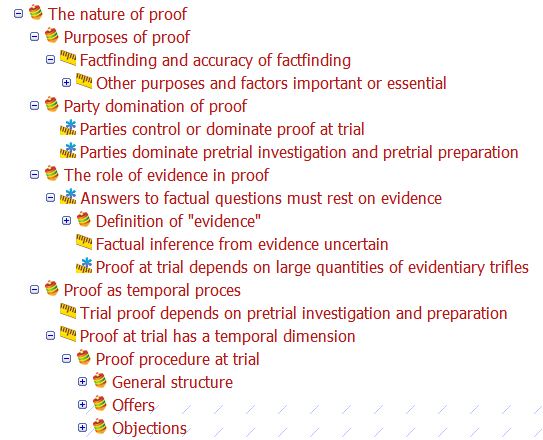
Admissibility:

Weight and sufficiency:

See the law of evidence on Spindle Law. See also this post and this post.
Proof:
Admissibility:
Weight and sufficiency:
See the law of evidence on Spindle Law. See also this post and this post.
It's here: the law of evidence on Spindle Law. See also this post and this post.


It's here: the law of evidence on Spindle Law. See also this post and this post.
"This isn't a criminal investigation, it's a scientific study." He [Sciss] stood up and continued. "What do you want--an explanation? You'll get it, don't worry."I wonder how the story unwinds. I will have to find out. It appears that a motive force underlying the plot is a struggle between statistical explanation and causal explanation! Which one prevails? Or is the victor an entirely different type of explanation? If so, what?"... This case has nothing at all in common with criminology. No offense of any kind was committed, no more than when someone is killed by a meteor."
"You mean that the operative causes are ... forces of nature," Gregory [a police detective, the novel's hero] asked....
"... Can you define those 'forces of nature' you mention so glibly? The problem in this case is strictly methodological. ..."
...
"Please look over here." [Sciss points at a map of England. The map is covered with red speckling in different degrees of density.]
... "Do you recognize the lightest area over here?"
"Yes. That's the area of Norfolk where the bodies were stolen."
"Wrong. This map shows the distribution of deaths from cancer in England for the last nineteen years. The region with the lowest death rate--that is, less than thirty percent...--falls within the boundaries of the area in which the corpses disappeared. In other words, there is an inverse proportion; I have formulated an equation to express it, but I won't go into that because you wouldn't understand it." ...
"It is your primary duty to respect the facts. Some corpses disappeared. How? The evidence suggests they walked away by themselves. Of course, you, as a policeman, want to know if anyone helped them. The answer is yes: they were helped by whatever causes shells to be dextrorotatory. But one in every ten million snail shells is sinistrorsal. This is a fact that can be verified statistically. I was assigned to determine the connection between one phenomenon and other phenomena. That's all science ever does, and all that it will ever do--until the end. Resurrection? Don't be ridiculous. The term is used much too loosely. ...[T]he corpses moved around, changed their positions in space. I agree, but the things you're talking about are nothing but facts--I have explanations!"
...
"A phenomenon is subject to analysis only if the structure of its events, as in this case, conforms to a regular pattern. ... If I were to ask why a rock falls, you would reply that it is due to the actions of gravity. Yet if I asked what gravity is, there would be no answer. But even though we don't know what gravity is, we can determine its regular pattern of action."
It's here: the law of evidence on Spindle Law. See also this post and this post.
 See Douglas Adams, Dirk Gently's Holistic Detective Agency (Pocket Books 1987).
A very belated hat tip to Alex Paykin, investigator extraordinaire!
It's here: the law of evidence on Spindle Law. See also this post and this post.


