It's here: the law of evidence on Spindle Law. See also this post and this post.

It's here: the law of evidence on Spindle Law. See also this post and this post.
My course is a seminar (I think, but I await word from the administration). My course will cover some of the usual topics -- such as fingerprint evidence, mechanical lie detectors, syndrome evidence, and the like. But my course will not focus on the "technical" aspects of these topics (though it won't ignore them). I will focus on the basic epistemological issues raised by the use of hard science, soft science, and nonscientific expert evidence. (These questions cannot be avoided.)
I have told my students they must pick and discuss two major pieces of literature with different views on some topic. I am suggesting they pick asterisked literature from the following list:
*Ellen Bass & Laura Davis, The Courage to Heal: A Guide for Women Survivors of Child Sexual Abuse (1988); Ellen Bass & Laura Davis, The Courage to Heal: A Guide for Women Survivors of Child Sexual Abuse (4th ed., 2008); Wikipedia Article
*Erica Beecher-Monas, Evaluating Scientific Evidence: An Interdisciplinary Framework for Intellectual Due Process (Cambridge 2007)
*Scott Brewer, "Exemplary Reasoning: Semantics, Pragmatics, and the Rational Force of Legal Argument By Analogy," 109 Harv. L. Rev. 923-1028 (1996)
*Scott Brewer, "Scientific Expert Testimony and Intellectual Due Process, 107 Yale L.J. 1535
*Nancy Cartwright, The Dappled World: A Study of the Boundaries of Science (Cambridge 1999, reprinted 2001 & 2003)
*Susan A. Clancy, The Trauma Myth (Basic Books 2009)
*Martin A. Conway, Recovered Memories and False Memories (Oxford 1997)
*Deidre Dwyer, The Judicial Assessment of Expert Evidence (Cambridge 2008)
*Gerald Edelman, Second Nature: Brain Science amd Human Knowledge (Yale 2006)
*David L. Faigman, Legal Alchemy: The Use and Misuse of Science in the Law (W.H. Freeman & Co. 2009, 2000)
*David L. Faigman, "The Battered Woman Syndrome and Self-Defense: A Legal and Empirical Dissent," 72 Virginia Law Review 619 (1986); David L. Faigman & Amy J. Wright, "The Battered Woman Syndrome in the Age of Science," 39 Arizona Law Review 67 (1997)
*Paul Feyerabend, Against Method (3d edn. 1993)
*James Franklin, What Science Knows and How It Knows It (Encounter Books 2009)
*Michael Friedman, Dynamics of Reason (CSLI 2001)
*Timothy van Gelder, What Is Argument Mapping? (Feb. 17, 2009)
*Alvin I. Goldman, Knowledge in a Social World (Oxford 1999)
*Goodman, Fact, Fiction, and Forecast
*Susan Haack, Defending Science -- within Reason: Bteween Scientism and Cynicism (Prometheus 2003)
*Susan Haack, Deviant Logic, Fuzzy Logic: Beyond the Formalism (Chicago 1974, 1996)
*Ian Hacking, Logic of Statistical Inference (Cambridge 1965, reprinted numerous times)
*Ian Hacking, Representing and Intervening (Cambridge 1983)
*Ian Hacking, Rewriting the Soul: Multiple Personality and the Sciences of Memory (Princeton 1995)
*Ian Hacking, The Social Construction of What? (Harvard 1999)
*Alan Hájek, The reference class problem is your problem too 156 Synthese 563 (2007)
Hanson, Is There Logic of Scientific Discovery? 38 The Australasian Journal of Philosophy 91 (1960)
Hanson, Patterns of Discovery: An Inquiry Into the Conceptual Foundations of Science (Cambridge 1958)
*Peter W. Huber, Galileo's Revenge: Junk Science in the Courtroom (1991 & BasicBooks 1993)
*E.T. Jaynes, Probability Theory: The Logic of Science (Cambridge 2003) (only for people with considerable proficiency in mathematics and probability theory)
Philip Jenkins, Pedophiles and Priests: Anatomy of a Contemporary Crisis (Oxford 1996)
E.D. Klemke, Robert Hollinger & David Rudge with A, David Kline, Introductory Readings in the Philosophy of Science (Prometheus 3d ed., 1998)
Arthur Koestler, The Act of Creation (1964, reprinted 1989)
*Bart Kosko, Fuzzy Thinking: The New Science of Fuzzy Logic (1993)
*Thomas Kuhn, The Structure of Scientific Revolutions (Chicago, 2nd ed. 1969; 3rd ed. 1996)
Imre Lakatos, Proofs and Refutations: The Logic of Mathematical Discovery (Cambridge 1976)
*John Langbein, "The German Advantage in Civil Procedure," .....; Ronald J. Allen, ...
*Elizabeth Loftus & Katherine Ketcham, The Myth of Repressed Memory: False Memories and Allegations of Sexual Abuse (1994, paperback 1996)
*Lorenzo Mangnani, Abduction, Reason, and Science: Processes of Discovery and Explanation (Kluwer 2001)
Grover Maxwell & Robert M. Anderson, Jr., eds., Induction, Probability and Confirmation (University of Minnesota 1975) (vol. VI Minnesota Studies in the Philosophy of Science)
*John Monahan, Laurens Walker & Gregory Mitchell, "Contextual Evidence of Gender Discrimination: The Ascendance of 'Social Frameworks,'" 94 Virginia Law Review 1715 (2008)
*Robert P. Mosteller, "Syndromes and Politics in Criminal Trials and Evidence Law," 46 Duke Law Journal 461 (1996)
*Matteo Motterlini, ed., For and Against Method: Imre Lakatos and Paul Feyerabend (Chicago 1999)
*National Academies of Sciences, Strengthening Forensic Science in the United States: A Path Forward (National Academies Press 2009) (online & free)
*Sidney Perkowitz, Empire of Light: A History of Discovery in Science and Art Chapter 2 (Joseph Henry Press 1996) ("Seeing Light")
*August Piper, Linda Lillevik & Roxanne Kritzer, What's Wrong with Believing in Repression?: A Review for Legal Professionals, 14 Psychology, Public Policy & Law 223 (2008)
*Michael Polanyi, Personal Knowledge: Towards a Post-Critical Philosophy (Chicago 1958, 1962)
*Karl R. Popper, Conjectures and Refutations: The Growth of Scientific Knowledge (Routledge & Kegan 1963, 1965, 1969; reprinted 1974, 1976, 1978, 1984. and 1985; 1989, reprinted 1991 & 1992)
*Karl R. Popper, The Logic of Scientific Discovery (Routledge 1959, 1968, 1972, 1980)
*Karl R. Popper, Realism and the Aim of Science (Routledge 1983, paperback 1985; reprinted 1992 & 1994)
*Dorothy Rabinowitz, No Crueler Tyrannies: Accusation, False Witness, and Other Terrors of Our Times (Wall Street Journal Book, Free Press 2003)
*Mike Redmayne, Expert Evidence and Criminal Justice (Oxford 2001)
*Daniel L. Schachter, The Seven Sins of Memory: How the Mind Forgets and Remembers (Houghton Mifflin 2001)
Tom Siegfried, Odds Are, It's Wrong: Science fails to face the shortcomings of statistics Science News (March 27, 2010)
*Alan Sokal & Jean Bricmont, Fashionable Nonsense: Postmodern Intellectuals' Abuse of Science (Picador 1998)
*David Stove, Scientific Irrationalism: Origins of a Postmodern Cult (Transaction Publishers 2001, paperback 2007)
*D.C. Stove, The Rationality of Induction (1986)
*Peter Tillers, Picturing Infference (2004 & 2005)
Mark Twain, The Tragedy of Pudd'nhead Wilson and the Comedy of Those Extraordinary Twins (1894) (available in numerous reprints)
*United States v. Shonubi, 802 F. Supp. 859 (E.D.N.Y., 1992) (Weinstein, J.) ("Shonubi I"); United States v. Shonubi, 998 F.2d 84 (2d Cir, 1993) (Oakes, Newman & Cardamone, JJ.) ("Shonubi II"); Joint Report (Testimony) of Schum & Tillers (Dec. 21, 1994) in United States v. Shonubi; United States v. Shonubi, 895 F.Supp. 460 (E.D.N.Y.) ("Shonubi III") (Weinstein, J.); United States v. Shonubi ("Shonubi IV"); United States v. Shonubi, 962 F. Supp. 370, 375 (E.D.N.Y. 1997) ("Shonubi V"(!)); Peter Tillers, "Introduction: Three Contributions to Three Important Problems in Evidence Scholarship," 18 Cardozo Law Review 1875 (1997) (draft of pertinent part of article available here); Mark Colyvan, Helen M. Regan & Scott Ferson, "Is It a Crime to Belong to a Reference Class?," in Henry E. Kyburg, Jr. & Maraiam Thalos, eds., Probability Is the Very Guide of Life 331 (2003); Peter Tillers, If Wishes Were Horses: Discursive Comments on Attempts to Prevent Individuals from Being Unfairly Burdened by their Reference Classes 4 Law, Probability and Risk 33 (2005).
*Timothy Williamson, Vagueness (Routledge 1994)
Cf. Edward Levi, Introduction to Legal Reasoning (Chicago 1949 & revised 1962); H.L.A. Hart, The Concept of Law (1961, 2d ed. 1997)
&&&
It's here: the law of evidence on Spindle Law. See also this post and this post.
Footnote: If you believe (as I do) that all probabilities about factual hypotheses are conditional probabilities [e.g., P(element 1| evidence x)], then the product rule, if applied at all, should be applied to such conditional probabilities (and not to freestanding, or unconditional, probabilities [e.g. P(element 1)].My own comment gave me the following thought(s):
Although the elements of claims or affirmative defenses -- more precisely stated, although the facts that satisfy the elements of legal claims or affirmative defenses -- may be "random variables" in the sense that they can take on various probability values, they are not random variables in the sense in which an evenly balanced die is a random variable.
The probability of an element (or, more precisely stated, the probability of a fact that satisfies an element) is conditional on evidence: i.e., P(Element n|Evidence x) -- or, more precisely stated, P(Fact n| Evidence x). That expression yields a probability: the resulting probability is a function of (i) the prior probability Fact n and, (on a Bayesian view of things), (ii) on the ratio of P(Evidence X|Fact n)/P(Evidence x|~Fact n). The same will be true for every other element of the claim or affirmative defense.
Is there any reason to assume that the chance of any probability value (between and inclusive of 0 to 1) for some Fact n given some Evidence x is equal to the chances of any other probability value between and inclusive of 0 and 1? I can't think of a valid reason why we should make this assumption. Can you? So a material fact in issue conditional on some evidence is not that sort of random variable: The correct analogue is not the equiprobability that we attach to each of the possible outcomes of an evenly-balanced die or an evenly-balanced roulette wheel, is it?Note: Even the "prior probability" Fact n is not "absolute," or unconditional: The prior probability of Fact n is conditional on "background evidence," of evidence that is present, that is there, before Evidence x "comes along," or is considered. See Hajek's convincing argument that all probabilities are conditional probabilities.
If that's correct, just what, precisely, does the expression P(Fact n| Evidence x) represent or "stand for"? If the expression represents someone's epistemic uncertainty, ... whose uncertainty would a numerical value for P of Fact n given Evidence x represent? And once we have an answer to that question, what would our answer imply (if anything) for the chances of success for a proponent of a legal claim or an affirmative defense?
These are murky waters. Perhaps it is better for me to stay away from them. (I'm no mathematician or logician. I'm just a poor ol' befuddled law teacher.)
It's here: the law of evidence on Spindle Law. See also this post and this post.
Assume that legal liability depends on elements a, b, c & d. Assume that these four elements (or, in any event, 3 of these 4 elements) can be classified either as elements of a claim [assume a civil case] or as elements of an affirmative defense. (In theory affirmative defenses could be done away with altogether -- by making all elements elements of claims.)
Assume that claimant has the burden of persuasion (assume this is defined in terms of probabilities) of slightly more than p(.5) on each element of each claim and that respondent has the burden of persuasion of slightly more than p(.5) on the negation of each element of each affirmative defense.
If the product rule (not modified for dependencies) applies to legal claims (which are assumed to consist of elements) and also to affirmative defenses (which are also assumed to consist of elements) -- and why should not the product rule apply to affirmative defenses if it applies to claims?--, does it follow that if elements a, b & c rather than just elements a & b are elements of the claim, that the claimant's burden of persuasion for the entire claim (with three elements) is roughly .125 rather than .25 (with two elements) and does it also follow that the respondent's burden (on the entire affirmative defense) rises to roughly .5 (from .25)? Can this (logically) be?
Look at the problem this way. Assume the claim has two elements a & b. Assume the affirmative defense has elements c & d. If the claimant's burden of persuasion in this situation is _roughly_ .5 on each of the four elements, does it not follow that if an affirmative defense is "in play" (because properly raised by the pleadings or otherwise), the claimant's burden on all four elements -- the conjunction of those four elements -- is roughly .0625 whereas the respondent's burden on the affirmative defense (the conjunction of not-c and not-d) is roughly .25? Is there a paradox here, a paradox about the assumption that the product rule applies here?
Put it this (equivalent?) way: If the conjunction rule applies and all four elements are elements of the claim (and there is no affirmative defense), the respondent wins if it establishes that the probability of the negation of any one element is roughly (slightly more than) .5. However, if two of the four elements are part of an affirmative defense (and if, therefore, they are not elements of the claim), respondent wins by relying only on a showing of "high" probabilities (a probability slightly greater than .5) of the negation of each of the two elements -- i.e., by showing that the probability of the negation of each element of two elements is slightly more than .5. If so, how can it be (on one horn of the conjunction paradox) that claimant's responsibility is to show (at least) that p(c & d) is roughly .25 whereas respondent must show that the probability of p(~c & ~d) is roughly .25? Doesn't the rule against self-contradiction, or the inverse relationship between the probability of some thing X and the probability of some thing ~X and the convention that probability of some thing X and the probability of the complement of X must sum to one (1) mean that the probability of the subset (c & d) and the probability of the complementary subset (~c & ~d) must equal one? If so, is it logically incoherent, self-contradictory, to assume that the product rule applies to the problem of the burden of persuasion on a claim? (My basic argument remains unchanged if you assume that the burden of persuasion on a claim requires that probability of the entire claim be slightly more than .5 -- and that this means [the other horn of the conjunction paradox] that the probabilities of some elements of a claim must be more than .5, often [depending on the number of elements] much, much more than .5. But I think the counter-riddle I have tried to describe also arises here, though in a somewhat different guise. But don't ask me to explain!)
N.B. The conjunction paradox does not go away just because alternative factual scenarios (which have facts that instantiate or satisfy an element of a legal claim) can establish a legal claim: The paradox remains. (I once worked this out to my satisfaction. But, again, please don't ask me to do so here.) But my counter-paradox (meta-paradox?) also remains, I think.
If that's the case -- if, for example, in the usual civil case the trier of fact should uphold a claim or affirmative defense with numerous elements only if it finds that the probability of the claim or affirmative defense very substantially exceeds .5 -- does it follow that the jury or trial court should almost always find that the claim or an affirmative defense has not been sufficiently established? No, I think that does not follow at all -- because if the claimant or respondent has oodles of powerful evidence to support each element, the jury or the trial court should, of course, find that the claim as a whole [or the affirmative defense] has been sufficiently established, and it probably will do so. The high probability seemingly required for the claim [or affirmative defense] as a whole speaks only [if it does so] to the question of whether an investigation will uncover evidence that sufficiently establishes a claim or an affirmative defense. Moreover, whether an investigation will uncover sufficient evidence of numerous elements of a claim or an affirmative defense depends in part on the characteristics of the part of the world that is being investigated -- and this means it may or may not be very difficult to uncover evidence that will establish all of the various elements to a very high probability. Yes? No?
But in the State of Washington the res gestae exception is half-dead (and, if the law of non-contradiction applies, half-alive [but if Zadeh's fuzzy logic applies one would say that the degree of the membership of this exception in "living hearsay exceptions" is .5 {just to be completely clear on this point}]).
How is it possible that the res gestae exception still has some life in the State of Washington? Washington's evidence code does not have a res gestae exception.
The Supreme Court of Washington (or most of it, in any event) believes that the historical meaning of the res gestae hearsay exception is material to the question of the scope of Washington State's constitutional guarantee of confrontation. The Washington court reasoned that a judicial determination of the proper contemporary meaning of the State's confrontation guarantee (which speaks of the need for a "face to face" encounter) should at least be influenced by the meaning and extent of the hearsay rule when the constitution of the State of Washington was adopted. The Washington Supreme Court said that the statements whose admissibility were in question -- statements made by a telephone caller to 911 operator -- would have fallen within the res gestae hearsay exception to the hearsay rule. State v. Pugh, 167 Wash.2d 825, 225 P.3d 892 (2009) (susbtantial relying on the 1888 edition of Greenleaf's treatise).
Wigmore might or might not have been pleased. See 1A Wigmore on Evidence Section 218 at 1888 (P. Tillers rev. 1983). But dissenting Justice Sanders was clearly displeased. Id. at 905. He asked, perhaps a bit churlishly, "What is there about 'face to face' that the majority doesn't understand?" Beyond that, he chided the majority for relying on the discredited res gestae exception. He noted that Wigmore "criticize[d] the exception as 'most frequently used merely as a cover for loose ideas and ignorance of principles.'" Id. at 906 n. 2. In addition to that, that Justice Sanders said:
¶ 58 This provision could not be clearer: “In criminal prosecutions, the accused shall have the right ... to meet the witnesses against him face to face.” Const. art. I, § 22. We have previously determined an independent analysis of our confrontation clause is warranted. State v. Foster, 135 Wash.2d 441, 473, 481, 957 P.2d 712 (1998) (Alexander, J., concurring in part, dissenting in part; C. Johnson, J., dissenting); State v. Shafer, 156 Wash.2d 381, 391, 128 P.3d 87 (2006). The majority thus correctly turns to the text of our constitution and the law in place at the time of its ratification. Yet here the majority soon goes astray.Id. at 905-906.¶ 59 The text of our constitution is clear. Article I, section 22 states whom the defendant in a criminal case is entitled to meet-the “witnesses against him”-and how he is entitled to meet them-“face to face.” Our early cases construed this requirement in accordance with its plain language: “[t]his means that the examination of such a witness shall be in open court, in the presence of the accused, with the right of the accused to cross-examine such witness as to facts testified to by him....” State v. Stentz, 30 Wash. 134, 142, 70 P. 241 (1902), abrogated on other grounds by State v. Fire, 145 Wash.2d 152, 34 P.3d 1218 (2001). But the majority nevertheless argues the clause must not be read literally, for to do so would eliminate all hearsay exceptions. Majority at 897-98. However if a hearsay exception conflicts with our constitution, this court simply has no authority to choose the exception over the constitution.
¶ 60 Our constitution proclaims, “[w]e, the people of the State of Washington ... do ordain this constitution.” Const. pmbl. It is the people who ratified our constitution, and “the constitution is the expression of the people's will, adopted by them.” State ex rel. Albright v. City of Spokane, 64 Wash.2d 767, 770, 394 P.2d 231 (1964) (emphasis added). Therefore in analyzing the constitutional text “the intent to be determined is that of the people who ratified the document rather than the intent of the handful of men who wrote it.” Robert F. Utter, Freedom and Diversity in a Federal System: Perspectives on State Constitutions and the Washington Declaration of Rights, 7 U. Puget Sound L.Rev. 491, 511 (1984). Thus, “[a]ppropriate constitutional analysis begins with the text and, for most purposes, should end there as well.” Malyon v. Pierce County, 131 Wash.2d 779, 799, 935 P.2d 1272 (1997).
¶ 61 But our majority takes exactly the opposite approach. It looks not to the intent of the people who ratified our constitution in 1889, best illuminated by its text, but the res gestae exception to the hearsay rule of evidence as it was at the time.FN2 Presumably the majority believes if those who wrote the constitution were aware of res gestae as a rule of evidence, they must have intended to subordinate the clear text to it. But the people did not ratify the res gestae doctrine. The people ratified just the opposite, a text so plain its meaning is unmistakable. Admittedly, the meanings of words may change. Thus we might rightfully “inquire about the accepted meaning of the words at the time the provision was adopted,” Utter, supra, at 509 (citing State v. Brunn, 22 Wash.2d 120, 139, 154 P.2d 826 (1945)), because “[c]onstitutions being the result of the popular will, the words used therein are to be understood ordinarily in the sense that such words convey to the popular mind,” State ex rel. State Capitol Comm'n v. Lister, 91 Wash. 9, 14, 156 P. 858 (1916). But it hardly seems necessary to examine whether the popular meaning of “face to face” has changed over the past hundred-odd years. A textual analysis “includes the words themselves, their grammatical relationship to one another, as well as their context.” Malyon, 131 Wash.2d at 799, 935 P.2d 1272. Thus we repair to the words, grammar, and context of our confrontation clause, rather than the subtleties of an obscure evidence rule relating to res gestae.
It's here: the law of evidence on Spindle Law. See also this post and this post.
It's here: the law of evidence on Spindle Law. See also this post and this post. |
It's here: the law of evidence on Spindle Law. See also this post and this post.
It's here: the law of evidence on Spindle Law. See also this post and this post.
A South Australian police task force into child sex abuse within the Anglican Church had identified 217 victims and 48 possible offenders, police said today.
However the number of victims could rise to more than 400 as investigations continued, Police Commissioner Mal Hyde said.
Mr Hyde today likened the scale of police investigations into child sex abuse to those for the infamous Snowtown bodies-in-the-barrels murders in 1999.
"We have well over 200 matters to follow through on at this stage, with the possibility of that number increasing significantly," he told reporters.
"By anyone's measure that's a very, very significant and complex investigation to carry forward.
"I certainly don't know of any similar investigation on this scale within this state.
"The Snowtown case would have to rank up there but in a different kind of way."
Of the 217 victims identified, police said 136 cases involved the Anglican Church while the others related to other churches and organisations.
It's here: the law of evidence on Spindle Law. See also this post and this post.

A Westminster police detective and a corrections officer were charged Tuesday in the alleged rape and kidnapping of a 25-year-old restaurant worker in Ontario.
Westminster Police Det. Anthony Nicholas Orban, 30, was arrested Saturday on suspicion of kidnapping the woman at Ontario Mills Mall and raping her at gunpoint. Corrections Officer Jeff Thomas Jelinek, 30, from the Chino Institution for Men, was arrested on suspicion of carjacking and is being as an accessory to the crime.
It's here: the law of evidence on Spindle Law. See also this post and this post.
A Colonial School District math teacher was jailed today after allegedly engaging in sexual activity with one of his middle school students and soliciting nude photos from another.
It's here: the law of evidence on Spindle Law. See also this post and this post.
| Associated Baptist Press (April 5, 2010), http://www.abpnews.com/content/view/5017/9/: Catholic sex-abuse cases share window in Baptist house |
| By Norman Jameson | ||
| Monday, April 05, 2010 | ||
(ABP) -- It's easy for non-Catholic Christians to observe from a distance the clergy sex-abuse controversies that torment the Catholic Church. We take comfort that the deviant behavior of sick "celibate" priests did not occur within the confines of our own churches. ... Sex abuse in the church is not a Catholic crisis alone. A skeptical public repulsed at news of a priest abusing 200 deaf boys lumps local church leaders into the same putrid pot. All Christians are stained in the sweep of the same broad brush, but a Baylor University School of Social Work study released last fall suggests that tainting is not without foundation. The study found just over 3 percent -- or seven women in a typical congregation with 400 adult members -- have been victims of clergy sexual misconduct since they turned 18. American Catholics have instituted rules that immediately and forever remove a man from the priesthood who is shown to be guilty of abuse. The pope apologized for the sexual abuse of minors and pledged that pedophiles would not be allowed to become priests in the Catholic Church. The Vatican even instituted reforms to prevent future abuse in the U.S. by requiring background checks for church employees and issued new rules disallowing ordination of men with "deep-seated homosexual tendencies." Sex-abuse cases also rock Baptist churches. Individually they are just as bad, and collectively we are doing a lot less than the Catholics about resolution. Southern Baptists as a national entity have nothing in place to prevent abusers from carrying their satchels of pain to another church or to yank credentials from an abusive clergyman. A motion to institute a national registry of abusers was rejected by the Southern Baptist Executive Committee in 2008 on the basis of church autonomy. The Executive Committee recommended instead that churches run background checks through an already available U.S. Department of Justice system. That system contains names only of those convicted of a crime and not those times when a church forces a minister to leave and keep the reasons unstated to avoid lawsuits or embarrassment. We want to forgive and redeem, so we too easily accept apologies and promises of the offender never to do it again. Several websites list Christians charged with sex abuses and crimes, and a shocking number of them are Baptists. The list of stories related to the arrest of Baptist church staff across the country for crimes against members of their flocks stretches on and on. ... Writing recently about churches and sexual abuse, Christian ethicist David Gushee said: "The Baptist situation may be no better than the Catholic, only shielded more deeply from view. This situation demands reform, immediately, for the sake of the vulnerable and abused children among us -- not to mention for the sake of the gospel witness, so desecrated by the abuse behind our stained glass windows." | ||
It's here: the law of evidence on Spindle Law. See also this post and this post.
Question 1. Does this case have a connection with the issue of celibacy? Question 1A. Are celibate male clergy members more likely to stalk and sexually assault women than non-celibate male clergy are? Is that hypothesis counterintuitive? Are there statistics to back up that hypothesis?
Question 2. Do non-celibate non-Catholic male clergy members stalk and sexually assault women more often than celibate Catholic clergy members do?
Question 3. What is newsworthy about this story about a male Catholic priest who sexually assaulted a woman? Has no Protestant male clergy member recently sexually assaulted a woman? I don't understand the point of the story -- unless, that is, I impute base motives or prejudices to the New York Times.
Proof:
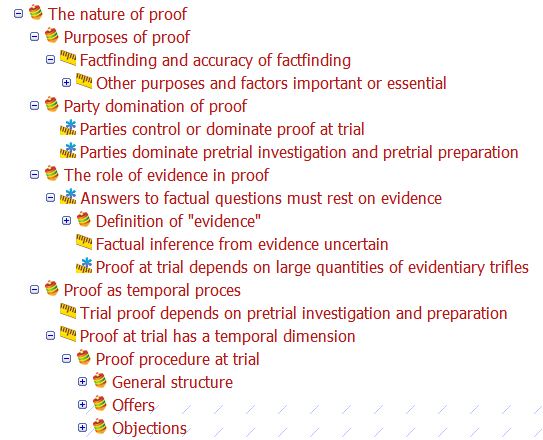
Admissibility:

Weight and sufficiency:

See the law of evidence on Spindle Law. See also this post and this post.
It's here: the law of evidence on Spindle Law. See also this post and this post.


It's here: the law of evidence on Spindle Law. See also this post and this post.
"This isn't a criminal investigation, it's a scientific study." He [Sciss] stood up and continued. "What do you want--an explanation? You'll get it, don't worry."I wonder how the story unwinds. I will have to find out. It appears that a motive force underlying the plot is a struggle between statistical explanation and causal explanation! Which one prevails? Or is the victor an entirely different type of explanation? If so, what?"... This case has nothing at all in common with criminology. No offense of any kind was committed, no more than when someone is killed by a meteor."
"You mean that the operative causes are ... forces of nature," Gregory [a police detective, the novel's hero] asked....
"... Can you define those 'forces of nature' you mention so glibly? The problem in this case is strictly methodological. ..."
...
"Please look over here." [Sciss points at a map of England. The map is covered with red speckling in different degrees of density.]
... "Do you recognize the lightest area over here?"
"Yes. That's the area of Norfolk where the bodies were stolen."
"Wrong. This map shows the distribution of deaths from cancer in England for the last nineteen years. The region with the lowest death rate--that is, less than thirty percent...--falls within the boundaries of the area in which the corpses disappeared. In other words, there is an inverse proportion; I have formulated an equation to express it, but I won't go into that because you wouldn't understand it." ...
"It is your primary duty to respect the facts. Some corpses disappeared. How? The evidence suggests they walked away by themselves. Of course, you, as a policeman, want to know if anyone helped them. The answer is yes: they were helped by whatever causes shells to be dextrorotatory. But one in every ten million snail shells is sinistrorsal. This is a fact that can be verified statistically. I was assigned to determine the connection between one phenomenon and other phenomena. That's all science ever does, and all that it will ever do--until the end. Resurrection? Don't be ridiculous. The term is used much too loosely. ...[T]he corpses moved around, changed their positions in space. I agree, but the things you're talking about are nothing but facts--I have explanations!"
...
"A phenomenon is subject to analysis only if the structure of its events, as in this case, conforms to a regular pattern. ... If I were to ask why a rock falls, you would reply that it is due to the actions of gravity. Yet if I asked what gravity is, there would be no answer. But even though we don't know what gravity is, we can determine its regular pattern of action."
It's here: the law of evidence on Spindle Law. See also this post and this post.
 See Douglas Adams, Dirk Gently's Holistic Detective Agency (Pocket Books 1987).
A very belated hat tip to Alex Paykin, investigator extraordinaire!
It's here: the law of evidence on Spindle Law. See also this post and this post.
A partial proof that what I have just said is true:
P. Tillers, "Webs of Things in the Mind: A New Science of Evidence," 87 Michigan Law Review 1225, 1251-1252 (1989):
It's here: the law of evidence on Spindle Law. See also this post and this post.


