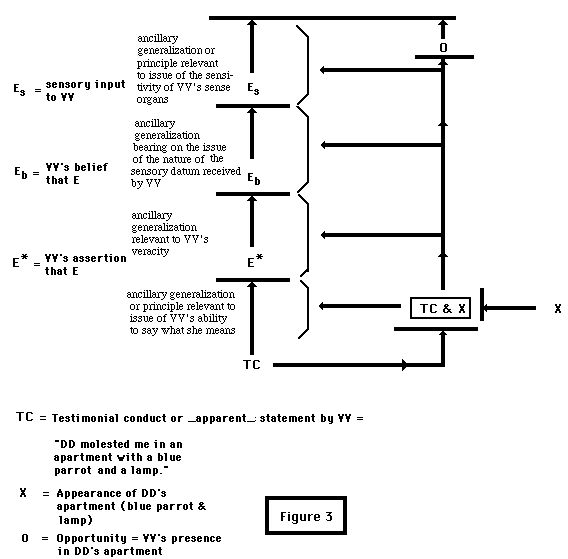
 The paper "Hearsay Logic" (8.5 MB) by Peter Tillers & David Schum is now available here.
Thursday, February 09, 2006
Hearsay Logic
The paper "Hearsay Logic" (8.5 MB) by Peter Tillers & David Schum is now available here.


A Pilgrim's Tale: Bayesian Dragons and Other Illusions
 I recently decided to post on the web some of my older papers that either are not available on LEXIS or WESTLAW or are available only in an imperfect form (because of the inability of the LEXIS and WESTLAW databases to reproduce diagrams, charts, and similar matter). Hence, Dear Reader, you can now peruse my disquisition about the "New [sic; see below] Evidence Scholarship," a disquisition that takes the form of a homily or parable about Bayesian dragons and other illusions.
The new evidence scholarship is no longer as new as it once was: this new type of scholarship has been in existence for more than 30 years. A few curmudgeons have asserted that there never was anything really new about the New Evidence Scholarship. Some meticulous observers see precursors in 17th century and 18th century literature on probability, and other observers trace the origins of NES to Classical Antiquity. These curmudgeons are, of course, correct -- to some degree. The New Evidence Scholarship is not wholly original. But it is significantly different from its ancestors. For example, some tools used by some New Evidence Scholars -- e.g., fuzzy sets, computer-generated images, certain statistical methods, probabilistic inference networks -- did not even exist until the second half of the twentieth century.
Monday, February 06, 2006
A New Science of Evidence
The following essay is now available on SSRN: Peter Tillers, "Webs of Things in the Mind: A New Science of Evidence," 87 Michigan Law Review 1225 (1989). This essay is available at the URL http://ssrn.com/abstract=880130.
The version of the essay available at SSRN, unlike the version available from the LEXIS and WESTLAW databases, accurately reproduces various diagrams that are central to the argument of the essay.
Sunday, February 05, 2006
Unnatural Lie Detectors
Ordinary people may ordinarily be lousy lie detectors under ordinary circumstances. Granted, this possible state of affairs may be a parlous one. But the question is this:
Do you have a better alternative?
Some people think they are on the verge of developing a better lie detector. And some people apparently even think that they have already acquired a high-tech key to the truth. See the entertaining and nuanced article, "Looking for the Lie," by Robin Marantz Henig in today's issue of the NYTimes Sunday Magazine (Feb. 5, 2006).
Henig recognizes, as many students of lie detector devices do not, that the accuracy of a testimonial report does not depend solely on the extent to which the testimonial source seeks to report the belief that he or she actually has. Many people genuinely hold foolish and false beliefs, and people sometimes inadvertently make assertions that they do not mean to make.
Ah, were it only possible to devise a machine that could "detect" all possible causes of errors in testimonial reports! Then we really would have a shortcut to proof and we could dispense with these complicated, expensive, and ridiculous proceedings called trials.
But it appears that a sucker is still born at least every minute or so. Consider, for example, Henig's account of the "holistic" lie detection method that Paul Ekman apparently peddles to law enforcement agencies. Ekman uses a lie detection procedure that employs a system of classification that he calls the "Facial Action Coding System." I have no doubt that Ekman has empirically verified the diagnostic power of all of the 10,000 or so significantly distinct facial expressions that he believes are generated by combinations of 43 independent muscles. (The article explains that Ekman also identifies other putative signs of credibility or incredibility.) In the NYTimes article Henig reports that Ekman stated that he has a "a rule that prohibits him from commenting on any elected official currently in office, no matter how tempting a target." The implication is that Ekman's sense of ethics leads him to adhere to this rule. One wonders if another motivation for Ekman's rule might be Ekman's fear that the use of his method to diagnose the veracity of contemporary public figures might cast some doubt on the degree of the accuracy -- 95% or so, no less -- that Ekman claims that his system of lie detection achieves. (Of course, the 95% statistic needs to be refined. I have a foolproof method for catching all lies. My method amounts to this: Declare that all testimonial reports -- except my own -- are lies.)
Thursday, February 02, 2006
Startling Statistics about Law Review Subscriptions
The 2006 Green Bag Almanac reports (at p. 260) that subscriptions to the "top ten" U.S. student-edited law reviews have declined in the following way from 1979-80 to 2004-05, respectively:
Yale:
4462 and 2579Harvard:
9064 and 3451Stanford:
1546 and 1112Columbia:
4014 and 1875NYU:
2105 and 1209Chicago:
2068 and 1845Pennsylvania:
2250 and 1180Michigan:
2950 and 1419Virginia:
2506 and 644Northwestern:
1826 and *
The above asterisk [*] means that "data is missing for this year." Circulation figures for Northwestern's law review were missing from 1995-96 through 2004-05, for ten years. The last reported circulation figure for that journal was 723, in 1994-95, which was then the lowest of the "top ten."Do the above statistics mean that major US law journals are being consigned to history's dustbin? Or does it merely mean that readers are accessing the journals with LEXIS or WESTLAW?
The second hypothesis is not clearly supported by the statistics collected at p. 260: subscriptions began declining sharply before the internet became a standard method of doing legal research.
It would be interesting to see if "major U.S. courts" now cite law the "major law journals" less than they did in 1979-80.
The circulation for Stanford Law Review spiked to 8850 in 2000-01. Does anyone know why?
The figures show that Chicago's circulation declined less than that of other law journals. Of course the figures also show that few people ever subscribed to Chicago's law journal.
Practice Makes Perfect
 Police Constable Mark Milton, of the UK, was acquitted of dangerous driving. The district judge who acquitted Milton said that the good constable had been "driving for police purposes." The district judge said that the good constable was driving for police purposes because the good constable drove a police car in excess of the police limit to "hon[e] his driving skills." In fact, the good and diligent constable drove a police car at 159 miles per hour. The High Court ordered a retrial. (Double jeopardy means something different in the UK than it does in the US; i.e., the principle of no double jeopardy now seems to mean very little in the UK.) Lady Justice Hallett, sitting with Mr Justice Owen, noted that Police Constable Milton had reached "eye watering speeds." See Independent Online Edition (Feb 2, 2006). All is once again well in those sceptr'd isles.
Saturday, January 28, 2006
Industrial-Style Scholarship; and, "Richard Posner, sub silentio, on Performance Measures and Scholarly Creativity"
Judge Richard Posner writes (see Becker-Posner Blog):
Quality of research is readily measurable by grants, prizes, and above all by citations to the professor's scholarly publications, weighted by the quality of the journal in which the citations appear.A Relatively Trivial Question:
Do citations in judicial opinions count?
A Less Trivial Question (Set of Questions):
What determines the "quality of the journal"? Common scholarly consensus?
This benchmark for the quality or standing of a journal presents problems of circularity that famously dog Frye, which attempts to measure scientific validity for forensic purposes by scientific consensus.There are deep problems here.One unavoidable question about the Frye and Posner measures of quality: Which scientists' or legal scholars' consensus counts? For example, is the validity of astrology to be determined by referring to the opinions of astrologers? Astronomers? Amateur astronomers? Reputable astronomers? Astronomers employed by universities or observatories? Astronomers employed by reputable universities or reputable observatories? Astronomers employed by wealthy universities or large observatories? Isaac Newton? Similarly (and more seriously), for example, whose opinions about fingerprint identification count for purposes of determining the scholarly or scientific standing of a scholarly or scientific journal in which a paper about fingerprint identification is published?Or are we to say that the scholarly standing of a journal is to be determined by the wealth and influence of the academic institution (if any) with which it is affiliated?Or is the scholarly standing of a journal determined only by circulation figures? If so, do Slate, Legal Affairs, and, indeed, the New York Daily News have (much) greater scholarly standing than the Harvard Law Review?
Is Posner's use of "quality of the journal" benchmark closely analogous to "short-term-winners' history"? Question: Do you predict that the Journal of Legal Studies will be widely read -- by reputable scholars :-) -- in, say, 50 years -- viz., do you predict that it will be more widely read than some other possible benchmarks of scholarly quality from our era? Another question: In some future generation will we measure the quality and originality of a scientist's or scholar's work by examining journals from the (alleged) scholar's era or from our own? But: If future generations will look to the opinions of their era to measure our originality, how shall we, in our own time, assess the quality and the originality of our contemporaries' (allegedly) scientific or scholarly work; i.e., what are we to do in the meantime, while we await the verdict of history on our work and the work of our colleagues? Living a long life is a partial solution to this problem. But it is only a partial solution -- because what happens in the meantime matters.
Wednesday, January 25, 2006
Old-Fashioned Scholarly Virtues
Professor Dr. Lorenzo Perilli, "What Researchers Really Want," 86 Humboldt Kosmos 46 (Dec. 2005):
Peace, time and trust. These three words sum up what research really needs. The demands of day-to-day research are just the opposite: haste, immediate results and accepting mistrustful controls. What counts is the quantity. You have to see to it that you publish as much as you can and get cited as often as possible. At the end of the day, publications and citations are simply lumped together and counted. Whether the work is of low quality or even insignificant is of no interest. ...Scientific progress, whether it be in the humanities or the natural sciences, often evolves from originality, from turbulences in the calm flow of routine. But originality is not recognised and accepted. It takes time for new and unusual ideas to establish themselves. If a citation index or an impact factor (i.e., the principle of "let's see how often I'm cited"), both of which are being applied more and more nowadays, had been used to assess the value of young Albert Einstein's or Kurt Goedel's work, a research proposed by either of them would never have attained a position in the academic world.
Tuesday, January 24, 2006
Conference: Visual and Graphic Representations of Evidence and Inference in Legal Settings
 Mark your calendar: Cardozo School of Law will host a conference on
 Dates: January 28-29, 2007.
Venue: Cardozo Law School, Yeshiva University, 55 Fifth Avenue (5th Ave. & 12th St.), New York (Manhattan), New York
Henry Prakken (Utrecht University) is the chair of the program committee; Thomas Cobb (University of Washington) is the deputy chair of the program committee. Peter Tillers is the conference chairman.
Panelists:
The public is invited. There is no registration fee. (However, there will be a modest charge for any lunches or dinners that attendees elect to take at the site of the conference, at Cardozo Law School.)Thomas D. Cobb (University of Washington School of Law)
Philip Dawid (U. College London)
Neal Feigenson (Quinnipiac University School of Law)
Branden Fitelson (U. of California at Berkeley)
Tim van Gelder (U. of Melbourne)
Thomas F. Gordon (FOKUS [Frauenhofer Institut fuer Offene Kommunikationssysteme]); web log
John Josephson (Ohio State University)
Marc Lauritsen (CEO, Capstone Practice Systems)
Richard Lempert (U. of Michigan Law School & National Science Foundation)
Ronald P. Loui (Washington University, St. Louis; Computer Science)
Jennifer Mnookin (UCLA School of Law)
Dale Nance (Case School of Law)
Andrew Palmer (U. of Melbourne, Law)(unconfirmed)
Priit Parmakson (Tallinn University, Tallinn, Estonia)
John L. Pollock (U. of Arizona)
Henry Prakken (Utrecht University & U. Groningen)
Chris Reed (U. of Dundee)
Burkhard Schafer (U. of Edinburgh, Law School)
David Schum (George Mason U.)
Richard Sherwin (New York Law School)
Samuel Solomon (CEO of DOAR, Inc.)
Peter Tillers (Cardozo Law School, Yeshiva University)
William Twining (U. College London, Law Faculty & U. of Miami, School of Law)
Bart Verheij (U. Groningen, Dept. of Artificial Intelligence; ALICE Institute)
Vern Walker (Hofstra U. School of Law)
Douglas Walton (U. of Winnipeg)
Program details will be provided later.
Conference: Visual and Graphic Representations of Evidence and Inference in Legal Settings
Mark your calendar: Cardozo School of Law will host a conference on Dates: January 28-29, 2007.
Venue: Cardozo Law School, Yeshiva University, 55 Fifth Avenue (5th Ave. & 12th St.), New York (Manhattan), New York
Henry Prakken (Utrecht University) is the chair of the program committee; Thomas Cobb (University of Washington) is the deputy chair of the program committee. Peter Tillers is the conference chairman.
Panelists:
The public is invited. There is no registration fee. (However, there will be a modest charge for any lunches or dinners that attendees elect to take at the site of the conference, at Cardozo Law School.)Thomas D. Cobb (University of Washington School of Law)
Philip Dawid (U. College London)
Neal Feigenson (Quinnipiac University School of Law)
Branden Fitelson (U. of California Â? Berkeley)
Tim van Gelder (U. of Melbourne)
Thomas F. Gordon (FOKUS [Frauenhofer Institut fuer Offene Kommunikationssysteme]); web log
John Josephson (Ohio State University)
Marc Lauritsen (CEO, Capstone Practice Systems)
Richard Lempert (U. of Michigan Law School & National Science Foundation)
Ronald P. Loui (Washington University, St. Louis; Computer Science)
Jennifer Mnookin (UCLA School of Law)
Dale Nance (Case School of Law)
Andrew Palmer (U. of Melbourne, Law)(unconfirmed)
Priit Parmakson (Tallinn University, Tallinn, Estonia)
John L. Pollock (U. of Arizona)
Henry Prakken (Utrecht University & U. Groningen)
Chris Reed (U. of Dundee)
Burkhard Schafer (U. of Edinburgh, Law School)
David Schum (George Mason U.)
Richard Sherwin (New York Law School)
Samuel Solomon (CEO of DOAR, Inc.)
Peter Tillers (Cardozo Law School, Yeshiva University)
William Twining (U. College London, Law Faculty & U. of Miami, School of Law)
Bart Verheij (U. Groningen, Dept. of Artificial Intelligence; ALICE Institute)
Vern Walker (Hofstra U. School of Law)
Douglas Walton (U. of Winnipeg)
Program details will be provided later.
Saturday, January 21, 2006
How To Do Legal Scholarship
 Rosa Brooks at LawCulture recently posted a blog Goodbye to Law Reviews?. This post, which tweaks the name of a famous law review article by Fred Rodell, Goodbye to Law Reviews, 23 Va. L. Rev. 38 (1936), has precipitated a stream of comments, mostly by law teachers. Many of those comments are interesting -- to law teachers, in any event.
I won't try to participate in extensive and careful discussion of the many interesting points found in Rosa Brooks' original post and the comments on her blog site and elsewhere about her post. Nevertheless, I would like make to some scattered comments here:
1. "What is worthy legal scholarship?" and "What sorts of intellectual activities will enhance the career prospects of the actor?" are separate questions even if they are not (one hopes) completely unrelated.
2. Fashions in scholarship -- including legal scholarship - change, sometimes dramatically. For example, several decades ago substantial segments of both the right and the left in the U.S. legal academic world proclaimed that legal treatises are an inconsequential form of scholarship -- if, that is, legal treatises are scholarship at all.
But the left and the right differed on the appropriate alternative to the legal treatise. The right -- i.e., some prominent folks in the law and economics crowd -- preferred the monograph. And by "monograph" these folks were referring mainly to articles about 10-15 pages long published in peer review journals, mainly in journals that counted only economists as "peers." The left -- i.e., some prominent Critical Legal Studies people -- pooh-poohed (sp?) -- in law journals -- all forms of legal scholarship; the idea of scholarship was thought to be incoherent, nonsensical.) Although it is no longer fashionable to sneer at legal treatises, publishers and other knowledgeable sources report that today it is difficult to recruit competent legal scholars to write or revise legal treatises.
3. The comments on LawCulture and elsewhere generally assume that the possible contenders to the throne of scholarship are the following: law review articles, books, newspaper articles, and blogs. But this list of possibilities does not range widely enough and it is insufficiently refined.
4. Fashions in legal scholarship are not just fashions. Fashions in scholarship can do great damage to career prospects. The fashions that prevail in the "major" student-edited journals can do such damage -- principally because there are many narrow-minded, rankings-minded, and hierarchically-minded law teachers and deans who put a big premium on publication in such journals. But when faced with necessity one makes do! I would urge junior scholars to consider the legal treatise as an an alternative outlet for your creative and unconventional scholarly energies."Books" should be divided (at least) into: (i) book-length monographs, (ii) mass market books, and (iii) legal treatises. Given my personal history, I am tempted to add (iv) "revisions of legal treatises." And I herewith do so. (This -- the revision -- is a form of scholarship that was well known in the middle ages and one that is still popular in the UK.) We should think not just about "law reviews" as vehicles for scholarly articles. We should distinguish (as some bloggers did) between (i) student-edited U.S. law journals, (ii) peer review journals, (iii) "foreign" (e.g., Canadian ) law journals, and (iv) journals in other fields that welcome papers about legal topics. Some forms of scholarship may not take the form of text. For example, it is possible that a software program is "scholarship," even legal scholarship. It is possible that a graph is scholarship. It is possible that a film is scholarship. It is possible that a painting is scholarship.
But there are downsides for scholars who decide to write legal treatises. One very big downside is many law teachers -- the people who hold the academic fortunes of junior scholars in their hands -- read legal treatises in their field only years and, more often, only decades after publication -- and even then in many instances law teachers, lemming-like, read only short extracts from legal treatises. So the legal treatise offers no promise of a meteoric career in legal academia. But if a legal scholar has no choice, she or he does what is possible. And the legal treatise at least can have a very long shelf life and the renown it may bring may be some comfort to the legal scholar in the twilight of his or her professional life.You have more freedom to make a legal treatise be what you want it to be. If you want your treatise to be scholarly, original, and, yes, unconventional, you have the freedom to make your treatise be like that. Keep in mind that many very intelligent people choose to practice rather than teach law. (It is even possible that there are more intelligent and talented people in law practice than in the law academy. Do not make the bad mistake of underestimating the intelligence of your audience.) Keep in mind that books, more often than law journal articles, have an impact years and decades after publication. Keep in mind that judges and legislators use legal treatises. And keep in mind that legal treatises can generate substantial income for their authors.
5. The tastes of student editors of law journals are not the only reason why fashions in legal scholarship can stifle original thought and important new directions in research and scholarship. Fashions among one's peers can also have this perfidious effect. But fashions in scholarship can also stifle thought and originality because of the tendency of many scholars (perhaps particularly younger and therefore more vulnerable scholars) to internalize scholarly fashions -- to kowtow to academic fashion. My most heartfelt recommendation is that you write what you really think and believe and tell yourself to let the devil take the hindmost. If you adopt this attitude, there is no guarantee that you will say interesting things or that your peers will think that you have said interesting things. But the strategy of using your own compass (and shedding your fears) at least creates the possibility that you will do original work. And if you labor hard enough and long enough, the chances are excellent that you will in fact contribute in a significant way to humankind's understanding of the world. This is what I believe.
6. Do keep in mind that it is possible to become a full-time author of legal treatises. Not many people manage to do this or want to do this. But it is a possibility, and it is a possibility worth thinking about.
Friday, January 20, 2006
Gliterati in the Blogosphere
This brand new blog is both entertaining and thoughtful; this blog practically glitters: LawCulture.
I have to restrain myself. I want to post comments about every provocative posting on this new cybersite. But I really can't afford to spend even more time on an activity that the producers of LawCulture say is not scholarship. Woe is I!
But question: If blogs are not worthy legal scholarship, what motivates the authors of LawCulture to blog? Are they after fortune? Fame? A judgeship? Power and influence? Catharsis? Sainthood? Community? Liberty? Some combination of these things (and other things?)?
Thursday, January 19, 2006
The Rule of Law
 Albert Gore recently gave a brilliant speech on the the rule of law. He talked about executive branch surveillance of domestic communications and about other matters. See Gore Speech. I have not been a fervent admirer of Albert Gore. But this speech made me very much wish that he rather than Bush were President.
Tuesday, January 17, 2006
Does This Test Pass the Smell Test?
Well, the question is hard to answer -- because this test is the smell test:
Donald G. McNeil, Jr., Dogs Excel on Smell Test to Find Cancer, NYTimes Online (January 17, 2006).
Monday, January 02, 2006
Riding While Under the Influence: Is a Horse a Vehicle?
 The Pennsylvania Supreme Court recently held that riding (a horse) while under the influence of alcohol does not constitute driving (a vehicle) while under the influence of alcohol. Commonwealth v. Noel et al., 579 Pa. 546, 857 A.2d 1283 (Sept. 22, 2004).
Lon Fuller, where are you? And what does fuzzy or rough set theory have to say about this case?
The applicable Pennsylvania DUI statute prohibited not the operation of a motor vehicle, but the operation of a vehicle simpliciter.
Another section of Pennssylvania's Motor Vehicle Code -- Section 3103(a) -- provided:
Every person riding an animal or driving any animal-drawn vehicle upon a roadway shall be granted all of the rights and shall be subject to all of the duties applicable to the driver of a vehicle by this part, except those provisions of this part which by their very nature can have no application or where specifically provided otherwise.The Supreme Court held that Section 3103(a) was unconstitutionally vague.
This kind of case is bound to provoke a judge to write a witty dissent. And Justice Eeakin did not disappoint. He wrote (in part):
A horse is a horse, of course, of course,Ray Evans and Jay Livingston, Mr. Ed, (CBS, 1961-1966).
And no one can talk to a horse of course
That is, of course, unless the horse is the famous Mr. Ed.Go right to the source and ask the horse
He'll give you the answer that you'll endorse.
He's always on a steady course.Talk to Mr. Ed.Mr. Ed would know which sections of Part III do not "by their very nature" apply to his rider, and I attribute the equivalent horse sense to the ordinary reasonable person. Because I cannot agree § 3103(a) of the Vehicle Code is unconstitutionally vague, I offer my respectful dissent.
***
Due process simply requires the statute in question to contain reasonable standards to guide prospective conduct. Id. (citations omitted). The majority rides far afield, wondering whether an equestrian could be cited for driving the horse over a fire hose ( § 3708), or on a sidewalk ( § 3703), or whether § 3746 requires a person falling off a horse to notify police. The answer to the first two is "of course." *** As for the third hypothetical, the situation remains one of common sense; any ambiguity in this section involves the word "accident," not its application to equestrians. ***
Besides, appellant is charged with DUI, not a fire hose or sidewalk violation. *** It is not within the purview of this Court to adjudicate the rights of hypothetical individuals engaged in hypothetical conduct. Id. We could fashion imaginary fact situations until the livestock returns to the barn, but that is not proper constitutional analysis.
Trotting through Part III, it is not difficult to discern which statutes "by their very nature" cannot apply to equestrians. ***
These are statutes "by their very nature" not applicable to animal drivers; interestingly, they are not by nature applicable to the driver of a car, either. It is the "rules of the road" that apply to the driver of the mustang and Mustang alike. Here, an ordinary person of common intelligence would know that riding a horse while intoxicated would be a violation of § 3731, just as the same person would recognize that the rider of a horse must stop at a stop sign, ride on the right side of the road, and signal before turning. ***
A horse is a horse, of course, of course,Because I cannot agree this statute is vague or ambiguous, I respectfully dissent.
but the Vehicle Code does not divorce
its application from, perforce,
a steed, as my colleagues said."It's not vague" I'll say until I'm hoarse,
and whether a car, a truck or horse
this law applies with equal force,
and I'd reverse instead.
Tuesday, December 27, 2005
The Law of Disorderly Conduct
 One of the controversies about the 2000 US Presidential election was over spoiled ballots -- for example, about ballots on which scratches were made but no holes were punched and about ballots that were punched two or three times instead of the one time that the voting instructions mandated. I remember there was much talk about inferring the intentions of the voters in such instances. I also remember that I ventured the opinion (an opinion which achieved no resonance) that in many instances voters probably deliberately diddled and daddled and acted in strange and non-purposive ways -- that, for example, they mutilated ballots just because they felt like mutilating ballots and had no other reason or discernible reason for doing so. Do you think that in fact a substantial number of voters might have acted in such seemingly odd -- or, in any case, inexplicable -- ways when they entered the voting booth? If so, perhaps you will agree with me that there may be at least an allusive connection between it is bit and the drawing of inferences about human behavior. Perhaps one of the hypotheses that ought to be in play when we attempt to infer what a human being did (is doing or will do) is that the possibility that the human behavior in question (whatever it was) was unmotivated by any discernible purpose or principle and was not explicable by reference to any rule of any sort. So perhaps it is possible that human behavior, like events at the quantum level, is to some extent fundamentally inexplicable and unpredictable. Professor Anton Zellinger of Vienna recently said (Dennis Overbye, Quantum Trickery: Testing Einstein's Strangest Theory, NY Times Online (Dec. 27, 2005):
The world is not as real as we think.Is it possible that human beings are also more weird than most academic observers seem to think?My personal opinion is that the world is even weirder than what quantum physics tells us.
What Is the Moral, for the Law of Evidence, of "It from Bit"?
 Dennis Overbye, Quantum Trickery: Testing Einstein's Strangest Theory, NY Times Online (Dec. 27, 2005):
In an essay recently in Nature, Dr. [Anton] Zeilinger sought to find meaning in the very randomness that plagued Einstein."The discovery that individual events are irreducibly random is probably one of the most significant findings of the 20th century," Dr. Zeilinger wrote.
Dr. Zeilinger suggested that reality and information are, in a deep sense, indistinguishable, a concept that Dr. Wheeler, the Princeton physicist, called "it from bit."
In information, the basic unit is the bit, but one bit, he says, is not enough to specify both the spin and the trajectory of a particle. So one quality remains unknown, irreducibly random.
As a result of the finiteness of information, he explained, the universe is fundamentally unpredictable.
"I suggest that this randomness of the individual event is the strongest indication we have of a reality 'out there' existing independently of us," Dr. Zeilinger wrote in Nature.
He added, "Maybe Einstein would have liked this idea after all."
Sunday, December 25, 2005

Wednesday, December 21, 2005
An Article of Impeachment against President Richard Nixon: Illegal Electronic Eavesdropping
Article II of the articles of impeachment approved by the Judiciary Committee of the House of Representatives against Richard Nixon related to domestic electronic surveillance that Nixon ordered without judicial authorization or review. And, it might be recalled, the United States of America was very much at war at that time, in 1974.
Yes, Article II of the articles of impeachment against Richard Nixon charged that Nixon's domestic surveillance had been done "for purposes unrelated to national security, the enforcement of laws, or any other lawful function of his office." Nixon himself, however, did not see things that way: he (or his counsel) asserted that the electronic surveillance that he had authorized was justified by national security considerations. This is also the claim that the current President makes. Of course, even if one assumes that unilateral executive domestic electronic surveillance is sometimes legally permissible, the secrecy that still surrounds the domestic electronic surveillance unilaterally authorized by President Bush makes it rather difficult to determine if the surveillance unrelated to national security was carried out. In any event, the reaction of the country and Congress to Watergate and Nixon's abuses of power to Watergate effectively rejected Nixon's claim that Article II of the Constitution of the United States confers on the President unilateral and judicially-unreviewable power to conduct any electronic surveillance of U.S. citizens that the President deems to be necessary for national security.
Immanuel Kant wrote a tract called Perpetual Peace. This President should write a screed called Perpetual War. Perhaps he has already done so?
Subscribe to:
Posts (Atom)
