Tuesday, December 27, 2005

The Law of Disorderly Conduct

One of the controversies about the 2000 US Presidential election was over spoiled ballots -- for example, about ballots on which scratches were made but no holes were punched and about ballots that were punched two or three times instead of the one time that the voting instructions mandated. I remember there was much talk about inferring the intentions of the voters in such instances. I also remember that I ventured the opinion (an opinion which achieved no resonance) that in many instances voters probably deliberately diddled and daddled and acted in strange and non-purposive ways -- that, for example, they mutilated ballots just because they felt like mutilating ballots and had no other reason or discernible reason for doing so. Do you think that in fact a substantial number of voters might have acted in such seemingly odd -- or, in any case, inexplicable -- ways when they entered the voting booth? If so, perhaps you will agree with me that there may be at least an allusive connection between it is bit and the drawing of inferences about human behavior. Perhaps one of the hypotheses that ought to be in play when we attempt to infer what a human being did (is doing or will do) is that the possibility that the human behavior in question (whatever it was) was unmotivated by any discernible purpose or principle and was not explicable by reference to any rule of any sort. So perhaps it is possible that human behavior, like events at the quantum level, is to some extent fundamentally inexplicable and unpredictable. Professor Anton Zellinger of Vienna recently said (Dennis Overbye, Quantum Trickery: Testing Einstein's Strangest Theory, NY Times Online (Dec. 27, 2005):
The world is not as real as we think.

My personal opinion is that the world is even weirder than what quantum physics tells us.

Is it possible that human beings are also more weird than most academic observers seem to think?

What Is the Moral, for the Law of Evidence, of "It from Bit"?

Dennis Overbye, Quantum Trickery: Testing Einstein's Strangest Theory, NY Times Online (Dec. 27, 2005):
In an essay recently in Nature, Dr. [Anton] Zeilinger sought to find meaning in the very randomness that plagued Einstein.

"The discovery that individual events are irreducibly random is probably one of the most significant findings of the 20th century," Dr. Zeilinger wrote.

Dr. Zeilinger suggested that reality and information are, in a deep sense, indistinguishable, a concept that Dr. Wheeler, the Princeton physicist, called "it from bit."

In information, the basic unit is the bit, but one bit, he says, is not enough to specify both the spin and the trajectory of a particle. So one quality remains unknown, irreducibly random.

As a result of the finiteness of information, he explained, the universe is fundamentally unpredictable.

"I suggest that this randomness of the individual event is the strongest indication we have of a reality 'out there' existing independently of us," Dr. Zeilinger wrote in Nature.

He added, "Maybe Einstein would have liked this idea after all."

Wednesday, December 21, 2005

An Article of Impeachment against President Richard Nixon: Illegal Electronic Eavesdropping

Article II of the articles of impeachment approved by the Judiciary Committee of the House of Representatives against Richard Nixon related to domestic electronic surveillance that Nixon ordered without judicial authorization or review. And, it might be recalled, the United States of America was very much at war at that time, in 1974.

Yes, Article II of the articles of impeachment against Richard Nixon charged that Nixon's domestic surveillance had been done "for purposes unrelated to national security, the enforcement of laws, or any other lawful function of his office." Nixon himself, however, did not see things that way: he (or his counsel) asserted that the electronic surveillance that he had authorized was justified by national security considerations. This is also the claim that the current President makes. Of course, even if one assumes that unilateral executive domestic electronic surveillance is sometimes legally permissible, the secrecy that still surrounds the domestic electronic surveillance unilaterally authorized by President Bush makes it rather difficult to determine if the surveillance unrelated to national security was carried out. In any event, the reaction of the country and Congress to Watergate and Nixon's abuses of power to Watergate effectively rejected Nixon's claim that Article II of the Constitution of the United States confers on the President unilateral and judicially-unreviewable power to conduct any electronic surveillance of U.S. citizens that the President deems to be necessary for national security.

Immanuel Kant wrote a tract called Perpetual Peace. This President should write a screed called Perpetual War. Perhaps he has already done so?

"Judge Reportedly Resigns Over U.S. Spy Program"

NYTimes Online (Associated Press story), December 21, 2005:
A federal judge has resigned from a special court set up to oversee government surveillance, apparently in protest of President Bush's secret authorization of a domestic spying program on people with suspected terrorist ties.

U.S. District Judge James Robertson would not comment Wednesday on his resignation, but The Washington Post reported that it stemmed from deep concern that the surveillance program Bush authorized was legally questionable and may have tainted the work of the court.

Monday, December 19, 2005

Flash! President Bush Nominates Representative Tom Delay ...

... for a federal judgeship and recommends that Delay be chosen as a judge of the FISA court -- Foreign Intelligence Surveillance Act court --, which secretly reviews secret applications for secret electronic eavesdropping and wiretapping in situations in which national security considerations are said to make such secrecy necessary. A classified announcement (leaked to the press) accompanying President Bush's (secret) nomination and recommendation stated that while Representative Delay's qualifications for a federal judgeship might be questioned, Mr. Delay clearly had exhibited the personal integrity and the sensitivity to civil liberties that are expected of a government official empowered to pass on the Executive's applications for permission to spy on American citizens. Defending his recommendation, President Bush stated (off the record), "Ya gotta remember that I don't have to go through FISA anyway. It's war, ya know."

Saturday, December 17, 2005

Picture-Thinking and Word-Thinking in Trials: Neo-Luddites in the Legal Academy

As a group, teachers of the law of evidence and procedure are probably not very knowledgeable about the use of computer-generated images in trials. As a group, law students seem to have more interest about matters of this sort:
Christopher J. Buccafusco, Gaining/Losing Perspective on the Law, or Keeping Visual Evidence in Perspective, 58 U. Miami L. Rev. 609, -- n.8 (2004):
Most of the scholarship in this area [use of digital media as evidence] has come from law students in law review notes. See, e.g., id.; John Selbak, Comment, Digital Litigation: The Prejudicial Effects of Computer-Generated Animation in the Courtroom, 9 High Tech. L. J. 337 (1994); Elan E. Weinreb, Note, 'Counselor, Proceed With Caution': The Use of Integrated Evidence Presentation Systems and Computer-Generated Evidence in the Courtroom, 23 Cardozo L. Rev. 393 (2001); Jill Witkowski, Note, Can Juries Really Believe What They See? New Foundational Requirements for the Authentication of Digital Images, 10 Wash. U. J.L. & Pol'y 267 (2002).
The difference between law teachers and their students may be generational. But law professors' lack of interest in and, sometimes, antipathy to the study of evidentiary use of digital images may reflect a professional academic prejudice (or preference), a prejudice in favor of the word. Many law teachers are interested in digital technology as a form of intellectual property, but this subject is very different from the use of images, whether in the classroom or the courtroom, as a means of communication.

I am skeptical that the legal profession as a whole is hostile to picture-thinking: to judge by actions, practicing lawyers -- including trial lawyers -- stand ready to embrace any technology that serves their self-oriented interests. (A hefty book for trial lawyers about visual evidence has been in the market for decades. See Gregory P. Joseph, MODERN VISUAL EVIDENCE (2003)(perhaps not the most recent edition).) It does not follow that judges are as receptive to digital images as trial lawyers are.

Not all law teachers are uninterested in the use of visual images in trials. Professor Jennifer, Mnookin, now at UCLA Law School, is perhaps the most prominent exception. See, e.g., Jennifer L. Mnookin, The Image of Truth: Photographic Evidence and the Power of Analogy, 10 Yale J. L. & Human. 1, 17 (1998). A more surprising -- and therefore more interesting -- exception is a prominent old-timer: Professor Paul Carrington of Duke University School of Law. See Paul Carrington, Virtual Civil Litigation: A Visit to John Bunyan's Celestial City, 98 Colum. L. Rev. 1516 (1998).

  • A few other law teachers with some interest in the use of visual images in trials are listed at Blog: Picturing Argument from & about Evidence in the 21st Century: A Conference (Dec. 3, 2005).
  • Some law teachers and other observers may be interested in the use of images in trials primarily because they are interested in the cultural significance of this use. However, as a weathered (wizened?) epistemologist and student of the law of evidence, I am mainly interested in the impact of images on the accuracy of factual proof. However, being philosophically inclined, I am acutely aware that it is difficult (and perhaps even unwise) to completely separate questions of knowledge from questions of value. Mainly I just want to announce that this blog does not presage my return to neo-Hegelian jargon or the use of words such as "decentered."

    Sidelight: my course in Advanced Evidence may take a gander at visual evidence and persuasion, but the extent to which this happens depends almost entirely on the preferences of the student members of this seminar. See also the nascent Visual Evidence, Argument & Persuasion Page.

    A merry and joyous Christmas to one and all!

    Saturday, December 03, 2005

    Picturing Argument from & about Evidence in the 21st Century: A Conference

    Well, if pictures of reasoning -- including reasoning from and about evidence -- are so persistent and powerful, why then there ought to be a conference -- about the visualization of evidence and inference. And such a conference will in fact take place -- in New York City (Manhattan) at Cardozo Law School in late January 2007. The conference will be called Graphic and Visual Representations of Evidence and Inference in Legal Settings. Henry Prakken is the chair of the program committee and Tom Cobb is the deputy chair of the program committee. The panelists for this two-day event include:
  • Tim van Gelder (U. of Melbourne)

  • John L. Pollock (U. of Arizona)

  • Philip Dawid (U. College London)

  • Douglas Walton (U. of Winnipeg)

  • Branden Fitelson (U. of California – Berkeley)

  • Priit Parmakson (Tallinn University, Tallinn, Estonia)

  • Dale Nance (Case School of Law)

  • William Twining (U. College London & U. of Miami)

  • Andrew Palmer (U. of Melbourne)

  • David Schum (George Mason U.)

  • Richard Lempert (U. of Michigan & National Science Foundation)

  • Henry Prakken (Utrecht University)

  • Chris Reed (U. of Dundee)

  • Vern Walker (Hofstra U.)

  • John Josephson (Ohio State University)

  • Neal Feigenson (Quinnipiac Law School)

  • Richard Sherwin (New York Law School)

  • Jennifer Mnookin (UCLA))

  • Peter Tillers (Cardozo Law School, Yeshiva University)

  • Ron Loui (Washington University, St. Louis)

  • Samuel Solomon (CEO of DOAR, Inc.)

  • Thomas Cobb (University of Washington School of Law)
  • (The names of several additional panelists will be announced soon.)

    Wigmore's Picture-Thinking

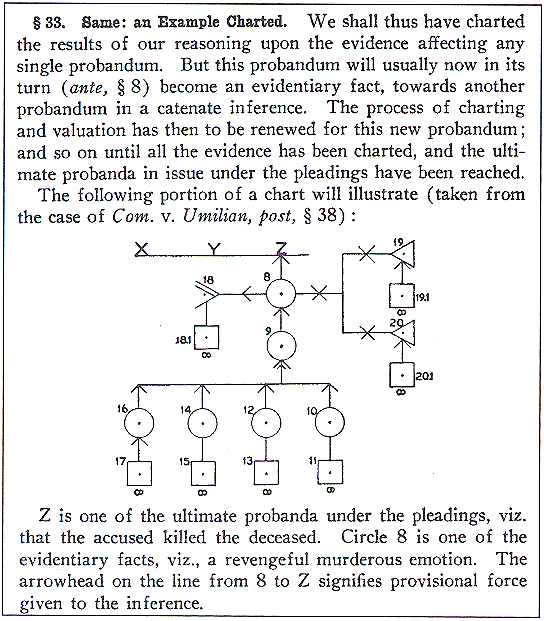
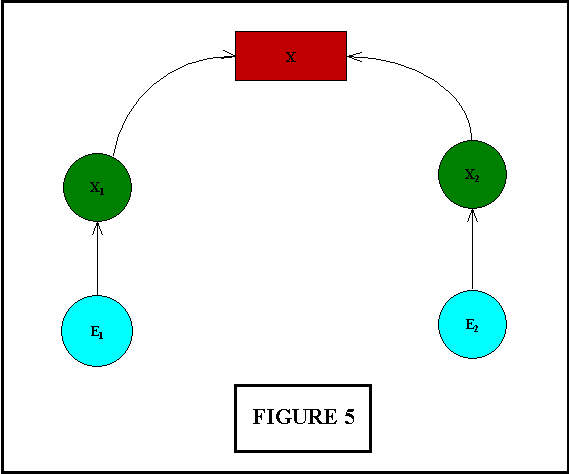
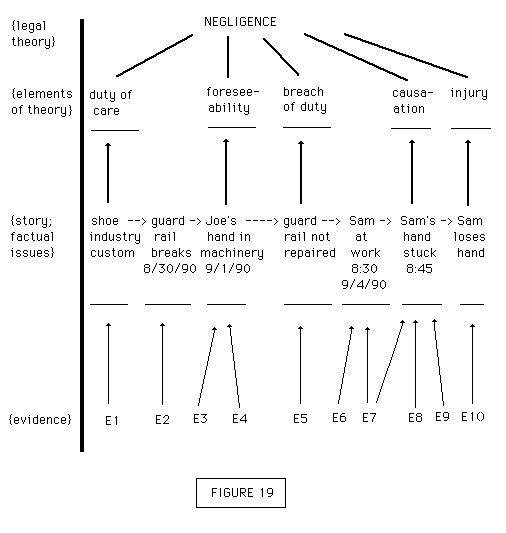
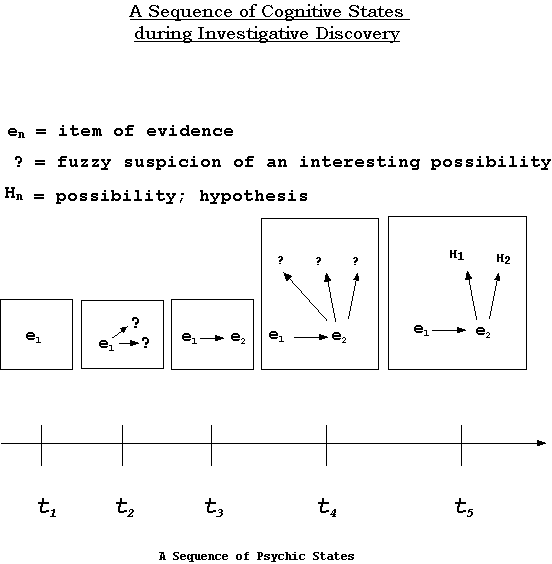
    ... but -- of course -- John Henry Wigmore got started decades ago on the business of "visualizing" complex argument. He gave us the following sorts of pictures of complex argument from evidence:

    Wigmore, however, was not the first person to diagram argument from or about evidence. William Lambarde did so in the seventeenth century -- his handbook for justices of the peace contained a diagram depicting the temporal sequence of events in issue and events that serve as evidence, or indicia, of such events in issue -- and even Lambarde's diagrams apparently drew on diagrams constructed much earlier. See B. Shapiro, INTELLECTUAL HISTORY, PROBABILITY, AND THE LAW OF EVIDENCE: "Beyond Reasonable Doubt" and "Probable Cause": Historical Perspectives on the Anglo-American Law of Evidence 152-154 (1991).

    They Also Do It in the UK: Visualize Argument

    Chris Reed and Glenn Rowe have developed argument visualization software Araucaria -- and it is free.

    Australian Mapping

    No, not mapping of Australia -- but mapping by an Australian -- Tim van Gelder. He is developing a method of argument visualization for lawyers. For details join the Austhink mailing list.

    Are There Preferred Classes of Evidence?

    Yet another court agrees that "direct" evidence is not necessarily more potent than circumstantial evidence:

    Whittington, Sr. v. The Nordham Group, 2005 U.S. App. LEXIS 25685 (10th Cir., Nov. 29, 2005) (civil action for damages under Age Discrimination in Employment Act; plaintiff was 62 years old when terminated; plaintiff relied in part on evidence showing that a similarly-situated employee of age 57 was not terminated):

    Nordam relies on cases from the Sixth, Seventh, and Eighth Circuits in arguing that we should adopt a bright-line rule that five years is an insignificant difference in age as a matter of law. None of those courts, however, applies such a bright-line rule. ...

    In our view, a definitive five-year rule is unjustified. ...

    To the extent that other circuits establish a direct-evidence requirement when the age difference is less than five years, we choose not to follow them. The authorities are legion that circumstantial evidence can be every bit as compelling as direct evidence. See, e.g., Rogers v. Missouri P. R. Co., 352 U.S. 500, 508 n.17, 77 S. Ct. 443, 1 L. Ed. 2d 493 (1957) (citing The Robert Edwards, 19 U.S. (6 Wheat.) 187, 190, 5 L. Ed. 238 (1821)) ("Circumstantial evidence is not only sufficient, but may also be more certain, satisfying and persuasive than direct evidence."); United States v. Becker, 62 F.2d 1007, 1010 (2d Cir. 1933) (Hand, J.) ("The requirement [that the jury be separately charged as to circumstantial evidence] seems to us a refinement which only serves to confuse laymen into supposing that they should use circumstantial evidence otherwise than testimonial."); 1A John Henry Wigmore, Evidence 26 (Peter Tillers rev. 1983) ("Wigmore's view that circumstantial evidence may be as persuasive and as compelling as testimonial evidence, and sometimes more so, is now generally accepted."). We decline to set rigid guidelines and will leave to the jury the evaluation of the evidence, subject as always to the oversight of the district court to refuse to permit unreasonable findings.

    Cf., e.g., the recent case McEwen v. Tennessee Dept. of Safety, 173 S.W.3d 815; 2005 Tenn. App. LEXIS 157 (March 22, 2005) (dispute over forfeiture of personal property for illegal sale of controlled substances; Court of Appeals rejected owner's contention that evidence of facts warranting forfeiture was insufficient):
    Direct and circumstantial evidence is equally relevant, NEIL P. COHEN ET AL., TENNESSEE LAW OF EVIDENCE § 4.01[5], at 4-10 (4th ed. 2000), and equally probative. See, e.g., State v. Kirchner, 600 N.W.2d 330, 334 (Iowa Ct. App. 1999); State v. Marsh, 278 Kan. 520, 102 P.3d 445, 450 (Kan. 2004); State v. Jenks, 61 Ohio St. 3d 259, 574 N.E.2d 492, 502 (Ohio 1991); State v. Cherry, 361 S.C. 588, 606 S.E.2d 475, 481 (S.C. 2004); see also 1A JOHN H. WIGMORE, EVIDENCE § 26 (Tillers rev. 1983). Accordingly, litigants may prove any material fact by direct or circumstantial evidence or a combination of both, State v. Phillips, 138 S.W.3d 224 at 230; Brown v. Daly, 83 S.W.3d 153, 160 (Tenn. Ct. App. 2001), and in certain situations, circumstantial evidence may be more convincing than direct evidence. United States v. Robinson, 177 F.3d 643, 648 (7th Cir. 1999); Estate of Brock ex rel. Yadon v. Rist, 63 S.W.3d 729, 731 (Tenn. Ct. App. 2001).

    Wednesday, November 30, 2005

    Death at Night in New Jersey: On Habit and Character

    I have a new paper:

    The Death of a Youth and of a Drunkard:
    A Remarkable Story of Habit and Character in New Jersey

    The paper's abstract reads:

    In many ways the case was unremarkable. It involved a traffic fatality that may have involved drunken driving, a tragic but common occurrence. This unremarkable case -- the criminal action of State of New Jersey v. Petro Radziwil, Indictment No. 1257-8-86 -- is nevertheless noteworthy. Radziwil raises important questions about an important part of the law of evidence: the relationship between habit evidence and character evidence. But the questions that Radziwil presents reach beyond the law of evidence. The criminal justice system is disproportionately populated with unsavory people, unpleasant people, stubborn people, and strong-willed people. Criminal defendants are frequently both unsavory and unpleasant, and many witnesses -- including prosecution witnesses -- share these traits. Prosecutors and criminal defense counsel, although not as a rule unsavory, can be unusually strong-willed and stubborn, and judges who preside in criminal cases may become hardened not just to the suffering of victims but also to the plight of those who cause harm. This combination of character traits has the making of a toxic brew. There is reason to worry about the capacity of strong-willed actors such as police officers and trial judges to make sound judgments about the unpleasant and unsavory people -- criminal defendants and witnesses -- that they routinely encounter while performing their assigned chores in the criminal justice system. The story of Petro Radziwil illustrates how personal likes and dislikes, and the prejudices of actors in the criminal process, can affect the outcomes of criminal proceedings. The story of Petro Radziwil also raises the question of whether much can be done to scrub the criminal process clean of the influence of the biases and emotions of the people who shape that process.

    An Amicus Brief in the Bobby Holmes Case

    Forty law professors -- all teachers of the law of evidence -- have joined in an amicus brief in the Bobby Holmes case. The amicus brief proceeds on the theory that the trial court's exclusion of exculpatory evidence deprived Bobby Holnes of his Sixth Amendment right to have a jury, not a court, decide his factual guilt or innocence.

    Tuesday, November 29, 2005

    J-Blogs: The Next Big Thing!

    We may be entering a new phase in the history of judicial appeals, judicial dissents, judicial arguments, judicial (self-)justification, and judicial loquaciousness. I refer, of course, to judicial blogs -- or, more pithily (for those in the know), to j-blogs or, better yet, j-blawgs. That this -- j-blogging (or j-blawging) -- is the next big thing in the history of the American judicial system is plainly shown by the recent exchange in the New Yorker (October 31, 2005, and December 5, 2005). The first part of this extrajudicial judicial debate began via an intermediary, Jeffrey Toobin. Mr. Toobin interviewed Justice Breyer and reported some of Breyer's views about methods for settling constitutional disputes. See J. Toobin, "Breyer's Big Idea," New Yorker (October 31, 2005). Judge Lawrence K. Karlton, Senior Judge, U.S. District Court, E.D. California, was not pleased by what he saw there. In a letter in the December 5 issue of the same periodical he wrote:
    The Supreme Court Justice Stephen Breyer's response to the quotation from my decision excluding the words "under God" from the Pledge of Allegiance seems to suggest that my complaint over the lack of guidance offered by the Supreme Court was a personal one. ... The intention [presumably J. Karlton's], however, was to note an institutional problem. [There is more. But I refrain from further quotation; buy the issue and read for yourselves.]
    Now this exchange (between a high judicial luminary and one that inhabits the nether regions of the federal judiciary) in a periodical that is sometimes practically funereal may not strike you as revolutionary. But, my fellow bloggers, au contraire: It is only a matter of time before such extrajudicial judicial argument spills over into widely-read periodicals such as New York's Daily News and, ultimately [horrors!?], into the blogosphere. As one eminent poobah recently said, "What's the point of writing something that no one reads?" Well, as all bloggers know, the best way to reach a world-wide audience is via the world wide web. Hence: the phenomenon of the j-blog is nigh.
  • Yes, I know, I know: Judge Richard Posner has been blogging for some time (with his spiritual kith and kin, the Chicago economist Gary Becker). But Judge Posner, I believe, has refrained from using his blog to defend his judicial opinions. (Am I wrong? I haven't read every blog written by Posner. [In my defense: It is beyond any human being's capacity to read everything written by Posner: Posner's pen moves faster than the eye. Posner himself has supra-human eyes and rapidly-moving word-processing fingers; and the electrical impulses in Judge Posner's brain clearly outrun the speed of light. {The existence of Richard Posner disproves Einstein!}])
  • Thursday, November 24, 2005

    When Guilt or Innocence Hangs on a Hair

    Recently I blogged on the disturbing case(s) of Steven Avery: When Chances Collide; DNA & "Exoneration"; Suggestibility & Gullibility (Nov. 12, 2005) and More about Steven Avery (Nov. 13, 2005). Steven Avery is the Wisconsin man who (i) is now charged with the murder of Teresa Halbach in 2005 (just a few weeks ago), (ii) was convicted in 1985 for the rape and attempted murder of Penny Beerntsen earlier that year, and (iii) was officially exonerated in 2003 of the rape and attempted murder of Beernsten in 1985.

    The evidence against Avery for the 2005 murder of Halbach seems very strong. One question raised by the evidence of Avery's complicity in the 2005 murder is whether the exoneration of Avery for the rape and attempted murder of Beernsten was a mistake.

    I cannot answer this question; I do not know the evidence in either case well enough. But it is pertinent to note that Avery's exoneration of the 1985 rape and attempted murder rested -- so newspaper accounts suggest -- on a single hair. See Michelle Kubitz, Avery One Year Later, Herald Times Reporter (September 10, 2004):

    Sept. 10, 2003: State Crime Lab tests on 13 hairs recovered from the victim [Penny Beerntsen] at the crime scene indicates that one [emphasis added by P. Tillers] of them did not match Avery's. That sample of DNA matches that of Wisconsin inmate Gregory Allen, who is serving a 60-year sentence for a different sexual assault in Brown County.
    Question: If Steven Avery did indeed rape and try to kill Beernsten, how did one of Gregory Allen's hairs end up on Penny Beernsten?

    I surely don't know the answer. But, as I suggested in one of my earlier posts, one possibility should be investigated. Newspaper reports suggest that in 1985 Steven Avery and Gregory Allen lived in the same area or neighborhood. If that is the case, it might be useful to know (i) whether Avery and Allen knew each other in 1985; (ii) if they did, whether they spent time together in 1985 or whether they were perhaps even close chums; and (iii) if they did spend time with each other and were acquaintances in 1985, whether they engaged in activities (e.g., touch football games, other physical horseplay with each other, joint hunting trips, sitting on the same couch in Avery's house or Allen's house) that might have resulted in the transfer of one of Allen's hairs to Avery or to Avery's clothing.

    Wednesday, November 23, 2005

    Hypnosis & Witnesses & Subconscious Inference

    There is a considerable body of law, much of it dating from the 1980s, about the question of the admissibility or inadmissibility of the testimony of witnesses who have (allegedly) been hypnotized. A recent article in the New York Times describes recent studies of hypnosis by neuroscientists. See Sandra Blakeslee,This Is Your Brain Under Hypnosis, in SCIENCE, NYTimes Online (Nov. 22, 2005). One of the major conclusions of these recent studies parallels the general conclusion of many earlier studies of human perception and human memory: the mind is not a tabula rasa; the mind constitutes, or creates, perceptions (or conclusions based on perceptions) from the sensory signals that are fed into the human brain and the human organism. But there are important differences in detail between the older and newer studies of perception -- there are differences in theories about precisely how the brain processes sensory data and converts them into perceptions -- and the article describes some of the mechanisms that are, it is now thought, in play.

    Some of the recent studies described in the article involve the study of the brain activity during hypnosis. According to some current neuroscientific theory, "top-down" processing is very important in the brain's interpretation of sensory inputs:

    One area that it may have illuminated is the processing of sensory data. Information from the eyes, ears and body is carried to primary sensory regions in the brain. From there, it is carried to so-called higher regions where interpretation occurs.

    For example, photons bouncing off a flower first reach the eye, where they are turned into a pattern that is sent to the primary visual cortex. There, the rough shape of the flower is recognized. The pattern is next sent to a higher - in terms of function - region, where color is recognized, and then to a higher region, where the flower's identity is encoded along with other knowledge about the particular bloom.

    The same processing stream, from lower to higher regions, exists for sounds, touch and other sensory information. Researchers call this direction of flow feedforward. As raw sensory data is carried to a part of the brain that creates a comprehensible, conscious impression, the data is moving from bottom to top.

    Bundles of nerve cells dedicated to each sense carry sensory information. The surprise is the amount of traffic the other way, from top to bottom, called feedback. There are 10 times as many nerve fibers carrying information down as there are carrying it up.

    These extensive feedback circuits mean that consciousness, what people see, hear, feel and believe, is based on what neuroscientists call "top down processing." What you see is not always what you get, because what you see depends on a framework built by experience that stands ready to interpret the raw information - as a flower or a hammer or a face.

    Some of the studies described in the NYTimes article show that such top-down processing can be so powerful that it can make a human beings "see" the color red when in fact some other color is plainly before the human actor's eyes. This sort of one finding is one reason why students of the law of evidence should be interested in these recent neuroscientific studies. Such studies may have a bearing on controversies about the appropriate treatment of witnesses who have been hypnotized. But the studies may also have implications for the more general question of the "suggestibility" of witnesses and the implantation or development of false memories and beliefs. However, as always, whether such studies have any immediate practical implications depends very much on the details. The mere insight that the human mind is an active participant in perception -- like the insight, or conclusion, that expectations are capable of altering or falsifying perceptions (or conclusions based on perception) -- is not new. One needs to know, for example, under what circumstances various kinds of changes in (conclusions based on) perceptions occur, what the magnitude of such changes is, and so on.

    There is more in the article -- much more. I strongly suggest you read it -- and then dip into further literature in this area.

    AI (Computational Intelligence) and Law -- AI of the Uncertain Variety, That Is -- Should Not Be a Fad

    The meaning of legal rules -- such as rules of evidence -- depends only in part, but in essential part on how such rules work. To wit: You do not know the meaning of a legal rule of evidence unless and until you know how the rule works and the consequences that the rule (in its environment) produces. Given this, law professors should be devoting massive amounts of energy to study of scholarship in artificial intelligence a/k/a computational intelligence.

    I reiterate this preachy conclusion only because a recent UAI list call for papers [CFP] caught my eye and because this CFP, like many other UAI CFPs, reminded me of how little we law teachers (and, very probably, law and economics scholars) know about the meaning and workings of legal rules. [UAI is the acronym for "Uncertainty in Artificial Intelligence."] Take a gander at these extracts from a CFP for a forthcoming (May 8 & 9, 2006) program of CLIMA VII, Seventh International Workshop on Computational Logic in Multi-Agent Systems, at Future University, Hakodate, Japan, http://www.fun.ac.jp/aamas2006/:

    Multi-Agent Systems are communities of problem-solving entities that can perceive and act upon their environment to achieve their individual goals as well as joint goals. ...

    Computational logic provides a well-defined, general, and rigorous framework for studying syntax, semantics and procedures for various tasks by individual agents, as well as interaction amongst agents in multi-agent systems ....

    The process of litigation and proof involves "multiple agents", such agents (lawyers, clients, judges, other actors) are "problem-solving entities", such agents "can perceive and act upon their environment", they can act to "achieve ... individual as well as joint goals."
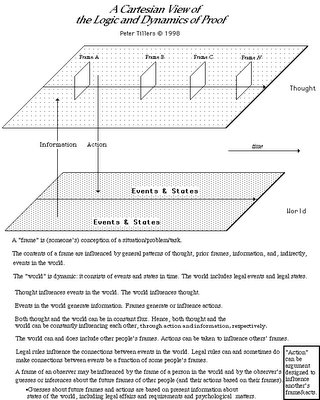
    Consider for a moment some of kinds of methods that are used to try to decipher multi-agent systems:

    * logical foundations of (multi-)agent systems
    * extensions of logic programming for (multi-)agent systems
    * modal logic approaches to (multi-)agent systems
    * logic-based programming languages for (multi-)agent systems
    * non-monotonic reasoning in (multi-)agent systems
    * decision theory for (multi-)agent systems
    * agent and multi-agent hypothetical reasoning and learning
    * theory and practice of argumentation for agent reasoning and interaction
    * knowledge and belief representation and updates in (multi-)agent systems
    * operational semantics and execution agent models
    * model checking algorithms, tools, and applications for (multi-) agent logics
    * semantics of interaction and agent communication languages
    * distributed constraint satisfaction in multi-agent systems
    * temporal reasoning for (multi-)agent systems
    * distributed theorem proving for multi-agent systems
    * logic-based implementations of (multi-)agent systems
    * specification and verification of formal properties of (multi-) agent systems
    Does the above list of topics suggest that legal scholars have something to learn from their brothers and sisters in computational intelligence and allied fields?

    Interdisciplinary work is hard. Interdisciplinary work is humbling. And interdisciplinary work demands humility. I often think that law teachers would do more and better interdisciplinary work if they (law teachers) were not so determined to show how smart they are. There are many intelligent people on earth, and many of them are in disciplines other than law, and some of those people know things law teachers don't. I have found that confessing ignorance while approaching smart people in other disciplines is a fruitful strategy. Your colleagues in foreign disciplines will be flattered by your interest and they will often take the time to explain things to you. Oh yes, remember this: you know some things they don't know, and you're not as stupid as you may sometimes feel you are.

    BTW, some law & economics literature seems determined to talk about decision but not about inference. Isn't this is a fundamental mistake? If some of the actors or agents in the environment that one wishes to understand and explain have inferential mechanisms or processes in their souls, isn't it clear that the behavior of such agents ordinarily cannot be predicted well if little or no account is taken of the agents' inferential processes? (And please note, you law & economics folk: those inferential mechanism and processes are extraordinarily complicated, and simplifying such processes "for the sake of argument" is often unjustified.)

    Sunday, November 13, 2005

    More about Steven Avery

    I blogged about the Steven Avery cases just a little while ago: When Chances Collide; DNA & "Exoneration"; Suggestibility & Gullibility

    Now I have a bit of additional information and one or two new random thoughts.

    Tom Kertscher, Avery to be charged on DNA, Milwaukee Journal Sentinel (Nov. 12, 2005):
    DNA evidence, which freed Steven Avery after he spent 18 years in prison for a rape he didn't commit, will now be used to charge him with a crime that could return him to prison for the rest of his life.

    Friday's announcement that Avery will be charged with killing Teresa Halbach also means Avery will likely become the first person in the nation charged with a homicide after being exonerated by DNA.
    Halbach's vehicle, spattered with blood, was found a week ago in the Manitowoc County auto salvage yard owned by Avery's family. On Friday, authorities said tests confirmed that Avery's DNA was in the vehicle and on the ignition key, which was found hidden in Avery's home on the property.

    ***

    Avery, 43, became the marquee case for the Wisconsin Innocence Project two years ago when the University of Wisconsin Law School program proved with DNA evidence that he did not commit a 1985 sexual assault in Manitowoc County.

    ***

    Investigators say Halbach was last seen the afternoon of Oct. 31 when she visited Avery's home to take a photo for Auto Trader of a vehicle he was selling. ...

    ***

    Asked about Halbach by the Journal Sentinel on Monday, Avery said she was "not my type" because he liked women who weren't as slim.

    ***

    Calumet County District Attorney Ken Kratz, the special prosecutor in the Halbach case [because of Avery's lawsuit against Manitowoc County for wrongful imprisonment on the 20 year-old rape case], said he believes [Halbach] was killed the same day that she visited Avery's home, a trailer that is adjacent to the family's auto salvage yard. ...
    . ... [I]nvestigators said in obtaining search warrants that they believed Halbach was sexually assaulted.

    The investigators searched the auto salvage yard, Avery's trailer, a garage and other parts of the sprawling family property. Court records show they found what appeared to be blood on Avery's home, in his bathroom, in the garage and on "a number" of vehicles in the salvage yard.

    The records also show that the searchers found, on unspecified parts of the property, remains of a woman, remnants of clothing and what appeared to be a cell phone and camera, all of which had been burned, as well as handcuffs, leg irons, sexual devices and pornographic materials.

    Avery's mother, Dolores Avery, maintained that her son is innocent.

    "I don't know why the hell they do that stuff," she said of the plan to charge Avery with killing Halbach. "They must like wrecking people's lives."

    ***

    Sheriff's Department records show that shortly after a woman was sexually assaulted on a beach in July 1985, Manitowoc police raised Gregory Allen as a potential suspect. It was Allen's DNA that was found in 2003 in testing of evidence found on the victim.

    ***

    Findley, of the Wisconsin Innocence Project, said Avery's being charged with Halbach's killing, while tragic, does not change the fact that a judge declared him innocent of the sexual assault. ...


    &&&&&&&&&&&&&&&&&

    Gregory Allen's DNA was found on the 1985 rape victim. In 1985 Allen, who was later imprisoned for sexual offenses against other women, lived in the same area that Steven Avery did. I wonder if Allen and Avery knew each other. If so, I wonder if they spent time together. If so, I wonder ....
    Gregory Allen was not tried for the 1985 rape of Penny Beerntsen because, a prosecutor said, Ms. Beernsten did not want to press charges against Allen. In 2003, when Avery was released from prison, Allen was still in imprisoned; he had been sentenced to prison for 60 years for sex crimes against other women. I wonder if Allen and Avery met while they were both imprisoned in Wisconsin.


    &&&&&&&&&&&&&&&

    Do you agree that Steven Avery's 2003 exoneration is not placed in doubt even if it is established (to your satisfaction) that Steven Avery murdered and raped Halbach in 2005?

    I greatly admire the work of the various Innocence Projects around the country. What troubles me is the occasional proclivity of participants in such Projects to assert that the DNA evidence they have unearthed conclusively establishes the innocence of the clients that they say they have "exonerated." This is dangerously hyperbolic talk -- and this sort of hyperbolic talk has the ability to bite back.


    Saturday, November 12, 2005

    The Absence of the Appurtenances of a Process of Proof, and the Shell of a System of Adversary Ajudication

    Jim Yardley, Desperate Search for Justice: One Man vs. China, NYTimes Online (November 12, 2005):

    A quarter century ago, after the chaos of Mao's Cultural Revolution, China essentially had no legal system. In that context, it has made significant strides. The 1996 reforms were intended to shift toward an adversarial trial process, modeled in part after the American system. Instead, the reforms have become most notable for what was left out.

    "They didn't put in rules of evidence," said Jonathan Hecht, deputy director of the China Law Center at Yale University. "They didn't put in requirements that witnesses appear at trial. Lawyers weren't given the ability to really prepare a case. They kind of created the shell of an adversarial process, but they didn't create the guts of it."