Wednesday, June 28, 2006

Being in the Classroom Intentionally

About two weeks ago the Association of American Law Schools held an extended workshop (in Canada) called "Teaching Intentionally."

The title of the workshop reflects the precision with which law teachers characteristically use language.

P.S. One year I actually tried teaching unintentionally. It didn't work. I usually ended up in some neighborhood cafe or in the Bahamas rather than at my law school. So there's no doubt about it: being intentional is good.

Thursday, June 22, 2006

A Familiar but Unresolved(?) Puzzle: Substantive Definitions of Crimes versus Proof Beyond Reasonable Doubt

A very recent Supreme Court decision -- Dixon v. United States, No. 05-7503 (June 22, 2006) -- serves as a reminder that three principles are well-entrenched in U.S. constitutional jurisprudence:
1. The prosecution must prove all essential elements of the crime charged beyond a reasonable doubt. This is required by due process.

2. It is constitutionally permissible for a State or the U.S. Government to make a criminal defendant bear the burden of proving that an affirmative defense applies: due process does not require that the government prove beyond a reasonable doubt that an affirmative defense to a criminal charge does not apply.

3. Legislative bodies (including Congress) have the authority to define crimes. Legislative bodies are therefore free to decide which elements are essential elements of a given crime. Similarly, legislative bodies are free to proclaim that the truth or falsity of a given element -- a given type of fact -- is part of an affirmative defense rather than part of the definition of a given crime.

Propositions #2 and #3 perhaps reflect the notion that legislative bodies are free to choose how a concern for public security and the concern for the role of blame in criminal justice are to be balanced. But if legislative bodies are to have this prerogative, why are they not also free to proclaim that conviction of crime can be had even if the essential elements of crimes -- crimes that those same legislative bodies have defined -- have not been established beyond a reasonable doubt? If the constitution recognizes that legislative bodies are entities that have the constitutional authority to balance the concern for public safety and the concern for protection of the innocent, why aren't those same legislative bodies free to decide how much proof there must be of the essential elements that those legislative bodies have decided should be part of the definition of the crime in question?

I doubt that legislative authority over legal definitions of criminal culpability is compatible with the principle or rule that criminal guilt must be established beyond a reasonable doubt. (In Dixon the Court seems to assume that an accused's mere [pre-existing] knowledge of the illegality of the conduct undertaken ["perpetrated"?] by the accused is sufficient to establish whatever degree of criminal culpability the constitution may demand. But I cannot imagine that even the most hard-hearted member of the Supreme Court will adhere to this harsh principle when push comes to shove -- when, for example, the knowledge of the accused is accompanied by extreme extenuating circumstances such as duress on the accused in the form of extreme physical torture.)

  • The riddle I have sketched above remains fundamentally unchanged if courts (as well as legislative bodies) are thought to have authority to define crimes and affirmative defenses.
  • The tension between the reasonable doubt principle and legislative power to define crimes reawakens in my mind the suspicion that the reasonable doubt principle is more show than substance. I have the suspicion that the reasonable doubt standard is more show than substance because I simply do not understand why the reasonable doubt standard does not itself imply or generate a constitutional obligation on the part of government to structure the entire criminal process (including police investigation) in a way that provides reasonable assurance that convictions will be had only when there is a very high probability of guilt.

    Sunday, June 18, 2006

    Bayesian Spam

    The cleverness of spammers knows no bounds. Today I received an e-mail message from the following sender:

    Bays H. Network

    P.S. I regret to say that the message did not contain a network. What a fraud!

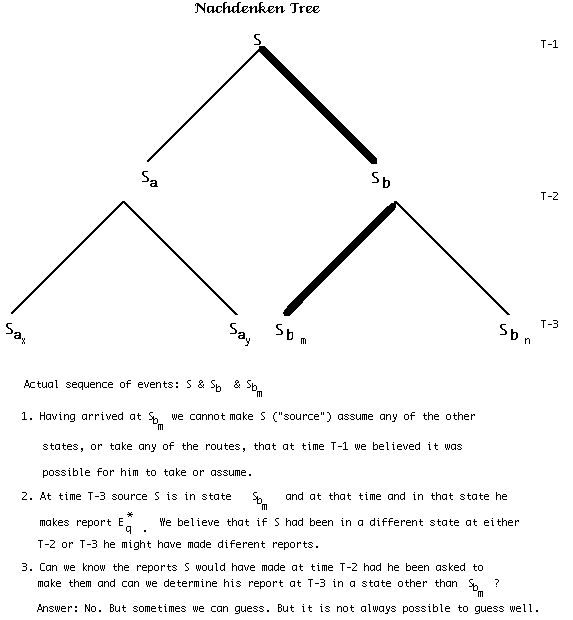
    What Does That Darned Picture Mean?

    Is the following statement true or (better yet!) when is it true (and not true)?:
    If a mental picture is used to represent a thought, it needs to be accompanied by a caption, by a set of instructions for how to interpret the picture--what to pay attention to and ignore.
    Steven Pinker, How the Mind Works pp. 297 (1997).

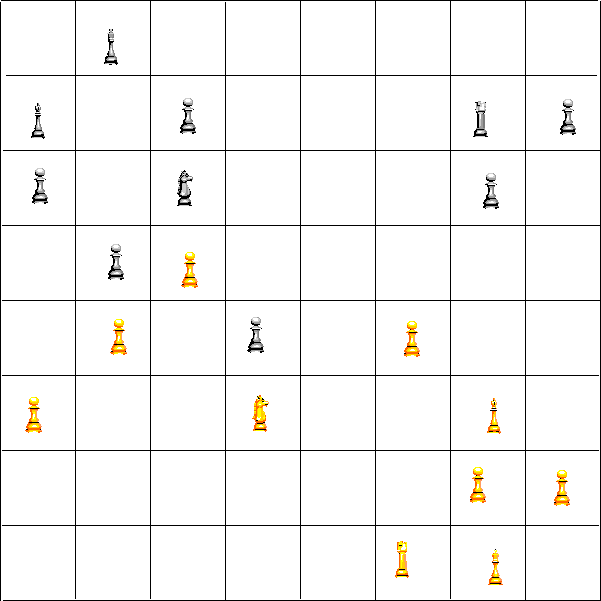
    It is the case, of course, that instructions for use can be remembered and that people can learn to recall almost instantaneously -- very quickly -- the intended use or meaning of at least some images. Consider (some) highway signs containing pictures. Or, chess players, consider a diagram of a chess position (with icons representing the King, Bishop, etc.).

  • Indeed, my friends, are physical chess pieces different in any pertinent way from "immaterial" icons representing chess pieces? "Real" chess pieces and "real" chess boards also don't usually carry captions describing how chess pieces can be played.
  • Pictures and Thinking

    "My computer screen is festooned with little cartoons that do various things when selected by a click of the mouse. For the life of me I can't remember what the tiny binoculars, eyedropper, and silver platter are supposed to do. A picture is worth a thousand words, but that is not always such a good thing. At some point between gazing and thinking, images must give way to ideas." Steven Pinker, Chapter 4 ("The Mind's Eye"), How the Mind Works p. 298 (1997).

    This thought has many implications for visualizing evidence. One implication is the following:

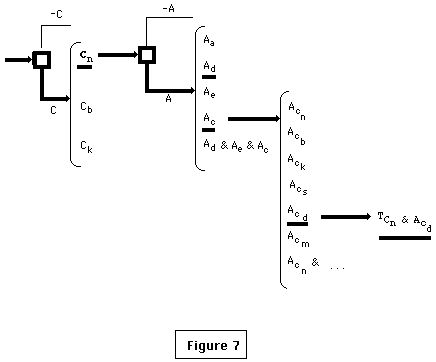
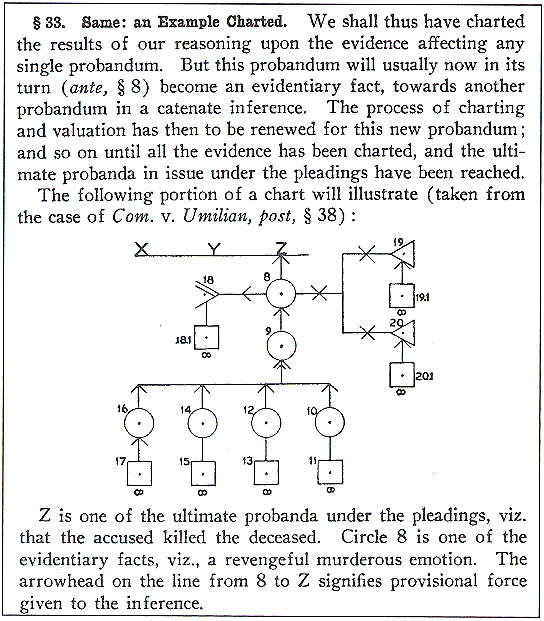
    The mental labor required by a method of picturing evidence and inference ordinarily should not outweigh the cognitive benefits of using such that method.
    Compare the following lead balloon produced by the ordinarily-superlative John Henry Wigmore: Even though Wigmore's method of picturing inference was far from user-friendly, it is good that Wigmore created his leaden method of charting evidence and inference. For example, his effort helped to get some legal professionals to start thinking about inference networks and it eventually helped to get probabilists to think more carefully about cascaded probabilistic inference and about the peculiar and interesting properties of complex evidential inference.

    Once Again: What Is "Visualization" of Evidence and Inference?

    Oliver Sacks, A Neurologist's Notebook: To See and Not See, THE NEW YORKER (May 10, 1993, posted online June 12, 2006):
    The seventeenth-century philosopher William Molyneux, whose wife was blind, posed the following question to his friend John Locke: “Suppose a man born blind, and now adult, and taught by his touch to distinguish between a cube and a sphere [be] made to see: [could he now] by his sight, before he touched them . . . distinguish and tell which was the globe and which the cube?” Locke considers this in his “Essay Concerning Human Understanding” (1690) and decides that the answer is no. In 1709, examining the problem in more detail, and the whole relation between sight and touch, in “A New Theory of Vision,” George Berkeley concluded that there was no necessary connection between a tactile world and a sight world—that a connection between them could be established only on the basis of experience.

    Barely twenty years elapsed before these considerations were put to the test—when, in 1728, an English surgeon named William Cheselden removed the cataracts from the eyes of a thirteen-year-old boy born blind. Despite his high intelligence and youth, the boy encountered profound difficulties with the simplest visual perceptions. He had no idea of distance. He had no idea of space or size. And he was bizarrely confused by drawings and paintings, by the idea of a two-dimensional representation of reality. As Berkeley had anticipated, he was able to make sense of what he saw only gradually, and insofar as he was able to connect visual experiences with tactile ones. It had been similar with many other patients in the two hundred and fifty years since Cheselden’s operation: nearly all had experienced the most profound, Lockean confusion and bewilderment.

    And yet, I was informed, as soon as the bandages were removed from Virgil’s eye he saw his doctor and his fiancĂ©e, and laughed. Doubtless he saw something—but what did he see? What did “seeing” for this previously not-seeing man mean? What sort of world had he been launched into?

    This tale has implications for the conference on Graphic and Visual Representations of Evidence and Inference in Legal Settings.

    Friday, June 16, 2006

    Deporting the Evidence

    John P. Martin, Judge wants 11 deported Hundurans back in N.J., The Star-Ledger p. 1 (June 14, 2006):
    A federal [trial] judge [Joel Pisano] took the unusual step of ordering the government to locate 11 Hundurans it deported last year and arrange for their return, ruling they should not have been expelled because they might vindicate a Hudson County bar owner accused of running a human trafficking ring. ...

    ...

    "There is no question that had the agents focused on their obligations to preserve evidence in the case, it might have been advisable for them to invoke the material witness statute, and we wouldn't be in the situation we are today," Pisano said.

    ...

    The ... detainees from the raids -- eight women and three men -- ... told agents Medrano [the accused] did not arrange their smuggling and never pressured anyone, and that the women voluntarily lived and worked together.

    Those witnesses were deported.

    Saturday, June 10, 2006

    Quirky Behavior Frustrates Rational Inference

    Steve Coll, Citizens, The New Yorker p. 27 (June 5, 2006):

    On that summer morning [of June 7, 2005], three young Muslim men blew themselves up on Underground cars, and a fourth immolated himself on a double-decker bus....

    The four men depicted in the report are in some respects unfathomable. When Shezad Tanweer, a talented athlete who was twenty-two years old, bought snacks at a highway convenience store four hours before his death, he haggled over the change. ...

    What Is "Visualization" of Evidence and Inference?

    Premise: Visualization can facilitate the comprehension, memorization, and analysis of evidence. See Conference Announcement: Graphic and Visual Representations of Evidence and Inference in Legal Settings. But what is "visualization"? (Can blind people visualize evidence?) And when and why do visual representations of evidence and inference impede rather than facilitate understanding? Do successful visual (or graphic) representations of complex problems simplify them? How do they do that? Can representations built out of simple elements become complex? (Yes.) Unintelligible? (Yes.)

    For interesting notes about these and other questions -- including the relationship between (i) "artistic" representations and (ii) representations using "logical" elements such as arcs and nodes -- see Priit Parmakson, When Does Non-Visual Become Visual?.

    Friday, June 09, 2006

    Buy This Gem

    Be sure to place an advance order for your copy of the following sparkler: the second edition of The Structure of Legal Argument and Proof: Cases, Materials, and Analyses by J.S. Covington, Jr. You will find no better introduction to legal reasoning and other kinds of uncertain reasoning in law. This little book has much to offer old war horses as well as young stallions and fillies.

    The book will be available in August from William S. Hein & Co., Inc., Buffalo, New York.

    Poor or non-existent marketing by the publisher of the first edition doomed the author's first effort to obscurity. You should help see to it that such an injustice does not happen again. If it does, you will be the poorer for it.

    Covington is Professor of Law Emeritus at the University of Houston.

    Thursday, May 25, 2006

    Character & Criminality: Some Crime Really Runs in Families

    Several years ago an interesting article appeared in the NYTimes but, as far as I can tell, the article got little attention in the Evidence community. The article was about Rooster Bogle and his family. It was written by Fox Butterfield and appeared in the New York Times on August 21, 2002. A fellow blogger, Dr. Jim Eckman, has this interesting summary of the story of Rooster Bogle and his family:
    THE LEGACY OF A FATHER

    The Old Testament talks about the sins of the fathers being visited on the four or five generations that follow. This has always been a difficult concept to understand. At the very least, it gives focus to the truth that fathers have an enormous influence on their children. How a father lives will influence his children, who will then influence their children, etc. The case of Rooster Bogle of Salem, Oregon illustrates this truth.

    Dale Vincent Bogle, known as Rooster Bogle, taught his children well. He was in and out of prisons all of his life. He regularly beat his wife and taught his children to steal.

    By the time his sons were 10, they were breaking into liquor stores for their dad or stealing tractor-trailer trucks, hundreds of them. His girls turned to petty crimes to support their drug addiction. In time, everybody in the family was in jail. By official count, 28 in the Bogle clan have been arrested and convicted, including several of Rooster’s grandchildren. One of Rooster’s children stated, “Rooster raised us to be outlaws. There is a domino effect in a family like ours. What you’re raised with, you grow to become. You don’t escape.”

    Prison officials are now concluding that the Bogle clan is an extreme example of the reality that crime runs in families. Justice department figures demonstrate that 47% of inmates in state prisons have a parent or other close relative who has also been incarcerated. Similarly, the link between the generations is so powerful that half of all juveniles in custody have a father, mother or other close relative who has been in jail or prison. Incredibly, until recently, few states have paid attention to this obvious cycle of crime. The cost to society is enormous. The cost, for example, of incarcerating just 5 of the 28 Bogle clan is $3 million, not counting the cost of their trials.

    What social science is now showing us is that the fundamental cause of crime is not primarily poverty, abuse, neglect or drug use, all of which do contribute to criminal behavior. Perhaps the critical reason for criminal behavior is that children learn to imitate their parents. Instead of learning appropriate behavior, they learn to steal, cheat, lie and manipulate. The point is that parents play a tremendous role in shaping the behavior of their children. What they do is often modeled by their children. That is why Moses argued in Deuteronomy 6 that parents are to formally teach the truth about God and to model that same truth through the daily routines of life. There is therefore both a formal and an informal means for communicating truth. If parents like Rooster Bogle formally and informally teach rebellion, dishonesty and violence, the children will grow up doing the same thing. What social science is now telling us is what the Bible has been saying for thousands of years.

    Thursday, May 11, 2006

    Worrisome Details in Case Involving Fantastic Claims

    Until today I had not heard about the trial (and, now, conviction) of the Toledo priest charged with a satanic killing of a nun -- 26 years ago. See, e.g., "Priest convicted of killing nun," UPI Online (Toledo, Ohio; May 11, 2006).

    The victim, Margaret Ann, a nun, was murdered in a hospital chapel. "She was murdered on Holy Saturday, the day before Easter, as she prepared the chapel for holiday services. The killer attacked her in the chapel sacristy where the Eucharist was held, strangling her and then stabbing her 31 times, including nine times through an altar cloth. Those wounds [the prosecutor argued] formed the shape of an inverted cross." Harriet Ryan, "Catholic priest convicted of nun's 1980 murder," courttvnews [online] (May 11, 2006). The defendant, a priest, was the chaplain at the chapel.

    The jury convicted the defendant, Gerald Robinson, of murder. The jury was apparently convinced that Robinson used a letter opener that he owned to kill Harriet Ryan. However, there are some troubling details about case against Robinson:

    1. The reopening of the case against the priest was precipitated by an anonymous person who accused various priests in the Toledo area, including the defendant, of having molested that person years earlier. However, no action has been taken on that complaint.

    2. A local member of SNAP -- Survivors Network for Those Abused by Priests --, it appears, played a large role in getting the prosecutor to reopen the case and to investigate the possibility that Robinson was the culprit. SNAP has rarely if ever encountered an abuse charge against a priest that it disbelieves. Why was this member of SNAP interested in a murder charge against Robinson? Did this member of SNAP have a connection to the anonymous sex abuse complainant or to some other alleged victim or victims of Robinson's sexual molestation and, if so, was this member of SNAP trying to use the murder charge as leverage for possible civil actions against Robinson? What precisely was this SNAP member's role in the murder case?

    3. Evidence purporting to show some sort of satanic practices by the defendant Robinson was submitted at the trial. But in his closing argument the prosecutor said "that the murder was not a satanic or ritualized killing" but that, nevertheless, "Robinson performed a 'bastardized version of last rites' on Sr. Margaret Ann.'" Id. I'm not sure there is much of a difference between these two types of alleged religious misconduct. But if there is a difference, why did the prosecutor apparently try to run away from the charge of satanic practices? And if satanic practices were not part of the prosecutor's theory of the case, why did the prosecutor offer evidence of satanic practices at trial?

    4. "During the three-week trial, an expert in the occult testified that only a member of the clergy would have the specialized knowledge of Catholic rituals evidenced in the killing." Id. Are you as suspicious as I am about thus supposed expert in the occult? Is it your guess that this "expert" spouted hokum? And why is it that the prosecutor used this "expert in the occult" to testify to Catholic religious rituals instead of an expert in Catholic religious rituals, a person such as a Catholic bishop or a member of the faculty at a Catholic seminary?

    5. The evidence that the killing was done in conformity with some distorted religious ritual is highly suspicious. For example, the prosecutor argued that the 31 wounds on the nun's formed an upside down cross. Was that impression -- the impression that the wounds formed a cross -- something akin to a Rorschach test? (Do you recall the highway overpass on which, it appeared -- to some believers -- that an image of the Virgin Mary appeared, at least at times? [Some people, try as they might, could not discern the image of a woman on the overpass. Other people thought they saw streaks created by rain flowing down over grainy concrete.] In these situation much depends on the imagination of the beholder.) And if the killer did make a cross, he must have been fairly clever and persistent and strong and fearless to take the time to kill the victim by precisely landing 31 stab stabs in the pattern of a cross, don't you think?

    6. And what evidence was there that Robinson rather than someone else was the guy who stabbed Margaret Ann? Well, it wasn't DNA: DNA tests on Margaret Ann's clothing revealed the DNA of some third person. This, of course, doesn't prove Robinson's innocence. It is entirely possible that after Margaret Ann was killed but before her body was removed, some intruder, a third person, molested the dead body of Margaret Ann and deposited his DNA on her underpants.

    7. Well, if DNA didn't identify Robinson, what did? The answer, some news reports tell us, is some creative forensic science, some of it provided by the estimable Dr. Henry Lee. But was this forensic science perhaps too creative for its own good? Consider item 1: Blood spatter evidence -- the pattern of blood spatter from Mary Ann's wounds -- was used, we are told, to help establish that the weapon used to kill Margaret Ann was a letter opener rather than a weapon such as scissors or an ordinary knife. Proposition: The pattern of spatter from a wound can discriminate between letter openers and scissors or ordinary knives. Do you believe that? Consider item 2: There was, we are told, a faint blood stain on cloth that was draped over the altar, an altar that was close to the location of the murder. A part of this faint blood stain -- which would have to have been 20 years old and might have been dry-cleaned a few times -- "bore a striking resemblance to a medallion on the priest's letter opener." Id. What do we have here -- another Rorschach test?

    Based on the little I know, this is a very troubling case.

    John Silber Reaps the Rewards of Scholarship

    "John Silber, who was one of the most handsomely paid university presidents in the nation, has received about $7 million in deferred compensation and other benefits from Boston University since he stepped down as chancellor in 2003." Marcella Bombardieri, Rich rewards outlast Silber's reign, Boston Globe Online (May 10, 2006)

    Tuesday, April 25, 2006

    Conference Announcement: Graphic and Visual Representations of Evidence and Inference in Legal Settings

    Cardozo School of Law will host a conference on

    Graphic and Visual Representations of Evidence and Inference in Legal Settings


    Dates: January 28-29, 2007.

    Venue: Cardozo Law School, Yeshiva University, 55 Fifth Avenue (5th Ave. & 12th St.), New York (Manhattan), New York
     

    Description of conference:

    One of the largest problems faced by crime investigators, litigators, paralegals, judges, triers of fact, and other actors interested in disputes about factual questions in legal settings is the sheer mass of available evidence in many cases. It is often difficult to remember, retrieve, and interpret evidential information, so that patterns, relations, and inconsistencies often go unnoticed. Tools that support the storage, retrieval, and interpretation of masses of evidence could therefore be of great use.

    Psychological studies have shown that people's ability to remember, retrieve, and interpret information is greatly enhanced if they organize information in a way that is meaningful to them. Scholars of the law of evidence have long suggested that graphical representations of evidential arguments and inferences could support humans in making sense of masses of evidence. As early as 1913, John Henry Wigmore claimed that his charting method promoted rational thinking about legal evidence. While Wigmore had only pencil and paper to draw his cumbersome graphs, today the computer could make his ideas practically feasible for everyone. Software could be used to draw graphical representations of arguments and inferences about masses of evidence. Moreover, such software could be combined with existing database, document management, and search technology so that collections of evidentiary documents could be stored and retrieved in terms of the user's thinking about a case. Such software would also facilitate transfer of case files to others by increasing the transparency of the files, so that subsequent investigators, prosecutors, and fact finders could gain a quicker and better understanding of the case.

    Such software is currently being investigated for use in various domains. Argument visualization software has been designed, for instance, to support the teaching of scientific reasoning or critical thinking skills (Belvedere, Reasonable, Araucaria, Convince Me), to support intelligence analysis, and to facilitate individual or collaborative problem solving (Questmap, SEAS). Moreover, current artificial intelligence research offers precise accounts of evidential reasoning and thus provides a clear semantics of graphical notations as well as ways to compute with them.

    In the legal domain, fact investigators and litigators increasingly use software that supports the storage and retrieval of information in terms of conceptual and relational networks (Holmes 2, Analyst's Notebook). However, as yet, such tools offer little or no support for the structuring of human thinking about thus stored information. This software allows users to store evidentiary data in terms of events, objects, actors, and the relations among these things, but it does not allow users to represent how such data support or undermine hypotheses about what has happened.

    This interdisciplinary conference brings together scholars and practitioners from such fields as law, philosophy, computer science, artificial intelligence, cognitive psychology, and linguistics who are interested in the graphic visualization of legal evidentiary inference and its support by software tools. The following issues will be addressed:

  • Current and new graphical means to visualize factual inference and proof
  • Semantics of such graphical notations: what are the underlying theories of evidential reasoning? (jurisprudential, philosophical, psychological, rhetorical, logical, or mathematical)
  • Which software tools for graphical representations of factual inference and proof are currently available or being developed?
  • What are the potential contexts for the use of such software and what are the potential benefits of such software? (crime investigation, litigation, trial, law teaching, etc.)
  • To what extent can graphic representation of evidential arguments support the automatic evaluation of hypotheses?
  • How can current insights about human-computer interaction be exploited to increase the usefulness of such software? (e.g., how can visual complexity created by the size of the available mass of evidence be managed?)
  • Are empirical results available on usability and effects of use of charting methods (whether manual or digital) in legal or other contexts?
  • What are the practical constraints faced by crime investigators or legal professionals who want to use such software?
  • Conference officials:
    Peter Tillers (Cardozo Law School): Conference chair e-mail address: peter@tillers.net
    Henry Prakken (Universiteit Utrecht / University of Groningen): Program chair e-mail address: henry@cs.uu.nl
    Thomas D. Cobb (University of Washington, Seattle): Deputy program chair e-mail address: tomcobb@u.washington.edu

    Panelists:

  • Thomas D. Cobb (University of Washington School of Law)
  • Philip Dawid (U. College London)
  • Neal Feigenson (Quinnipiac University School of Law)
  • Branden Fitelson (U. of California at Berkeley)
  • Tim van Gelder (U. of Melbourne)
  • Thomas F. Gordon (FOKUS [Frauenhofer Institut fuer Offene Kommunikationssysteme]); web log
  • John Josephson (Ohio State University)
  • Marc Lauritsen (CEO, Capstone Practice Systems)
  • Richard Lempert (U. of Michigan Law School & National Science Foundation)
  • Ronald P. Loui (Washington University, St. Louis; Computer Science)
  • John D. Lowrance (Program Director, Artificial Intelligence Center, SRI International)
  • Jennifer Mnookin (UCLA School of Law)
  • Dale Nance (Case School of Law)
  • Andrew Palmer (U. of Melbourne, Law)(unconfirmed)
  • Priit Parmakson (Tallinn University, Tallinn, Estonia)
  • John L. Pollock (U. of Arizona)
  • Henry Prakken (Utrecht University & U. Groningen)
  • Chris Reed (U. of Dundee)
  • Burkhard Schafer (U. of Edinburgh, Law School)
  • David Schum (George Mason U.)
  • Richard Sherwin (New York Law School)
  • Samuel Solomon (CEO of DOAR, Inc.)
  • Peter Tillers (Cardozo Law School, Yeshiva University)
  • William Twining (U. College London, Law Faculty & U. of Miami, School of Law)
  • Bart Verheij (U. Groningen, Dept. of Artificial Intelligence; ALICE Institute)
  • Vern Walker (Hofstra U. School of Law)
  • Douglas Walton (U. of Winnipeg)

    The public is invited. There is no registration fee. (However, there will be a modest charge for any lunches or dinners that attendees elect to take at the site of the conference, at Cardozo Law School.)

    Program details will be provided later.

  • Wednesday, April 05, 2006

    Judicial Prudence: Does the Supreme Court Always Fail Us Precisely When We Need It the Most?

    The Supreme Court of the United States has chosen not to review the Padilla case, the case in which a U.S. citizen was seized in Chicago and held for three years as an "enemy combatant" -- all without a showing of probable cause before a judicial officer and without any other form of judicial review of the merits of the seizure and detention.Bruce Ackerman has it right: this sort of "judicial restraint" leaves open the possibility that this President or another will unilaterally seize and imprison (and execute?) greater numbers of U.S. citizens in the name of the "war" on terror.

    The Supreme Court failed us during the Vietnam War: it successfully avoided having to decide the illegality or illegality of that war. Today's edition of the Supreme Court may fail us again: this Court may successfully avoid deciding whether a President can or cannot unilaterally seize and imprison a U.S. citizen. This sort of "restraint" is contemptible judicial behavior; it is a mockery of the ideal of the rule of law; and it is a crude violation of the fundamental principle that the life and liberty of citizens may not be taken away by the whim or the pleasure of the executive.

  • Of course, it is possible that the Supreme Court secretly harbors the intention of someday rendering an opinion about the legality of the government's treatment of Padilla. If so, I say: What harm can a few more years or decades do? After all, unlike Milosevic, Padilla probably won't die of a heart attack during his first decade of imprisonment.
  • The Evidence Eliminator

    A sure sign of a guilty conscience? See Erica Taub, Deleting May Be Easy, but Your Hard Drive Still Tells All, NYTimes Online (April 5, 2006):
    Various software programs can be used to overwrite data. One popular product, Evidence Eliminator, draws a red flag in legal circles.

    "I'm still puzzled why someone would use a product of that name," said Michael A. Gold, a senior partner with the law firm Jeffer, Mangels, Butler & Marmaro in Century City, Calif., and a chairman of the firm's Discovery Technology Group.

    Saturday, April 01, 2006

    Off-Topic: Larry Alexander on Academic Freedom

    I usually focus on evidence and inference. But in recent months and years I have been thinking seriously (but sporadically) about the question of the condition of scholarship in the legal academy. For example, I have been interested in some of the things I recently heard Prof. Peter Schuck say.

    Today I downloaded an essay by Prof. Larry Alexander on Academic Freedom (March 2006). I'm not entirely sure what to make of Alexander's essay. Some of it rings true to me. Other parts of it sound as if Alexander is fighting the last Kulturkampf. But I don't have a good feel for the state of scholarship and politics in the law school world nationwide (in the U.S., that is). So perhaps his broad characterizations of the ostensibly parlous condition of academic freedom -- and, by extension, scholarship -- in many parts of the academy are correct.

    In the last couple of decades when I have thought about legal scholarship in the U.S., I have usually thought about the question of of the condition of legal scholarship in microscopic rather than macroscopic terms. (Ancient personal history: My decision to concentrate on an ant-level perspective on law was in part a flight from certain excesses of grand jurisprudential and philosophical theorizing, excesses to which I had fallen prey.) I have been particularly interested in the workings of evidential inference.

    I have been drawn to a particular way of studying factual inference: I have tried (how successfully, however, I do not know) --, I have tried to pursue a method of study that I see as quasi-scientific; I have been drawn to a type of scholarship that wishes to test itself (its conjectures and hypotheses) against things as they are.

    What has impressed (depressed!) me from time to time is how little many legal scholars seem to care about the sort of "pedestrian" scholarly work that I myself so admire and how much more a good many legal scholars seem to prefer fields of legal scholarship that are suffused by grand generalities and abstractions that appear to be almost wholly exempt from truth-checking encounters with "reality" or any form of at least partially-independent data or facts.

    Perhaps there is a connection between my (admittedly-diffuse) plaint and Alexander's. But perhaps there is not much of a connection. I would like to hear the opinions of others about this question. I want to collect the opinions of others about this issue largely because I personally do not really want to sally forth into the wide and murky terrain that scholars such as Alexander and Schuck explore; I would much prefer to continue to tend my own little garden (which contains factual inference, factual proof, fact investigation, and similar matters).

  • By the by: It is literally impossible to study the plants and weeds in my garden without thinking seriously and carefully about matters such as values, norms, preferences, and all that. But I fancy that my ruminations about matters such as norms are more closely tied to granular phenomena and realities. Perhaps this more restricted perspective is an advantage, at least sometimes.
  • But if Alexander is correct, I cannot afford to be myopic. Is he correct (in the main)? Is Peter Schuck correct (in the main)?