What are the main lines of inquiry?The [UK] security services will focus on where the polonium 210 came from. If it was made in a nuclear facility, it will contain traces of other radioactive isotopes that could identify the facility.
Sunday, November 26, 2006
Tracing the Original Source of the Polonium 210
The Guardian reports:


Is This Keystone Cops Story True?
Eric Margolis of the Toronto Sun writes (emphasis added):
During 1999, Moscow and a provincial city were racked by a series of apartment building bombings that killed 300 people. Panic swept Russia.Question: Is this story true?The bombings were blamed on "Chechen Islamic terrorists." But Moscow police caught a team of SVR [Russian intelligence agency for foreign affairs] agents red-handed planting explosives in a residential building. The agents claimed they were running a "security test."
A nuclear reactor may have been required to kill Litvinenko
Acording to the NYTimes, 11/24, a nuclear reactor would be required to produce the amount of polonium 210 reportedly found in Alexander V. Litvinenko's (dead) body:
[M]aking the "significant quantities" described in Mr. Litvinenko's body by the British Health Protection Agency would require a nuclear reactor that could bombard the element bismuth with neutrons."To most chemists, this is astonishing," said Dr. Andrea Sella, a lecturer in inorganic chemistry at London’s University College. "This is not available commercially."
"This is not the kind of weapon that any kind of amateur could construct," he added. "It would require real resources to do it."
Polonium 210 is "extremely hard to detect"
Associated Press reports that polonium 210, which was used to kill Alexander V. Litvinenko, is extremely hard to detect. See CNN.com, Nov. 24, 2006.
Saturday, November 25, 2006
A Big Power Spy-and-Statecraft Puzzle
 What an interesting case.
His name is Alexander V. Litvinenko.
He is dead.He claims -- that is, claimed before his death [it is said] -- that Putin ordered his death.Before we talk about the material that killed him, consider the possible motivation.
Mr. Litvinenko at one point said, I believe, that the bombings of some residential buildings in Moscow -- Was it Moscow? -- were a ruse. He charged (did he not?) that the Russian secret service or some such agency actually did the bombing(s) with the plan to blame the bombing(s) on Chechen rebels.
The bombing did take place. I remember newspaper and media accounts immediately thereafter blamed it on the Chechen rebels.
Mr. Litvinenko was himself once a Russian intelligence agent.
What killed Mr. Litvinenko? It was, today's NYTimes reports, polonium 210, which is a "rare and hard-to-produce substance" and "dangerous when breathed, injected or ingested."
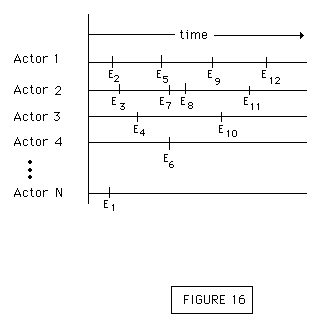
For the sleuth, the rare nature of polonium 210 should be an advantage. For example, does it take certain very expensive equipment to produce? Do only a few people know how to make it? Does it leave telltale radioactive traces when it is transported in, say, a suit case? Does a particular sample have a kind of signature? What is this stuff polonium 210?
Ancient facts: Stalin deported, it is said, the entire population of Chechnya during WWII. But the Chechens get little sympathy in the rest of the world, let alone in Russia. Do they deserve all of the hatred they get? Is some of their militaristic activity a prediction made true? Are Chechen rebels freedom fighters? How should we think about them? Does it matter -- for purposes of our little (big?) spymaster riddle?
Let's get more facts.
Putin rejected the family's charge of murder. Does his denial have any probative value? What say you, Richard Friedman?
Does it matter whether Putin's denial was "vehement"? How are we to know whether Putin denied the charge vehemently? By how red-faced the Russian spokesmen were when they made denials on his behalf? Did Putin make a denial in person -- e.g., before the cameras at the EU-Russia conference?
Read on, ptillers!
NYTimes today: "Mr. Litvinenko's slow and inexorable death was among the most bizarre since Georgi Markov, a Bulgarian dissident, was murdered in London with a jab from a poison-tipped umbrella in 1978."
What would motivate someone to kill someone with a substance such as polonium 210 rather than with, say, rat poison or mercury or lead or arsenic? Was a message being sent? Or is polonium 210 harder to detect and trace?
Read on, ptillers.
NYTimes: "Doctors said that the Ukrainian president, Viktor A. Yushchenko -- who campaigned in 2004 to move Ukraine away from Russian influence and forge closer ties with the European Union -- was poisoned with dioxin when he was running for office, leaving his face badly disfigured. Russia, as well as an array of Mr. Yushchenko's political adversaries, was suspected in the poisoning, but the matter was never resolved."
Do only intelligence agencies use small quantities of rare radioactive substances to kill their targets? How would we know if that is the case?
Read on, ptillers.
NYTimes today: "The police searched several locations that Mr. Litvinenko had visited in early November -- the Itsu sushi bar on Piccadilly, his home in the white-collar Muswell Hill neighborhood of north London and the Mayfair Millennium Hotel near the American Embassy in Grosvenor Square -- and said they had found radioactive traces at each of them."
We need some time lines -- both big and small.Now this is interesting.
We need a time (and space) line of Mr L's movements over the last few weeks and perhaps months. We also need a timeline of his adult life, do we now?
Rogue intelligence agents are a possibility.
Another possibility: An intelligence agent (Russian?) with a purely personal animus against Mr. L.
Another possibility: An elaborate suicide hoax (but the death was no hoax).
Ah now, this tidbit from the NYTimes is very important:
A British counterterrorism official said polonium 210 was a byproduct of the nuclear industry and is used in the production of antistatic materials. But in the form believed to have been used in the suspected poisoning, it would have required high-grade technical skills and a sophisticated scientific process to produce, probably within a nuclear lab.Nuclear labs? What kind? The kind that universities operate? Something more elaborate? A nuclear weapons plant?
Note: NYTimes on Mr. L's personal past and also on alleged Russian skullduggeryuggery in creating bombing incidents to whip up enthusiasm for the second Chechen war (the 1999 war):
Mr. Litvinenko was a former operative in the K.G.B. who became a colonel in its successor organization, known by its Russian initials as the F.S.B. In the late 1990s, Mr. Litvinenko said publicly that he had been ordered to assassinate Boris Berezovsky, an exiled Russian tycoon, but had refused to do so. He fled to Britain and secured British citizenship earlier this year. In 2003, he wrote a book accusing the Russian secret service of orchestrating apartment house bombings in Russia in 1999 that led to the second Chechen war.'Tis true that Soviet intelligence agents (and agents of ministries such as the "Interior Ministry") have a long history of agitprop, which sometimes took the form of staging violent incidents that could bebe blamed on chosen targets. Some people have said the Soviets learned these tricks from the Nazis. Or was it the reverse? In any case, the tactics were used by Soviet actors even in the Baltics in the early 1990s. But the Balts knew, of course, who was doing what. Unclear if the senior Bush saw through the ruses.
Ah, Putin charges that L's death was a political act by Russia's enemies:
Mr. Putin found himself on the defensive when he appeared in Helsinki, Finland, after a meeting with leaders of the European Union, as he had been when he traveled in Europe following the death of Ms. Politkovskaya.Note: Putin himself was a Soviet intelligence agent stationed in East Germany. He must have known about dirty tricks, even if he did not personally perpetrate them.He called Mr. Litvinenko's death a tragedy, but suggested that there was "no indication that it was a violent death," citing what he said was a British medical report. He called for an investigation and pledged the assistance of Russian authorities.
"I hope that the British authorities will not contribute to the fanning up of political scandals having no real grounds," he said in remarks televised in Russia.
Mr. Putin also brushed aside the significance of Mr. Litvinenko's poisoning, suggesting his death was being used for political purposes.
"Those who did it are not the Lord, and Mr. Litvinenko is not Lazarus," he went on. "It is regretful that even such a tragic event as the death of a human being is being used for political provocation."
Is the following a coincidence?:
Andrei Lugovoi, a former K.G.B. colleague who met Mr. Litvinenko in London, denied in a radio interview on Friday that he or a colleague, Dmitry Kovtun, had any part in poisoning him. Speaking on Ekho Moskvy, an independent Russian radio station, Mr. Lugovoi said that he and Mr. Kovtun had met Mr. Litvinenko at a hotel in London on Nov. 1, the day he fell ill, and had discussed business for 20 to 30 minutes.Do I have the patience to unravel this puzzle? Do you? The FSB?"He did not order anything," he said. "We did not pour anything for him."
In any event: problems of evidence are everywhere, and this one has pizazz.
Wednesday, November 15, 2006
If You Want a Friend in Washington, Get a Dog
 Now everyone loves Joe. So sayeth Mark Leibovitch, Enter, Pariah: Now It’s Hugs for Lieberman, in the NYTimes (Nov. 14, 2006):
Senator Joseph I. Lieberman strode into a Democratic caucus gathering like he owned the place or, at the very least, like someone who is a flight risk and could leave at any minute, taking the Democrats’ new majority with him.
In other words, everyone was extra-special nice to the wayward Democrat on Tuesday.
“It was all very warm, lots of hugs, high-fives, that kind of stuff,” said Senator Ken Salazar of Colorado.
&&&
And Senator Blanche Lincoln of Arkansas noted, “I gave him a hug and a kiss.”
Mr. Lieberman received a standing ovation at a caucus luncheon after Senator Harry Reid of Nevada, who is poised to become the majority leader, declared, “We’re all family.”
&&&
These would be many of the same good friends “who were happy to leave my dad by the side of the road,” as Mr. Lieberman’s son, Matthew, put it in an election night speech. ...
&&&
“It was very painful to him to have all these people he thought were his friends embrace his opponent,” Ms. Collins said. “They just threw him overboard. But now, not only is he re-elected resoundingly, but he is also the key to which party controls the Senate.”
Mr. Lieberman’s situation underscores the precarious calculus of political friendships. People close to him say he remains miffed, if not bitter, about what he considers the betrayal of allies who supported an unknown, untested and unfamiliar candidate.
In recent months, Mr. Lieberman has frequently invoked the Harry Truman maxim that if you want a friend in Washington, get a dog.
&&&
Mr. Lieberman was asked Tuesday if he viewed his position as similar to a swing vote on the Supreme Court, a role often played by former Justice Sandra Day O’Connor or Justice Anthony M. Kennedy. The parallel had not occurred to him, Mr. Lieberman replied, but he considered it “a complimentary analogy.”
He beamed as he said this, as he did for much of the day.
Sunday, November 05, 2006
Conference on Graphic and Visual Representations of Evidence and Inference in Legal Settings
Dates: January 28-29, 2007.
Venue: Cardozo Law School, Yeshiva University, 55 Fifth Avenue (5th Ave. & 12th St.), New York (Manhattan), New York
First day (January 28, 2007):
9.00am-9.20am: Welcoming Comments (Tillers)
9.20am-11.00am:
Vern Walker, Visualizing the Dynamics around the Rule/Evidence Interface
in Legal Reasoning
Richard Sherwin & Neal Feigenson, Thinking beyond the Shown: Implicit
Inferences in Visual Evidence and Argument
Kevin Ashley, Comment
11.00am-11.20am: coffee break
11.20am-1.00pm:
Tim van Gelder, Rationale: A Generic Argument Mapping Tool
Chris Reed, Wigmore, Toulmin and Walton: The Diagramming Trinity and
their Application in Legal Practice
Dale Nance, Comment
1.00pm-2.00pm: lunch
2.00pm-3.40pm:
John L. Pollock, Some Puzzles about Defeasible Reasoning
Ron Loui, A Modest Proposal for Annotating the Dialectical State of
a Dispute
Richard Lempert, Comment
3.40pm-4.00pm: tea break
4.00pm-5.20pm:
Thomas F. Gordon & Doug Walton, Visualizing Arguments of the Carneades
Argumentation Framework
Bart Verheij, Virtual Arguments: On the Design of Argument Assistants
for Lawyers and Other Arguers
Marc Lauritsen, Comment
5.20pm-6.30pm: dinner
6.30pm-8.15pm:
Douglas N. Walton, Argumentation Theory for the Law of Evidence
Henry Prakken, Argument Visualisation Software for Crime Investigators:
Design and First Experiences
William Twining, Comment
Second day (January 29, 2007):
9.00am-10.40am:
John Lowrance, Graphical Manipulation of Evidence in Structured Arguments
John Josephson, Graphical Display of Evidence and Inference in a Prototype
System for Command-Post Information Fusion
10.40am-11.00am: coffee break
11.00am-1.00pm:
David Schum & Jon Morris, Law Comes to the Rescue of Intelligence
Analysis: Evaluating HUMINT
Philip Dawid & Amanda B. Hepler, Bayesian Networks for the Analysis of Evidence
Branden Fitelson, Argument Diagrams, Bayes Nets, and Independent Evidence
1.00pm-2.00pm: lunch
2.00pm-3.40pm:
Bruce Hay, Law's Visual Imagination
Priit Parmakson, Can Effective Visual Representations Be Produced Systematically?
Neal Feigenson, Comment
3.40pm-4.00pm: tea break
4.00pm-6.20pm:
Thomas Cobb, Argument Visualization as Jury Reform
Jennifer Mnookin, Visual and Expert Evidence: Rhetorical Connections
and Invisible Affinities
Samuel Solomon, Visual Storytelling - Contextualizing Evidence through
Visualization Taken from Real Cases
David Tait, Comment
6.20pm-6.35pm: Closing Comments (Prakken)
Conference officials:
Peter Tillers (Cardozo Law School): Conference chair; e-mail address: peter@tillers.net
Henry Prakken (Universiteit Utrecht & University of Groningen): Program
chair; e-mail address: henry@cs.uu.nl
Thomas D. Cobb (University of Washington, Seattle): Deputy program chair;
e-mail address: tomcobb@u.washington.edu
Jonathan Gottfried: Local affairs coordinator: Jonathan Gottfried; e-mail address: jgottfried@pobox.com"
Panelists:
Lecturer
University of Washington School of Law
Professor of Statistics
University College London
Professor
Quinnipiac University School of Law
Assistant Professor of Philosophy
University of California at Berkeley
Associate Professor of Philosophy
University of Melbourne
Senior Research Scientist
eGovernment Competence Center
Fraunhofer Institut fuer Offene Kommunikationssysteme; web log
Professor
Harvard Law School
Department of Statistical Science
University College London
Research Scientist
Laboratory for Artificial Intelligence Research
Computer Science and Engineering
Ohio State University
President
Capstone Practice Systems
Eric Stein Distinguished University Professor of Law and Sociology
University of Michigan Law School
Associate Professor of Computer Science and Engineering
Washington University in St. Louis
Program Director, Artificial Intelligence Center
SRI International
Professor
UCLA School of Law
Affiliate Faculty Member
School of Information Engineering and Technology
Systems Engineering and Operations Research
George Mason University
Professor
Case Western Reserve University School of Law
Lecturer
Tallinn University
Professor of Philosophy and Cognitive Science
University of Arizona
Lecturer, Department of Information and Computing Sciences
Utrecht University
&
Professor of Law and ICT
Faculty of Law
University of Groningen
Senior Lecturer & Assistant Head of Research
University of Dundee
Professor
Systems Engineering & Operations Research
George Mason University
Professor & Director, Visual Persuasion Project
New York Law School
Chairman & CEO
DOAR Litigation Consulting
Senior Lecturer
School of Law
University of Canberra
Professor
Cardozo School of Law
Yeshiva University
Quain Professor of Jurisprudence emeritus
University College London Law Faculty &
Professor
University of Miami School of Law
Lecturer & Researcher
Artificial Intelligence
University of Groningen
Professor
Hofstra University School of Law
Professor of Philosophy
University of Winnipeg
Description of conference:
One of the largest problems faced by criminal investigators, litigators, paralegals, triers of fact, and others interested in disputes about factual questions in legal settings is the sheer mass of evidence available. It is often difficult to remember, retrieve, and interpret voluminous evidential information, and important relationships and inconsistencies may go unnoticed as a result. Tools that support the storage, retrieval, and interpretation of large masses of evidence would therefore be of great use.
Psychological studies have shown that people's ability to remember, retrieve, and interpret information is greatly enhanced when they organize it in a way that is meaningful to them. Scholars of the law of evidence have long suggested that graphical representations of evidential arguments and inferences could help people make sense of masses of evidence. As early as 1913, John Henry Wigmore claimed that his charting method promotes rational thinking about legal evidence. Wigmore had only pencil and paper to draw his cumbersome graphs. Today computer software may make it possible for almost anyone to construct useful graphical representations of arguments and inferences related to large collections of evidence. If such software were combined with with existing database, document management, and search technology, documentary evidence could be stored and retrieved in accordance with the user's view of a case. This would facilitate the transfer of a case file from one person to another because it would make it easier for recipients of files to grasp the signficance of the evidentiary details of a case.
Software for graphical representation of evidential argument is currently being investigated for use in various domains. Argument visualization software has been designed, for instance, to support the teaching of scientific reasoning and critical thinking skills (e.g., Belvedere, Reasonable, Araucaria, Convince Me), to support intelligence analysis, and to facilitate individual or collaborative problem solving (e.g., Questmap, SEAS). Moreover, current artificial intelligence research offers precise accounts of evidential reasoning and thus provides a clear semantics of graphical notations as well as computationall methods.
In the legal domain, fact investigators and litigators increasingly use software that supports the storage and retrieval of information in terms of conceptual and relational networks (e.g., Holmes 2, Analyst's Notebook). As yet, however, such tools offer little or no support for structuring thinking about information: existing software allows users to store evidentiary data in terms of events, objects, actors, and the relations among these things, but it does not allow users to represent how such data support or undermine factual hypotheses.
This interdisciplinary conference brings together scholars and practitioners from fields such as law, philosophy, computer science, artificial intelligence, cognitive psychology, and linguistics. The following topics and issues will be addressed:
- New and current graphical means for visualization of factual inference and proof.
- Semantics of graphical notations: what are the underlying theories of evidential reasoning, including jurisprudential, philosophical, psychological, rhetorical, logical, and mathematical theories?
- Software tools that are currently available or under development for graphical representation of factual inference and proof.
- Potential contexts for the use of such software (e.g., criminal investigation, intelligence analysis, trials, and law teaching).
- Can graphical representation of evidential argument support automatic evaluation of hypotheses?
- How can current insights into human-computer interactuions be exploited to increase the usefulness of such software; e.g., how can visual complexity generated by large masses of evidence be managed?
- Are there pertinent empirical studies and findings about real-world use of evidence-charting methods in legal and other contexts?
Drafts and abstracts of some or all papers will be made available online at http://tillers.net/conference.html shortly before the conference begins. Final versions of the papers will be published in Law, Probability and Risk in 2007 and 2008.
The public is warmly encouraged to attend the conference. Advance registration is not required and there is no registration fee. However, there will be a charge for any lunches or dinners that attendees elect to take at the site of the conference, at Cardozo Law School. If you are not a panelist and would like to join us for any lunches or dinners at Cardozo, please RSVP to the address shown below by January 15, 2007, and indicate which meals you wish to purchase, enclosing payment of $35 for each. Please make checks payable to Cardozo School of Law. Send payment to
Alisa Norr
Legal Secretary
Friedman Kaplan
Seiler & Adelman LLP
1633 Broadway, 46th floor
New York, NY 10019
United States
Hotel arrangements may be made through the conference travel agency:
Morris Park Travel Bureau
1745 Wiliamsbridge Road
Bronx, NY 10461
1-718-792-9850 or toll free 1-877-526-8844
Fax: 1-718-863-7121
Email: MPTVL@AOL.COM
Monday, October 16, 2006
Image and Inference
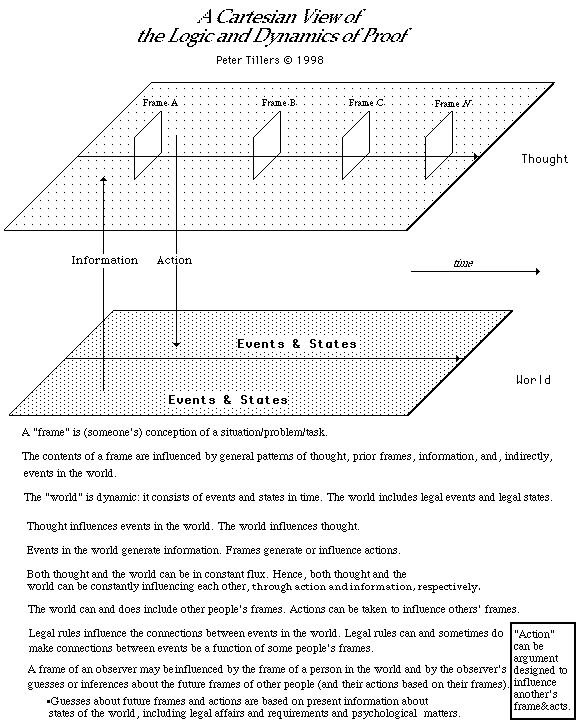
N.B. The thing ^ is Priit Parmakson's adaptation -- reconfiguration -- of one of my images.James Franklin, "Diagrammatic Reasoning and Modelling in the Imagination: the Secret Weapons of the Scientific Revolution," in, G. Freeland & A. Corones, eds., 1543 and All That: Image and Word, Change and Continuity in the Proto-Scientific Revolution (Dordrecht, 1999) (footnotes omitted):
"One must consider the affection which is produced in the soul, and in that part of the body which contains the soul -- the affection, the lasting state of which we call memory -- as a kind of picture" : Aristotle 145 "There are no such things as mental pictures" : Ryle 146 We live at the end of a period which, perhaps more than any other, has hidden the pictorial life of the mind from intellectual view. Philosophy in the mid-[20th] century regarded "sense data" as fictions, arrived at by (bad) inference and suitable for disposal as an undergraduate exercise. It was seriously maintained that all inner representation was propositional. (That is philosophy in the English-speaking tradition; continental philosophy being, if anything, even more word-oriented). Psychology in the behaviourist decades was not much concerned with any inner life, pictorial or not, and "imagery" tended to be associated with the Gestalt school, labelled "unscientific". Introspection, despite being reproducible with reasonable consistency, was ruled out as a source of experimental data. Frege, Russell and Hilbert, followed by Turing and the computer scientists and Artificial Intelligentsia, imposed on the learned world a view of inference as the manipulation of uninterpreted symbols according to formal rules. No room for pictures there. Even mathematics, once centred on geometry, maintained hardly any formal role for pictures, holding that geometrical intuition is unreliable. Galton was surprised to find even at the end of the nineteenth century that scientists were claiming to think in symbols, not images, and supposed that science had atrophied the imagination. It is true that there has been a kind of tradition in the physical sciences of remarks on the need for mental geometrical intuition, but it is one of those "traditions" that presents itself as a novelty every time it is reinvented. At about the time Ryle was denying the reality of mental pictures, Einstein was saying:The words or the language, as they are written or spoken, do not seem to play any role in my mechanism of thought. The psychical entities which seem to serve as elements in thought are certain signs and more or less clear images which can be "voluntarily" reproduced and combined . . . The above mentioned elements are, in my case, of visual and some of muscular type. Conventional words or other signs have to be sought for laboriously only in a secondary stage, when the mentioned associative play is sufficiently established and can be reproduced at will.Generally, though, the image was left to intellectual marginals: diagrammatic inference to the engineers, with their slide rules, flow charts and circuit diagrams, and mental images to the Freudians and their dream fantasies.The result is that the late-millennial intellectual has several layers of defence against accepting the medieval unselfconsciousness about using the imagination as a tool for doing science. First, we doubt the existence of the inner life at all. Or, we regard it as reached only by a chain of inference, not open to view. Or, we regard it as vague, and primarily emotional, not precise and scientific. Or, we presume the "stream of consciousness", if there is one, is a flow of words, the preserve of psychiatrists and novelists. Or, if we do take the visual side of the imagination seriously, we think of it as something like a muse, "inspiring" artists and poets in a manner too sublime to analyse. We have every excuse for misunderstanding.
At the leading edge of science, this picture is no longer true. Two developments especially have made the difference: psychological experiments on mental images, and scientific visualization by computer. The psychological work is especially relevant. Around 1970, Shepard and Metzler found that the time subjects took to decide whether one 3D figure could be rotated to fit in the same space as another was proportional to the angle required, suggesting that the subjects were actually performing the rotation in some kind of mental space. Since then, similar techniques have been used to investigate how subjects imagine themselves in an environment while mentally searching it, and how they construct a mental model from a description of a scene. It is found generally that reasoning about space is done by means of mental models, not via chains of propositions. In view of what was said above about the importance of reasoning in three dimensions, it is significant that 3D imagining is found to be remarkably powerful: one can, for example, mentally scan across an imagined space from any viewpoint: the space is mentally encoded in 3D, but can be "displayed" from any viewpoint in 2D.
The other development that has given images scientific respectability is the very recent availability of computer-intensive visualisation tools, used for such purposes as understanding complex fluid flows. The images are not themselves mental, but of course the point of computer visualization is to create pictures that lead to understanding, that is, cause suitable mental representations. To some extent, the two themes are connected by research in education, which finds that mental visualization is a necessary skill for learning in the sciences. Anyone with some sympathy for the idea that ontogeny recapitulates phylogeny will be ready to look for some parallel process in the history of science.
These developments are yet to flow through into general intellectual consciousness, but progress has been sufficient to assert, at least, that Aristotle was more right than Ryle, and that there are no longer any barriers in principle to taking literally what the medievals were saying about mental images.
Sunday, October 15, 2006
Inferring Other People's Actions and Intentions
Giacomo Rizzolatti, Leonardo Fogassi, and Vittorio Gallese, "Mirrors in the Mind," Scientific American 54 (November 2006):
John watches Mary, who is grasping a flower. John knows what Mary is doing--she is picking up the flower--and he also knows why she is doing it. Mary is smiling at John, and he guesses that she will give him the flower as a present. The simple scene lasts just moments, and John's grasp of what is happening is nearly instantaneous. But how exactly does he understand Mary's action, as well as her intention, so effortlessly?***
[Our research group] found that answer somewhat accidentally in a surprising class of neurons [which we later called "mirror neurons"] in the monkey brain that fire when an individual performs simple goal-directed motor actions...
... John grasps Mary's action because even as it is happening before his eyes, it is also happening, in effect, inside his head. It is interesting to note that philosophers in the phenomenological tradition long ago posited that one had to experience something within oneself to truly comprehend it. But for neuroscientists, this finding of a physical basis for that idea in the mirror neuron system represents a dramatic change in the way we understand the way we understand.
Wednesday, September 13, 2006
Conference on Graphic and Visual Representations of Evidence and Inference in Legal Settings
Dates: January 28-29, 2007.
Venue: Cardozo Law School, Yeshiva University, 55 Fifth Avenue (5th Ave. & 12th St.), New York (Manhattan), New York
First day (January 28, 2007):
9.00am-9.20am: Welcoming Comments (Tillers)
9.20am-11.00am:
Vern Walker, Visualizing the Dynamics around the Rule/Evidence Interface
in Legal Reasoning
Richard Sherwin & Neal Feigenson, Thinking beyond the Shown: Implicit
Inferences in Visual Evidence and Argument
Marc Lauritsen, Comment
11.00am-11.20am: coffee break
11.20am-1.00pm:
Tim van Gelder, Rationale: A Generic Argument Mapping Tool
Chris Reed, Wigmore, Toulmin and Walton: The Diagramming Trinity and
their Application in Legal Practice
Dale Nance, Comment
1.00pm-2.00pm: lunch
2.00pm-3.40pm:
John L. Pollock, Some Puzzles about Defeasible Reasoning
Ron Loui, A Modest Proposal for Annotating the Dialectical State of
a Dispute
Richard Lempert, Comment
3.40pm-4.00pm: tea break
4.00pm-5.20pm:
Thomas F. Gordon & Doug Walton, Visualizing Arguments of the Carneades
Argumentation Framework
Bart Verheij, Virtual Arguments: On the Design of Argument Assistants
for Lawyers and Other Arguers
5.20pm-6.30pm: dinner
6.30pm-8.15pm:
Doug Walton, Argumentation Theory for the Law of Evidence
Henry Prakken, Argument Visualisation Software for Crime Investigators:
Design and First Experiences
William Twining, Comment
Second day (January 29, 2007):
9.00am-10.40am:
John Lowrance, Graphical Manipulation of Evidence in Structured Arguments
John Josephson, Graphical Display of Evidence and Inference in a Prototype
System for Command-Post Information Fusion
10.40am-11.00am: coffee break
11.00am-1.00pm:
David Schum & Jon Morris, Law Comes to the Rescue of Intelligence
Analysis: Evaluating HUMINT
Philip Dawid, Bayesian Networks for the Analysis of Evidence
Branden Fitelson, Argument Diagrams, Bayes Nets, and Independent Evidence
1.00pm-2.00pm: lunch
2.00pm-3.40pm:
Bruce Hay, Law's Visual Imagination
Priit Parmakson, Can Effective Visual Representations Be Produced Systematically?
Neal Feigenson, Comment
3.40pm-4.00pm: tea break
4.00pm-6.20pm:
Thomas Cobb, Argument Visualization as Jury Reform
Jennifer Mnookin, Visual and Expert Evidence: Rhetorical Connections
and Invisible Affinities
Samuel Solomon, Visual Storytelling - Contextualizing Evidence through
Visualization Taken from Real Cases
David Tait, Comment
6.20pm-6.35pm: Closing Comments (Tillers)
Conference officials:
Peter Tillers (Cardozo Law School): Conference chair; e-mail address: peter@tillers.net
Henry Prakken (Universiteit Utrecht & University of Groningen): Program
chair; e-mail address: henry@cs.uu.nl
Thomas D. Cobb (University of Washington, Seattle): Deputy program chair;
e-mail address: tomcobb@u.washington.edu
Jonathan Gottfried: Local affairs coordinator: Jonathan Gottfried; e-mail address: jgottfried@pobox.com"
Panelists:
Lecturer
University of Washington School of Law
Professor of Statistics
University of College London
Professor
Quinnipiac University School of Law
Assistant Professor of Philosophy
University of California at Berkeley
Associate Professor of Philosophy
University of Melbourne
Senior Research Scientist
eGovernment Competence Center
Fraunhofer Institut fuer Offene Kommunikationssysteme; web log
Professor
Harvard Law School
Research Scientist
Laboratory for Artificial Intelligence Research
Computer Science and Engineering
Ohio State University
President
Capstone Practice Systems
Eric Stein Distinguished University Professor of Law and Sociology
University of Michigan Law School
Associate Professor of Computer Science and Engineering
Washington University in St. Louis
Program Director, Artificial Intelligence Center
SRI International
Professor
UCLA School of Law
Affiliate Faculty Member
School of Information Engineering and Technology
Systems Engineering and Operations Research
George Mason University
Professor
Case Western Reserve University School of Law
Lecturer
Tallinn University
Professor of Philosophy and Cognitive Science
University of Arizona
Lecturer, Department of Information and Computing Sciences
Utrecht University
&
Professor of Law and ICT
Faculty of Law
University of Groningen
Senior Lecturer & Assistant Head of Research
University of Dundee
Professor
Systems Engineering & Operations Research
George Mason University
Professor & Director, Visual Persuasion Project
New York Law School
Chairman & CEO
DOAR Litigation Consulting
Senior Lecturer
School of Law
University of Canberra
Professor
Cardozo School of Law
Yeshiva University
Quain Professor of Jurisprudence emeritus
University College London Law Faculty &
Professor
University of Miami School of Law
Lecturer & Researcher
Artificial Intelligence
University of Groningen
Professor
Hofstra University School of Law
Professor of Philosophy
University of Winnipeg
Description of conference:
One of the largest problems faced by criminal investigators, litigators, paralegals, triers of fact, and others interested in disputes about factual questions in legal settings is the sheer mass of evidence available. It is often difficult to remember, retrieve, and interpret voluminous evidential information, and important relationships and inconsistencies may go unnoticed as a result. Tools that support the storage, retrieval, and interpretation of large masses of evidence would therefore be of great use.
Psychological studies have shown that people's ability to remember, retrieve, and interpret information is greatly enhanced when they organize it in a way that is meaningful to them. Scholars of the law of evidence have long suggested that graphical representations of evidential arguments and inferences could help people make sense of masses of evidence. As early as 1913, John Henry Wigmore claimed that his charting method promotes rational thinking about legal evidence. Wigmore had only pencil and paper to draw his cumbersome graphs. Today computer software may make it possible for almost anyone to construct useful graphical representations of arguments and inferences related to large collections of evidence. If such software were combined with with existing database, document management, and search technology, documentary evidence could be stored and retrieved in accordance with the user's view of a case. This would facilitate the transfer of a case file from one person to another because it would make it easier for recipients of files to grasp the signficance of the evidentiary details of a case.
Software for graphical representation of evidential argument is currently being investigated for use in various domains. Argument visualization software has been designed, for instance, to support the teaching of scientific reasoning and critical thinking skills (e.g., Belvedere, Reasonable, Araucaria, Convince Me), to support intelligence analysis, and to facilitate individual or collaborative problem solving (e.g., Questmap, SEAS). Moreover, current artificial intelligence research offers precise accounts of evidential reasoning and thus provides a clear semantics of graphical notations as well as computationall methods.
In the legal domain, fact investigators and litigators increasingly use software that supports the storage and retrieval of information in terms of conceptual and relational networks (e.g., Holmes 2, Analyst's Notebook). As yet, however, such tools offer little or no support for structuring thinking about information: existing software allows users to store evidentiary data in terms of events, objects, actors, and the relations among these things, but it does not allow users to represent how such data support or undermine factual hypotheses.
This interdisciplinary conference brings together scholars and practitioners from fields such as law, philosophy, computer science, artificial intelligence, cognitive psychology, and linguistics. The following topics and issues will be addressed:
- New and current graphical means for visualization of factual inference and proof.
- Semantics of graphical notations: what are the underlying theories of evidential reasoning, including jurisprudential, philosophical, psychological, rhetorical, logical, and mathematical theories?
- Software tools that are currently available or under development for graphical representation of factual inference and proof.
- Potential contexts for the use of such software (e.g., criminal investigation, intelligence analysis, trials, and law teaching).
- Can graphical representation of evidential argument support automatic evaluation of hypotheses?
- How can current insights into human-computer interactuions be exploited to increase the usefulness of such software; e.g., how can visual complexity generated by large masses of evidence be managed?
- Are there pertinent empirical studies and findings about real-world use of evidence-charting methods in legal and other contexts?
The public is warmly encouraged to attend. Adavance registration is not required and there is no registration fee. However, there will be a charge for any lunches or dinners that attendees elect to take at the site of the conference, at Cardozo Law School. If you are not a panelist and would like to join us for any lunches or dinners at Cardozo, please RSVP to the address shown below by January 15, 2007, and indicate which meals you wish to purchase, enclosing payment of $35 for each. Please make checks payable to Cardozo School of Law. Send payment to
Alisa Norr
Legal Secretary
Friedman Kaplan
Seiler & Adelman LLP
1633 Broadway, 46th floor
New York, NY 10019
United States
Hotel arrangements may be made through the conference travel agency:
Morris Park Travel Bureau
1745 Wiliamsbridge Road
Bronx, NY 10461
1-718-792-9850 or toll free 1-877-526-8844
Fax: 1-718-863-7121
Email: MPTVL@AOL.COM
Sunday, September 10, 2006
The Estimable Mr. William Safire on the Definition of Evidence and Proof
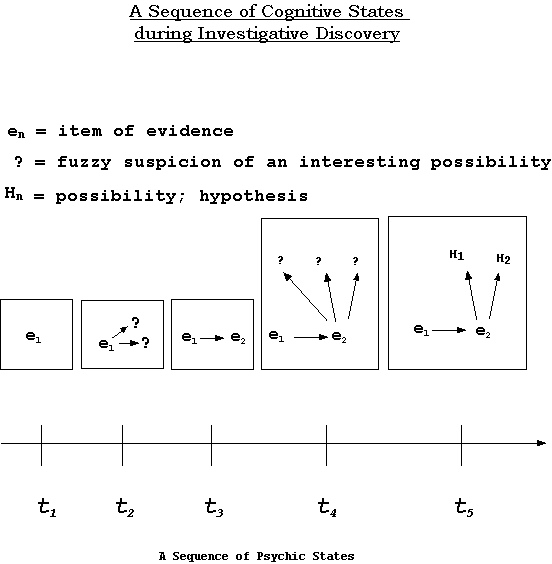 The following comment in today's New York Times Magazine is better than just about anything I have seen in any scholarly treatise on the law of evidence:
Evidence Some of our top intelligence officials are irritated at the way their analysts have been playing down reports from agents in the field of contacts between Hezbollah in Lebanon and Iran’s Revolutionary Guard. Gun-shy after criticism about past analyses of a series of contacts between Saddam’s Iraq and Al Qaeda, they are said to be “unwilling to make judgment calls.. . .We’re not in a court of law,” a source identified as “a senior United States official” told Mark Mazzetti of The Times. “When they say there is ‘no evidence,’ you have to ask them what they mean — what is the meaning of the term ‘evidence’?”
...
The job of a rhetorician is to answer rhetorical questions. I would sharpen the question, “What is the meaning of the word evidence?” by adding “and how is it different from proof?” Here’s an answer:
First, forget the cliché modifier credible; when it comes to evidence, what is believable to one analyst is incredible to another. Evidence may be hard or soft, conflicting or incontrovertible, it may be unpersuasive or convincing, exculpatory or damning, but with whatever qualifier it is presented, the noun evidence is neutral: it means “a means of determining whether an assertion is truthful or an allegation is a fact.”
But here’s the rub that rubs so many intelligence analysts the wrong way: Evidence — from tips, taps, tapes, testimony, confessions, weapons, documents, satellite photos and the like — is not in itself proof. Only the conclusion that experienced minds draw from a weighing of all the evidence can approach proof. With that requirement for human judgment understood, intelligence analysts can take their best shot.
Tuesday, September 05, 2006
Draft Program & Other Information for Conference on Graphic and Visual Representations of Evidence and Inference in Legal Settings
Dates: January 28-29, 2007.
Venue: Cardozo Law School, Yeshiva University, 55 Fifth Avenue (5th Ave. & 12th St.), New York (Manhattan), New York
* First day (January 28, 2007):
9.00am-9.20am: Welcoming Comments (Tillers)
9.20am-11.00am: 2 talks + 1 comment:
Vern Walker, Visualizing the Dynamics around the Rule/Evidence Interface
in Legal Reasoning
Richard Sherwin & Neal Feigenson, Thinking beyond the Shown: Implicit
Inferences in Visual Evidence and Argument
Marc Lauritsen, Comment
11.00am-11.20am: coffee break
11.20am-1.00pm: 2 talks + 1 comment
Tim van Gelder, Rationale: A Generic Argument Mapping Tool
Chris Reed, Wigmore, Toulmin and Walton: The Diagramming Trinity and
their Application in Legal Practice
Dale Nance, Comment
1.00pm-2.00pm: lunch
2.00pm-3.40pm: 2 talks + 1 comment
John L. Pollock, Some Puzzles about Defeasible Reasoning
Ron Loui, A Modest Proposal for Annotating the Dialectical State of
a Dispute
Richard Lempert, Comment
3.40pm-4.00pm: tea break
4.00pm-5.20pm: 2 talks
Thomas F. Gordon & Doug Walton, Visualizing Arguments of the Carneades
Argumentation Framework
Bart Verheij, Virtual Arguments: On the Design of Argument Assistants
for Lawyers and Other Arguers
5.20pm-6.30pm: dinner
6.30pm-8.15pm: 2 talks + 1 comment
Doug Walton, Argumentation Theory for the Law of Evidence
Henry Prakken, Argument Visualisation Software for Crime Investigators:
Design and First Experiences
William Twining, Comment
* Second day (January 29, 2007):
9.00am-10.40am: 2 talks + 1 comment
John Lowrance, Graphical Manipulation of Evidence in Structured Arguments
John Josephson, Graphical Display of Evidence and Inference in a Prototype
System for Command-Post Information Fusion
Burkhard Schafer, Comment
10.40am-11.00am: coffee break
11.00am-1.00pm: 3 talks
David Schum & Jon Morris, Law Comes to the Rescue of Intelligence
Analysis: Evaluating HUMINT
Philip Dawid, Bayesian Networks for the Analysis of Evidence
Branden Fitelson, Argument Diagrams, Bayes Nets, and Independent Evidence
1.00pm-2.00pm: lunch
2.00pm-3.40pm: 2 talks + 1 comment
Bruce Hay, Law's Visual Imagination
Priit Parmakson, Can Effective Visual Representations Be Produced Systematically?
Neal Feigenson, Comment
3.40pm-4.00pm: tea break
4.00pm-6.20pm: 3 talks + 1 comment
Thomas Cobb, Argument Visualization as Jury Reform
Jennifer Mnookin, Visual and Expert Evidence: Rhetorical Connections
and Invisible Affinities
Samuel Solomon, Visual Storytelling - Contextualizing Evidence through
Visualization Taken from Real Cases
David Tait, Comment
6.20pm-6.35pm: Closing Comments (Tillers)
Conference officials:
Peter Tillers (Cardozo Law School): Conference chair e-mail address: peter@tillers.net
Henry Prakken (Universiteit Utrecht / University of Groningen): Program
chair e-mail address: henry@cs.uu.nl
Thomas D. Cobb (University of Washington, Seattle): Deputy program chair
e-mail address: tomcobb@u.washington.edu
Panelists:
Description of conference:
One of the largest problems faced by crime investigators, litigators, paralegals, judges, triers of fact, and other actors interested in disputes about factual questions in legal settings is the sheer mass of available evidence in many cases. It is often difficult to remember, retrieve, and interpret evidential information, so that patterns, relations, and inconsistencies often go unnoticed. Tools that support the storage, retrieval, and interpretation of masses of evidence could therefore be of great use.
Psychological studies have shown that people's ability to remember, retrieve,
and interpret information is greatly enhanced when people organize information
in a way that is meaningful to them. Scholars of the law of evidence have
long suggested that graphical representations of evidential arguments and
inferences could support humans in making sense of masses of evidence. As
early as 1913, John Henry Wigmore claimed that his charting method promoted rational thinking about legal evidence. Wigmore had only pencil and paper to draw his cumbersome graphs. Today the computer could make his ideas practically useful for everyone: Software could be used to draw graphical representations of arguments and inferences about masses of evidence. Moreover, such software could be combined with existing database, document management, and search technology so that collections of evidentiary documents could be stored and retrieved in terms of the user's thinking about a case. Such software would also facilitate transfer of case files to others by increasing the transparency of the files, so that subsequent investigators, prosecutors, and fact finders could gain a quicker and better understanding of the case.
Such software is currently being investigated for use in various domains.
Argument visualization software has been designed, for instance, to support
the teaching of scientific reasoning or critical thinking skills (Belvedere,
Reasonable, Araucaria, Convince Me), to support intelligence analysis, and
to facilitate individual or collaborative problem solving (Questmap, SEAS).
Moreover, current artificial intelligence research offers precise accounts
of evidential reasoning and thus provides a clear semantics of graphical
notations as well as ways to compute with them.
In the legal domain, fact investigators and litigators increasingly use software that supports the storage and retrieval of information in terms of conceptual and relational networks (Holmes 2, Analyst's Notebook). However, as yet, such tools for the storage and retrieval of information offer little or no support for the structuring of human thinking about information: Existing software for storing and retrieving information allows users to store evidentiary data in terms of events, objects, actors, and the relations among these things, but it does not allow users to represent how such data support or undermine hypotheses about what has happened.
This interdisciplinary conference brings together scholars and practitioners from such fields as law, philosophy, computer science, artificial intelligence, cognitive psychology, and linguistics who are interested in the graphic visualization of legal evidentiary inference and its support by software tools. The following issues will be addressed:
Current and new graphical means to visualize factual inference and proof
Semantics of such graphical notations: what are the underlying theories of evidential reasoning? (jurisprudential, philosophical, psychological, rhetorical, logical, or mathematical)
Which software tools for graphical representations of factual inference and proof are currently available or being developed?
What are the potential contexts for the use of such software and what are the potential benefits of such software? (crime investigation, litigation, trial, law teaching, etc.)
To what extent can graphic representation of evidential arguments support the automatic evaluation of hypotheses?
How can current insights about human-computer interaction be exploited to increase the usefulness of such software? (e.g., how can visual complexity created by the size of the available mass of evidence be managed?)
Are empirical results available on usability and effects of use of charting methods (whether manual or digital) in legal or other contexts?
What are the practical constraints faced by crime investigators or legal professionals who want to use such software?
The public is invited. There is no registration fee. (However, there will be a modest charge for any lunches or dinners that attendees elect to take at the site of the conference, at Cardozo Law School.)
Hotel and flight arrangements may be made through the conference travel agency:
Morris Park Travel Bureau
1745 Wiliamsbridge Road
Bronx, NY 10461
1-718-792-9850 or toll free 1-877-526-8844
Fax: 1-718-863-7121
Email: MPTVL@AOL.COM
Sunday, September 03, 2006
Scholars & Recluses
 In a letter to the editor Professor Mark Gerstein of Yale writes:
One cannot help but wonder whether the way that Dr. Perelman sequestered himself from the minutiae of academic life and from e-mail and correspondence altogether is a principal reason he has been able to think so deeply about a problem.NYTimes, Sunday, September 3, 2006 There may be some truth in what Gerstein says. However, note that Gerstein is a professor of biomedical informatics and molecular biophysics. I think few law teachers genuinely share Gerstein's sentiments; legal scholars are generally gregarious (though not usually convivial or diplomatic) and legal scholarship is rarely done in splendid isolation.Perhaps tranquil reclusion is a prerequisite for brilliant thought, as evident in other legendary geniuses like Newton and Darwin.
If legal scholarship is rarely done in "tranquil reclusion," does it follow that legal scholarship is rarely the product of "brilliant thought"? The possibility cannot be dismissed out of hand!
Perelman, however, is not the only genius known to (wo)mankind. For example, Albert Einstein was a genius. But Einstein was not really a reclusive fellow. Nor were Aristotle, Descartes, Rousseau, G.W.F. Hegel, Bertrand Russell, Richard Feynman, Robert Oppenheimer, Charles Peirce (who, however, was a very strange man), Mozart, and many other "geniuses."
N.B. Today one does not count as a genius if one does not appear on TV. Proof: In internal memoranda circulated at my law school, faculty members' appearances in the mass media are routinely noted and celebrated -- but there are few equivalent internal memoranda celebrating faculty members' scholarly publications.
Saturday, September 02, 2006
Graphic and Visual Representations of Evidence and Inference in Legal Settings: An Update
Dates: January 28-29, 2007.
Venue: Cardozo Law School, Yeshiva University, 55 Fifth Avenue (5th Ave. & 12th St.), New York (Manhattan), New York
Description of conference:
One of the largest problems faced by crime investigators, litigators, paralegals, judges, triers of fact, and other actors interested in disputes about factual questions in legal settings is the sheer mass of available evidence in many cases. It is often difficult to remember, retrieve, and interpret evidential information, so that patterns, relations, and inconsistencies often go unnoticed. Tools that support the storage, retrieval, and interpretation of masses of evidence could therefore be of great use.
Psychological studies have shown that people's ability to remember, retrieve,
and interpret information is greatly enhanced if they organize information
in a way that is meaningful to them. Scholars of the law of evidence have
long suggested that graphical representations of evidential arguments and
inferences could support humans in making sense of masses of evidence. As
early as 1913, John Henry Wigmore claimed that his charting method promoted rational thinking about legal evidence. While Wigmore had only pencil and paper to draw his cumbersome graphs, today the computer could make his ideas practically feasible for everyone. Software could be used to draw graphical representations of arguments and inferences about masses of evidence. Moreover, such software could be combined with existing database, document management, and search technology so that collections of evidentiary documents could be stored and retrieved in terms of the user's thinking about a case. Such software would also facilitate transfer of case files to others by increasing the transparency of the files, so that subsequent investigators, prosecutors, and fact finders could gain a quicker and better understanding of the case.
Such software is currently being investigated for use in various domains.
Argument visualization software has been designed, for instance, to support
the teaching of scientific reasoning or critical thinking skills (Belvedere,
Reasonable, Araucaria, Convince Me), to support intelligence analysis, and
to facilitate individual or collaborative problem solving (Questmap, SEAS).
Moreover, current artificial intelligence research offers precise accounts
of evidential reasoning and thus provides a clear semantics of graphical
notations as well as ways to compute with them.
In the legal domain, fact investigators and litigators increasingly use software that supports the storage and retrieval of information in terms of conceptual and relational networks (Holmes 2, Analyst's Notebook). However, as yet, such tools offer little or no support for the structuring of human thinking about thus stored information. This software allows users to store evidentiary data in terms of events, objects, actors, and the relations among these things, but it does not allow users to represent how such data support or undermine hypotheses about what has happened.
This interdisciplinary conference brings together scholars and practitioners from such fields as law, philosophy, computer science, artificial intelligence, cognitive psychology, and linguistics who are interested in the graphic visualization of legal evidentiary inference and its support by software tools. The following issues will be addressed:
Current and new graphical means to visualize factual inference and proof
Semantics of such graphical notations: what are the underlying theories of evidential reasoning? (jurisprudential, philosophical, psychological, rhetorical, logical, or mathematical)
Which software tools for graphical representations of factual inference and proof are currently available or being developed?
What are the potential contexts for the use of such software and what are the potential benefits of such software? (crime investigation, litigation, trial, law teaching, etc.)
To what extent can graphic representation of evidential arguments support the automatic evaluation of hypotheses?
How can current insights about human-computer interaction be exploited to increase the usefulness of such software? (e.g., how can visual complexity created by the size of the available mass of evidence be managed?)
Are empirical results available on usability and effects of use of charting methods (whether manual or digital) in legal or other contexts?
What are the practical constraints faced by crime investigators or legal professionals who want to use such software?
Conference officials:
Peter Tillers (Cardozo Law School): Conference chair e-mail address: peter@tillers.net
Henry Prakken (Universiteit Utrecht / University of Groningen): Program
chair e-mail address: henry@cs.uu.nl
Thomas D. Cobb (University of Washington, Seattle): Deputy program chair
e-mail address: tomcobb@u.washington.edu
Panelists:
Program details will be provided later.
Drafts and abstracts of some or all papers will be made available online at http://tillers.net/conference.html shortly before the conference begins. Final versions of the papers will be published in Law, Probability and Risk in 2007 and 2008.
The public is warmly encouraged to attend the conference. Advance registration is not required and there is no registration fee. However, there will be a charge for any lunches or dinners that attendees elect to take at the site of the conference, at Cardozo Law School. If you are not a panelist and would like to join us for any lunches or dinners at Cardozo, please RSVP to the address shown below by January 15, 2007, and indicate which meals you wish to purchase, enclosing payment of $35 for each. Please make checks payable to Cardozo School of Law. Send payment to
Alisa Norr
Legal Secretary
Friedman Kaplan
Seiler & Adelman LLP
1633 Broadway, 46th floor
New York, NY 10019
United States
Hotel and flight arrangements may be made through the conference travel agency:
Morris Park Travel Bureau
1745 Wiliamsbridge Road
Bronx, NY 10461
1-718-792-9850 or toll free 1-877-526-8844
Fax: 1-718-863-7121
Email: MPTVL@AOL.COM
Saturday, August 19, 2006
A Useful Skeptic
Jack Shafer of the online magazine Slate has been a longtime, thoughtful, and valuable skeptic about numbers often bandied about in the media -- numbers pertaining to matters such as the incidence of "meth" use, child kidnapping, the accuracy of various kinds of putative "deception detectors," and the like. His most recent article More Mythical Numbers (August 16, 2006) further documents the lack of documentation for estimates of the number of victims of human trafficking.
Keep it up Jack!
As I recall, Shafer was equally skeptical of inflated claims about:
Keep it up Jack!
As I recall, Shafer was equally skeptical of inflated claims about:
Bad things -- child abuse etc. -- do happen, of course. But if we want to say how often such bad things happen, let's use good numbers. So let's actually count -- carefully. And when we do count, let's be quite clear about what is being counted.
hunger in America
One Massachusetts organization managed to get such figures very high by defining (it told me) "hungry children in Massachusetts" with the number of children in Massachusetts who experienced two or more "episodes of hunger" in a given calendar year. child abuse in America
I recall that the "statistics" bandied about one year seemed to suggest that 25% or more of all children had been "abused" in any given year. Many organizations got child and wife abuse figures into the stratosphere by adopting very broad definitions of "abuse" or -- just as often -- by quoting the figures made up by some self-professed and oft-quoted "expert."
Thursday, August 10, 2006
A Close Encounter with a Prominent Celestial Phenomenon

I was a faithful member of the Columbus Astronomical Society. The time was the mid-1950s. I was 12 or 13 years old. The third Saturday of every month was the day for amateur observing at the McMillan Observatory on the Ohio State campus. On one such Saturday it was raining cats and dogs in the afternoon. Nonetheless, I took my trusty bicycle and rode from my home on the south side of Columbus to Ohio State University, which was far away on the north side. On arriving at the observatory I met two men, who were huddled over a calculator. They told me, naturally, that observing with the telescope was cancelled that night. I asked them what they were doing. They told me they had been making observations of a particular star and they were doing calculations that night to confirm that the star had the greatest apparent motion of any star that had thus far been observed. They wished me well in my study of astronomy. One them was, he said, J. Allen Hynek. See biographical note . For years -- until today – I thought I had met James A. van Allen, the discoverer of the Van Allen Belts, who just died. See NYTimes obituary. I’m glad to see that J. Allen Hynek had a distinguished career of his own. In addition to teaching at Harvard for a few years (after leaving Ohio State University) and becoming the head of the astronomy department at Northwestern University (in 1960), Hynek became become a prominent (and reputable) investigator of UFOs and was a consultant for Close Encounters of the Third Kind. See 1985 interview.
Does this story about my brush with fame have anything to do with evidence or the law of evidence?
Probably not. But perhaps -- with some effort -- it could serve as an object lesson about the frailty of human memory -- and then about our ability to uncover evidence that nonetheless gets the historical story straight.
The Death of a Youth and of a Drunkard
2005 preprint, published in R. Lempert, Evidence Stories (Foundation Press 2006)

Sunday, August 06, 2006
A New MarshalPlan!
There is now available a standalone version of MarshalPlan. This computer-generated gizmo -- and the words that follow are carefully chosen -- is a software representation of an approach to evidential inference that emerged out of my collaboration with David Schum in the late 1980s and early 1990s. This software -- one might call it MarshalPlan 2.0 -- is not exactly a "concept" of a software tool. It is a bit closer to being a "proof of concept"; i.e., MarshalPlan illustrates how my approach to inference works -- and that it does work. In any event, MarshalPlan is very clunky technologically speaking -- for example, some of the "buttons" in the various "stacks" that comprise my evidence marshaling system do not work; some or all of the color schemes I use are, at best, aesthetically unappealing; and the layout of fields, buttons, and other objects on the visual fields is inefficient.
The original version of MarshalPlan was created with HyperCard. The current version of MarshalPlan was created with Revolution Enterprise, a sophisticated successor to HyperCard. The sophistication of Revolution, however, is not matched by any sophistication that Tillers has in programming or scripting. Indeed, even though Revolution makes it easy for even an idiot to develop software, the author of MarshalPlan 2.0 is less than an idiot.
This clunky software, moreover, comes without commentary. You will not even find many explanatory notes. The only software manual you will find takes the form of published literature that lays out some (but not all) of the theoretical underpinnings for MarshalPlan. See, first, P. Tillers & D. Schum, A Theory of Preliminary Fact Investigation; and, second, David Schum, The Evidential Foundations of Probabilistic Reasoning 491-504 (Wiley & Sons, 1994; paperback reprint, Northwestern University Press, 2001). If you wish to have explanations, you will have to invite me to give a talk (and you will have to pay my expenses) or you will have to attend Professor Edward Cheng's Evidence Colloquium at Brooklyn Law School on November 21, 2006 -- my general topic will be "Reasoning about Evidence." Alternatively, come to the Cardozo Law School conference on Graphic and Visual Representations of Evidence and Inference in Legal Settings. It is possible that I will talk a bit about MarshalPlan 2.0 then.
If you would like to download MarshalPlan from the web, please send me an e-mail request (at peter@tillers.net) and, if your purposes are benign, I will send you the URL for the download page and a username and a password.
Today I added one (but just one) word of explanation in MarshalPlan 2.0. I inserted the following comment in a field in an otherwise empty stack called "Probative Value & Credibility Assessment":
MarshalPlan has no stack that lays out a strategy for assessing the probative value of evidence. This is only because I have nothing much to add to the extensive and exciting work that has been done and continues to be done on various kinds of inference networks. The leaders in this field are people such as Henry Prakken, Douglas Walton, Timothy van Gelder, and David Schum. (Judea Pearl has a very important theory of inference networks. But his theoretical commitment to the notion that there is no good inference without judgments about causal links sharply limits the utility of his theory for present purposes.)A Very Import Acknowledgment: If MarshalPlan 2.0 has any virtues, the credit belongs much more to David Schum than it does to me. Correlatively, if MarshalPlan 2.0 has any vices (and I think it has many), the fault is literally entirely mine.Credibility assessment is a special form of weight-of-evidence-assessment; i.e., it involves a special form of inference network logic; i.e., reasoning about testimonial credibility involves a special form of hierarchical evidential inference. The most elaborate and sophisticated theory of witness credibility assessment is the one developed by David Schum. (A gap in his theory -- the only significant gap I can find -- is the absence of much of anything about "linguistic uncertainty," the uncertainty one may have about a testimonial report because of the limitations in the speaker's ability to use language and, more generally, because of the inherent imprecision and ambiguity of language.)
The absence of a stack [in MarshalPlan] for weighing the probative value of evidence (including testimonial evidence) proves that weighing evidence involves more than weighing evidence: The weighing of evidence requires discovering evidence, imagining hypotheses, developing arguments, and a host of other mental activities, some of which are identified by the stacks in MarshalPlan. All of these activities involve imagination and constructive mental activity. (But these mental processes are not limited to imagination and mental fabrication: They also involve the EVIDENCE, which is an essential constraining force on human imagination and judgment.)
Wednesday, July 26, 2006
Here We Go Again: Hearsay, Shmearsay -- Any Good Old Hearsay Is Good Enough for the Commissions
Hearsay has it that the administration won't be denied its hearsay:
David S. Cloud & Sheryl G. Stolberg, White House Bill Proposes System to Try Detainees (July 26, 2006).A justification sometimes seen & heard on C-Span: "They're criminal terrorists and they don't deserve anything more." Some folks need a refresher course on the purpose of adjudication.
The New York Times is condemned now and then for reporting stories from anonymous sources. But it's o.k., I guess, to condemn detainees on the basis of anonymous hearsay reports. It would be so much trouble and expense to track down available hearsay declarants. Just trust that hearsay stuff and imprison (further) those detainees -- or just shoot (hang?) them. We have to protect ourselves, don't we?
Although it may not be a good idea to exclude all hearsay, the notion that hearsay is generally just as good as first-hand accounts is a myth.
I'll bet that some triers of fact on commissions would do a decent job of evaluating hearsay. But it would be a bit better if those triers had some experience and training in evaluating hearsay. And all the training and experience in the world won't do much good if the triers of fact have next-to-no information about the hearsay declarants.
The evaluation of such hearsay accounts by human sources in Afghanistan and elsewhere is greatly complicated by the fact that much of it probably consists of tiers of hearsay (and probably little or nothing is known about many of the intermediate links in such hearsay chains) and that in many cases the abilities (and memories) of the translators (out there in Afghanistan and possibly also in Guantanamo) are questionable.
Yes, justice is sometimes inconvenient and expensive. But perhaps paying, say, 1/10 the cost of an aircraft carrier for better fact-finding for the detainees at Guantanamo (and elsewhere?) would be worthwhile. The rest of the world probably thinks so and it might respect us more if we showed that we are willing to spend time and money to make proceedings fair and fairly accurate even for people who we think meant us serious harm. And do remember that sometimes mistakes are made {Don't you love the passive voice?}: some of the people who we think tried to do us harm did not try to do so; they were instead, e.g., goatherds who were caught up in an indiscriminate sweep or were taken into custody as a result of misjudgments resulting from heightened fears and suspicions in times of military conflict.
If we really believe in principles, we must be prepared to pay a price for them.
Subscribe to:
Posts (Atom)
