Sunday, March 11, 2007

Legal Scholarship: No. 8

In discussions of legal scholarship there is sometimes talk of

Law versus Theory
or

Legal Doctrine versus Theory

The disjunction between law and theory is spurious -- at least to the extent that the asserted disjunction is meant as an assertion that a legal scholar must choose between doctrine and theory. It is plain -- common sense suggests -- that a legal scholar can discuss both doctrine and theory.

It occurred to me just yesterday that even the admirable combination of theory and doctrine may be too narrow. Even better is

The Golden Triad

The Golden Triad consists of

Legal Doctrine, Theory & Technology

or, more simply,

Law, Theory & Technology

See The Dynamic Evidence Page

N.B. Ward Edwards once said to a friend of mine that it takes a lot of good theory to make a useful tool. Ward Edwards was a wise man.

Saturday, March 10, 2007

Legal Scholarship: No. 7

Basic Research

In legal scholarship there should be an analogue to the notion of basic research in science. But academic legal scholars must not get the idea that basic research is that sort of research that never needs to be put to the test. Untestable research is cheap and easy -- because there is no way to determine whether results of such "basic research" are valid or invalid.

Legal Scholarship: No. 6

To avoid the disease of industrial scholarship -- mass-produced scholarship to satisfy the demands of employers and the appetites of consumers -- it might be a good idea to reinvigorate the the idea that the scholarly life is a quasi-monastic one.
  • Quasi-monastic, I say. The notion that we should reinstitute celibacy in the academy is admittedly a bit much.
  • A "No" Will Do -- But Perhaps "Yes" Would Also Pass Muster

    I just received the following question via the UAI -- Uncertainty in Artificial Intelligence -- list:
    Are you good at hierarchical clustering/causal discovery/graphical modeling/link analysis/phylogenetics/string-matching?
    Since I don't fully understand the question, I think I can fairly answer the question with either a "yes" or a "no."

    Legal Scholarship: No. 5

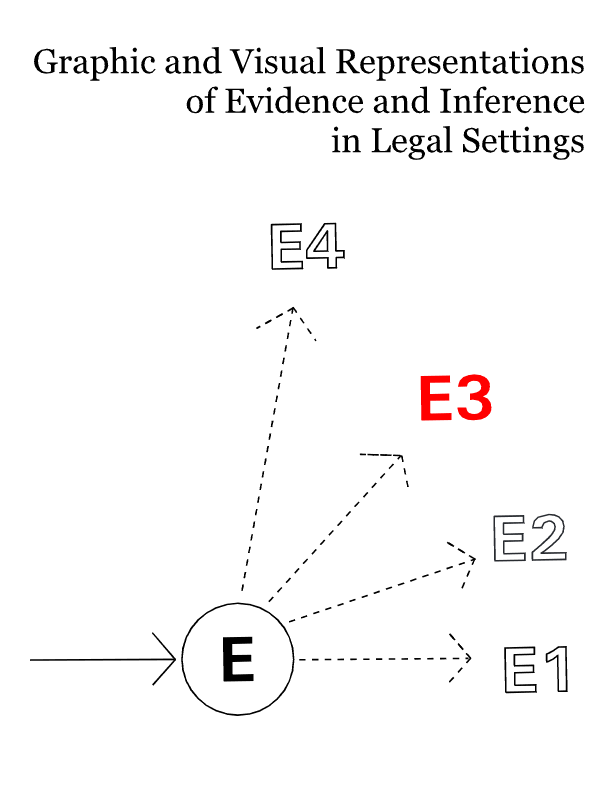
  • The above image is Prrit Parmakson's elegant recasting of a cruder image that I created.
  • ... but the use of citation counts or GOOGLE hits alone to measure the utility or scholarly merit of legal scholarship warrants the derogatory label "industrial scholarship"...

    Legal Scholarship: No. 4

    More on the legal treatise as (influential) legal scholarship:
    241 U.S. law journal articles in the LEXIS database have cited volume 1 or volume 1A of WIGMORE ON EVIDENCE (P. Tillers rev. 1983).
  • By a broader measure there were 320 citations in scholarly literature in the LEXIS database.
  • In GOOGLE the search terms "Wigmore Evidence Tillers" generated 1,140 hits today (but some of these hits are to my blogs and my other online material, and I estimate that 10% of the hits are false positives).

    Legal Scholarship: No. 3

    Legal Treatises

    The panel discussion at my law school involved many judges of the United States Court of Appeals for the Second Circuit. The gathering also involved (i) law faculty members at my law school, (ii) students at my law school, and (iii) assorted guests (many of them quite interesting).

    The topic was the "utility of legal scholarship to judges." The discussion initially focused almost exclusively on the utility vel non of law journal articles to judges. But some faculty members began to mention other possible forms of legal scholarship. I was no exception to this partially self-serving attempt to re-direct discussion: I raised the question of views (both outside and inside the legal academy) about the utility of legal treatises.

    Disclosure: I am working on a legal treatise. I also revised part of a legal treatise, part of John Henry Wigmore's monumental treatise on the law of evidence; I converted one of the volumes -- a hefty volume in small print -- into two hefty volumes (also in small print, with some of the longest footnotes known to man).

  • A Sign of the Times: This treatise is now available online.
  • More than two decades ago several prominent law teachers doubted the value of "doctrinal scholarship," including legal treatises. (The doubters were mainly lodged on the right side of the political spectrum and on the left side, but not in the moderate, or mushy, middle.) Earlier on this blog I expressed -- I reiterated -- my opinion that the notion that legal treatises cannot harbor original or creative thought is twaddle. See Platonic Hierarchies of Legal Scholarship.

    After the panel discussion with the judges, I had a hallway conversation that moved me to gather some data about the number of times that prominent courts cite to Wigmore's treatise, including my part of the treatise. Here is a bit of the largely self-serving stuff that I found and noted:

    There were a total of ca. 1,700 citations to the Wigmore Treatise by all U.S. courts from and including 2000 to the present.

    During the same period the Supreme Court of the United States cited to Wigmore's treatise in 17 judicial opinions.

  • For purposes of this count I do not distinguish between opinions of the Court, concurring opinions, and dissenting opinions.
  • &&&

    There were 16 citations to Wigmore by the 2nd Circuit from and including 2000.

  • My procedure here is to count the number of judicial opinions that cite the Treatise, not the actual number of citations. Hence, mutiple citations in one judicial opinion count as one citation.
  • There were 27 citations to Wigmore by the 9th Circuit from and including 2000.

    There were 6 citations to Wigmore by the 5th Circuit.

    There were 16 citation by the 4th Circuit.

    There were 15 citations by the 1st Circuit.

    So (as might have been expected) there is substantial variation among the circuits in the frequency to citations to Wigmore.

    &&&

    There were 9 citations by the NY Court of Appeals in the same period.

    In all New York state courts there were ca. 55 citations to Wigmore (but in this instance I didn’t check for false hits).

    &&&

    83 Supreme Court briefs cited to Wigmore during the same period.

    Westlaw’s database contains 9,428 appellate briefs around the country that cited to Wigmore during the same period (but I didn’t check for false positives).

    WESTLAW shows 337 appellate briefs in New York that cited to Wigmore during the same period.

    ***

    The Supreme Court of the United States has cited my Wigmore volumes -- 1 & 1A WIGMORE ON EVIDENCE (P. Tillers rev. 1983) -- four (4) times. See Selected Judicial Citations to vols. 1 & 1A J. Wigmore, Evidence (P. Tillers rev. 1983)

    The High Court of Australia has cited my volumes six (6) times.

    The Supreme Court of Canada has cited my revision seven (7) times. Id.

    The Constitutional Court of the Republic of South Africa cited my revision once.Id.

    For citations by U.S. Courts of Appeals and by the highest courts of the States of the United States, please see Selected Judicial Citations to vols. 1 & 1A J. Wigmore, Evidence (P. Tillers rev. 1983)

    ***

    More about citation counts later.

    Legal Scholarship: No. 2

    Are "blawgs" -- law blogs -- legal scholarship? Can they be? There was very recently a panel discussion about legal scholarship at my law school. One discussant mentioned blawgs. But there was no discussion of the scholarly standing ofblawgs. (The talk was almost entirely about law journals.) In the blogosphere there is considerable discussion about the scholarly status of blawgs. See, e.g., Blogs: Scholarship (with links) at ProfessorBainbridge.com (a blawg).

    It is a fair guess that bloggers have a more favorable opinion of blawgs than non-bloggers do.

    It is true that the panel discussion at my law school lasted only ca. 90 minutes. Hence, there was not much time to talk. Nonetheless, the decision to talk almost exclusively about law journal articles and not at all about blogs is some evidence of the scholarly standing (or non-standing) of blawgs.

    But blawgs are a recent development. Views about them will change. But precisely how they will change, I do not know -- and, at the moment, I won't venture to guess.

    Legal Scholarship: Official Post No. 1

    Legal scholars -- but the phrase is perhaps presumptuous -- love to talk and write about legal scholarship. That's partly because they love to talk about themselves. That's partly because they are narcissistic. (And that makes them solipsistic.) Considerations such as these -- and others (e.g., my insecurity about the value of my own scholarship, fear of the scorn of others, fear of retaliation) -- have made me hesitate to talk and write very much about legal scholarship -- its condition, its prospects, its purposes, etc. But now that my academic credentials seem to be reasonably well established, it's time that I speak out about legal scholarship a bit more frequently and a bit more frankly than I have in the past. Inevitably, many of my remarks will be self-serving. But I will do my best to make my comments be of some interest to someone other than myself. Moreover, I promise that some of my comments will have a contrarian tone. But this post is just an opening salvo: it is only an announcement of my intentions. Later posts will be substantive.

    N.B. I may have made a kind of promise. But caveat emptor: the promise I have made here is not enforceable. Do not rely on any assurance given here that I will comment on legal scholarship. I may change my mind.

    What sorts of matters will I discuss? I'm not sure. But here are some possibilities:

    1. Legal scholarship and science

    2. Legal scholarship and religion

    3. Legal scholarship -- in and out of the academy

    4. Legal scholarship and narcissism

    5. Legal scholarship and uncertainty

    5. Legal scholarship and law practice

    6. Legal scholarship and legal treatises

    7. Legal scholarship and "theory"

    8. Legal scholarship and evidential inference and factual proof

    9. Legal scholarship and "artificial intelligence"

    10. Legal scholarship and the rule of law

    You will forgive me, I hope, if many of my forthcoming ruminations are suffused by notions that I have acquired over the years as a result of my study of evidence, inference, and uncertainty about (and in) the world. (But not all of my thoughts are the result of this sort of preoccupation.)

    An Innocent(?) Man on Death Row in Japan for Forty Years

    Different people may be shocked by the below story for different reasons.

    Some people may be principally revolted by the possibility that an innocent man has been imprisoned for four decades.

    Other people may be shocked to learn that a prisoner has had to face the prospect of execution for forty years.

    The truth, of course, is that both things are appalling.

    Japan Times Online (March 10, 2007):

    One of the three Shizuoka District Court judges who in 1968 sentenced a pro boxer to hang for four murders said Friday he thought at the time the man was innocent.

    The judge, Norimichi Kumamoto, 69, said he agreed to the death sentence after the two other judges involved in the case made the decision, despite having prepared a 360-page document citing reasons supporting the man's innocence.

    Kumamoto, who resigned from the bench shortly after agreeing to the sentence, made the remark the day before the 71st birthday of Iwao Hakamada, who has been on death row for over 40 years, during which time he has sought a retrial for the murder of a family of four Shimizu in June 1966.

    Tuesday, February 27, 2007

    The Glue That Ties Inferences to Evidence: "Complex Ancillary Generalizations"

    In much theorizing about inference from evidence during the last 50 years and more there has been much talk about the role of "generalizations." I have long thought that the ordinary connotation of "generalization," though not necessarily its definition, fails to do justice to the complexity and depth of the complexes of ancillary theoretical propositions and arguments that bear on inferences from evidence. A nifty illustration of this might be the discovery or rediscovery that medieval Iranian craftsmen may have had an understanding of "an advanced math of quasi crystals, which was not understood by modern scientists until three decades ago." John Noble Wilford, In Medieval Architecture, Signs of Advanced Math, NY Times (Feb. 27, 2007). This understanding is inferred by Peter J. Lu and Paul J. Steinhardt from the patterns they observed in medieval Islamic architecture. See Decagonal and Quasi-Crystalline Tilings in Medieval Islamic Architecture, Science 23 February 2007: Vol. 315. no. 5815, pp. 1106 - 1110.
    One practically imagines Umberto Eco noting that one tile does not fit the usual pattern and attempting to infer some message that the designer of the ill-fitting tile might have been trying to send to some observer eight centuries later.
    The trouble (if any) with "generalization" is that it connotes "relative frequency statement." But is there an adequate substitute for "generalization"? "Law-like statement"? Are all generalizations "like" natural laws? "Nomological construct"? Such a phrase is redolent of all the ugly academic language that causes nightmares and public scorn. "Principles"? This is too broad and fuzzy.

    N.B. Scientists are not the only people who use complex theoretical constructs to draw inferences about the world. The difference between scientists and ordinary people with ordinary generalizations in their heads (and in their hearts?) may be mainly or only that (i) ordinary theoretical constructs are not usually (if ever) fully spelled out and (ii) ordinary theoretical constructs -- "generalizations" -- are not systematic in the way that principles in a scientific theory such as Newtonian mechanics are systematic (but this does not mean that "ordinary," or everyday, theoretical constructs are necessarily invalid or somehow "bad" -- because if that were the case most of us would have been dead long ago).

    Argumentation Map Etc.

    Check out Ib (diagramming excited utterances) in this periodic table

    See also Kn (the element "knowledge map," of course).

    Credit for reference to table: Ilga Blankmeyer

    Sunday, February 25, 2007

    What Is Happening to the Antarctic Ice Sheet(s)?

    Curt H. Davis, Yonghong Li, Joseph R. McConnell, Markus M. Frey & Edward Hanna Snowfall-Driven Growth in East Antarctic Ice Sheet Mitigates Recent Sea-Level Rise, SCIENCE (June 24, 2005)(abstract):
    Satellite radar altimetry measurements indicate that the East Antarctic ice-sheet interior north of 81.6°S increased in mass by 45 ± 7 billion metric tons per year from 1992 to 2003. Comparisons with contemporaneous meteorological model snowfall estimates suggest that the gain in mass was associated with increased precipitation. A gain of this magnitude is enough to slow sea-level rise by 0.12 ± 0.02 millimeters per year.
    Compare: "Insignificant change in Antarctic snowfall since the International Geophysical Year," A. J. Monaghan, D. H. Bromwich, R. L. Fogt, S.-H. Wang, P. A. Mayewski, D. A. Dixon, A. Ekaykin, M. Frezzotti, I. Goodwin, E. Isaksson, S. D. Kaspari, V. I. Morgan, H. Oerter, T. D. Van Ommen, C. J. Van der Veen, and J. Wen (2006) Science 313, 827-831

    Saturday, February 24, 2007

    Platonic Hierarchies of Legal Scholarship

    A recent post on a law colleague's blog makes a new (and whimsical?) stab at a establishing -- this is really deja vu redux all over again! -- a new hierarchy of forms of legal scholarship. Although this new ranking of scholarly & intellectual worth is not as odious as a common ranking having some currency in some elevated circles of academia a generation ago -- today's new Platonic ordering does not consign treatises wholly to the dustbin --, this new attempt at a hierarchy is still very a very bad business -- simply for saying and assuming that normative legal scholarship has to be done in this or that way, treatises are necessarily done in some other specific fashion, and so on. To prevent history from repeating itself -- and, more important, to vent my ire (and my spleen) -- I simply must repeat the words I published 24 years ago (and wrote 25 years ago):
    I am particularly grateful for [the] encouragement [of named individuals] since it has become fashionable in some quarters to think that the writing of treatises — not to speak of their revision — is a waste of intellectual capital. Their encouragement made me hold to the sensible view that books, just as much as articles in periodicals, can be a vehicle for expressing original thought and that nothing in heaven or on earth forces an author or reviser of a book to uphold every conceivable orthodoxy.
    The most probable explanation for the relatively low status of treatises in the law school world during the last two generations is that many American law professors long ago became too lazy to read books. The monograph is much more digestible; a typical specimen can be read (and rejected) in 60 minutes or so.

    In Canada, Liberty Cannot Be Taken Away without Due Process

    Ian Austen, "Canadian Court Limits Detention in Terror Cases," NYTimes (Feb. 23, 2007):
    “The overarching principle of fundamental justice that applies here is this: before the state can detain people for significant periods of time, it must accord them a fair judicial process,” Chief Justice Beverley McLachlin [of the Supreme Court of Canada] wrote in the ruling.

    ...

    The decision reflected striking differences from the current legal climate in the United States.

    Saturday, February 17, 2007

    A New Iteration of the 1956 Dartmouth Artificial Intelligence Conference?

    Tim van Gelder wrote in one of his blogs:
    This is day 1 [Jan. 29, Melbourne time, but Jan. 28, New York City time] of the Graphic and Visual Representations of Evidence and Inference in Legal Settings conference in New York. Probably never before have so many argument mapping aficionadoes been gathered at one place before. It is only a small conference - maybe 75 people total - but the concentration of interest is remarkable. I’d only met two of these people before, and then only briefly, but “knew” dozens of them in varying degrees by internet association or being otherwise acquainted with their work. In addition to the academics there are a number of lawyers and others coming from a more commercial direction, and their presence/interest is an indication of how structured argumentation, argument visualisation, etc., are starting to get traction outside of narrow academic niches. There’s a good chance that in 10-20 years it will turn out that this conference was a pivotal moment in the field of argument mapping - a bit like the 1956 Dartmouth Artificial Intelligence workshop.
    For another image of some people (Chris Reed & Tim van Gelder) at the conference see Pierre Pilon's posts for January 28, 2007.

    Saturday, February 10, 2007

    Friday, February 02, 2007

    The Evidence Visualization Conference Is Over

    The conference on graphic and visual representations of evidence and inference in legal settings is over -- and a good time was had by all (or almost all).

    Susanne Hoogwater celebrated the conference with a graphic impression of the conference theme and topics. (But one attendee complained that storytelling and causality had been left out of the image.)

    Watch for the papers and comments at the conference web site and, in the long run, at Law, Probability and Risk

    P.S. One attendee wrote, "Applying technology to problems in philosophy, law, critical thinking, education, etc. etc. could do for those disciplines what Excel has done for accounting." I didn't say that. But do you suppose it might be true?

    Liberty under Law: Whatever Happened to Probable Cause, Due Process of Law, Trial by Jury, Proof beyond Reasonable Doubt, Public Trial, Etc., Etc.?

    The Fifth Amendment to the Constitution of the United States provides in part:
    No person shall ... be deprived of life, liberty, or property, without due process of law.
    The Fourth Amendment provides:
    The right of the people to be secure in their persons, houses, papers, and effects, against unreasonable searches and seizures, shall not be violated, and no warrants shall issue, but upon probable cause, supported by oath or affirmation, and particularly describing the place to be searched, and the persons or things to be seized.

    The Fourteenth Amendment provides in part:

    [N]or shall any state deprive any person of life, liberty, or property, without due process of law.
    The Sixth Amendment provides:
    In all criminal prosecutions, the accused shall enjoy the right to a speedy and public trial, by an impartial jury of the state and district wherein the crime shall have been committed, which district shall have been previously ascertained by law, and to be informed of the nature and cause of the accusation; to be confronted with the witnesses against him; to have compulsory process for obtaining witnesses in his favor, and to have the assistance of counsel for his defense.
    These rights apparently do not extend to ants, termites, pigs, horses, amoeba, dogs, or ants. They may not extend to Martians. They may not extend to homo sapiens aliens living abroad. They may not extend to humanoid aliens legally residing in the U.S.A. And they may not extend to native-born residents and citizens of the United States of America. Or so the Justice Department suggests:
    “What would prevent you from plucking up anyone and saying, ‘You are an enemy combatant?’ ” Judge Roger L. Gregory of the United States Court of Appeals for the Fourth Circuit asked the administration’s lawyer, David B. Salmons.

    Mr. Salmons said the executive branch was entitled to make that judgment in wartime without interference from the courts. “A citizen, no less than an alien, can be an enemy combatant,” he added.

    Adam Liptak, Judges Pose Questions on Bush Detainee Policy, NYTimes Online (Feb. 1, 2007)

    Friday, January 19, 2007

    Conference on Graphic and Visual Representations of Evidence and Inference in Legal Settings

    Cardozo School of Law will host a conference on

    Graphic and Visual Representations of Evidence and Inference in Legal Settings

    Dates: January 28-29, 2007.

    Venue: Cardozo Law School, Yeshiva University, 55 Fifth Avenue (5th Ave. & 12th St.), New York (Manhattan), New York

    Program

    First day (January 28, 2007):

    9.00am-9.20am: Welcoming Comments (P. Tillers)

    9.20am-11.00am:

    Moderator: Henry Prakken
    Vern Walker, Visualizing the Dynamics around the Rule/Evidence Interface in Legal Reasoning
    Richard Sherwin & Neal Feigenson, Thinking beyond the Shown: Implicit Inferences in Visual Evidence and Argument
    Marc Lauritsen, Comment

    11.00am-11.20am: coffee break

    11.20am-1.00pm:

    Moderator: Thomas Cobb
    Tim van Gelder, Rationale: A Generic Argument Mapping Tool
    Chris Reed, Wigmore, Toulmin and Walton: The Diagramming Trinity and their Application in Legal Practice
    Dale Nance, Comment

    1.00pm-2.00pm: lunch

    2.00pm-3.40pm:

    Moderator: Justin Hughes
    John L. Pollock, Some Puzzles about Defeasible Reasoning
    Ron Loui, A Modest Proposal for Annotating the Dialectical State of a Dispute
    Richard Lempert, Comment

    3.40pm-4.00pm: tea break

    4.00pm-5.20pm:

    Moderator: Richard Lempert
    Thomas F. Gordon & Doug Walton, Visualizing Arguments of the Carneades Argumentation Framework
    Bart Verheij, Virtual Arguments: On the Design of Argument Assistants for Lawyers and Other Arguers

    5.20pm-6.30pm: dinner

    6.30pm-8.15pm:

    Moderator: Thomas Gordon
    Doug Walton, Argumentation Theory for the Law of Evidence
    Henry Prakken, Argument Visualisation Software for Crime Investigators: Design and First Experiences
    William Twining, Comment

    Second day (January 29, 2007):

    9.00am-10.40am:

    Moderator: William Twining
    John Lowrance, Graphical Manipulation of Evidence in Structured Arguments
    John Josephson, Graphical Display of Evidence and Inference in a Prototype System for Command-Post Information Fusion
    Kevin Ashley, Comment

    10.40am-11.00am: coffee break

    11.00am-1.00pm:

    Moderator: Kevin Ashley
    David Schum & Jon Morris, Law Comes to the Rescue of Intelligence Analysis: Evaluating HUMINT
    Philip Dawid & Amanda B. Hepler, Bayesian Networks for the Analysis of Evidence
    Branden Fitelson, Argument Diagrams, Bayes Nets, and Independent Evidence

    1.00pm-2.00pm: lunch

    2.00pm-3.40pm:

    Moderator: Jonathan Gottfried
    Bruce Hay, The Iconography of the Wigmore Chart
    Priit Parmakson, Can Effective Visual Representations Be Produced Systematically?
    Neal Feigenson, Comment

    3.40pm-4.00pm: tea break

    4.00pm-6.00pm:

    Moderator: Neal Feigenson
    Jennifer Mnookin, Visual and Expert Evidence: Rhetorical Connections and Invisible Affinities
    Samuel Solomon, Visual Storytelling - Contextualizing Evidence through Visualization Taken from Real Cases
    Deirdre Dwyer, Comment
    David Tait, Comment

    6.00pm-6.15pm: Closing Comments (Henry Prakken)


    Peter Tillers (Cardozo Law School): Conference chair; e-mail address: peter@tillers.net
    Henry Prakken (Universiteit Utrecht & University of Groningen): Program chair; e-mail address: henry@cs.uu.nl
    Thomas D. Cobb (University of Washington, Seattle): Deputy program chair; e-mail address: tomcobb@u.washington.edu
    Jonathan Gottfried: Local affairs coordinator: Jonathan Gottfried; e-mail address: jgottfried@pobox.com"


    Panelists:

  • Kevin Ashley University of Pittsburgh School of Law)
  • Thomas D. Cobb Lecturer University of Washington School of Law
  • Philip Dawid Professor of Statistics University College London
  • Deirdre M. Dwyer British Academy Post Doctoral Fellow Pembroke College Oxford University
  • Neal Feigenson Professor Quinnipiac University School of Law
  • Branden Fitelson Assistant Professor of Philosophy University of California at Berkeley
  • Tim van Gelder Associate Professor of Philosophy University of Melbourne
  • Thomas F. Gordon Senior Research Scientist eGovernment Competence Center Fraunhofer Institut fuer Offene Kommunikationssysteme; web log
  • Bruce Hay Professor Harvard Law School
  • Amanda B. Hepler Department of Statistical Science University College London
  • John Josephson Research Scientist Laboratory for Artificial Intelligence Research Computer Science and Engineering Ohio State University
  • Marc Lauritsen President Capstone Practice Systems
  • Richard Lempert Eric Stein Distinguished University Professor of Law and Sociology University of Michigan Law School
  • Ronald P. Loui Associate Professor of Computer Science and Engineering Washington University in St. Louis
  • John D. Lowrance Program Director, Artificial Intelligence Center SRI International
  • Jennifer Mnookin Professor UCLA School of Law
  • Jon Morris Affiliate Faculty Member School of Information Engineering and Technology Systems Engineering and Operations Research George Mason University
  • Dale Nance Professor Case Western Reserve University School of Law
  • Priit Parmakson Lecturer Tallinn University
  • John L. Pollock Professor of Philosophy and Cognitive Science University of Arizona
  • Henry Prakken Lecturer, Department of Information and Computing Sciences Utrecht University & Professor of Law and ICT Faculty of Law University of Groningen
  • Chris Reed Senior Lecturer & Assistant Head of Research University of Dundee
  • David Schum Professor Systems Engineering & Operations Research George Mason University
  • Richard Sherwin Professor & Director, Visual Persuasion Project New York Law School
  • Samuel Solomon Chairman & CEO DOAR Litigation Consulting
  • David Tait Senior Lecturer School of Law University of Canberra
  • Peter Tillers Professor Cardozo School of Law Yeshiva University
  • William Twining Quain Professor of Jurisprudence emeritus University College London Law Faculty & Professor University of Miami School of Law
  • Bart Verheij Lecturer & Researcher Artificial Intelligence University of Groningen
  • Vern Walker Professor Hofstra University School of Law
  • Douglas N. Walton Professor of Philosophy University of Winnipeg

    Description of conference:

    One of the largest problems faced by criminal investigators, litigators, paralegals, triers of fact, and others interested in disputes about factual questions in legal settings is the sheer mass of evidence available. It is often difficult to remember, retrieve, and interpret voluminous evidential information, and important relationships and inconsistencies may go unnoticed as a result. Tools that support the storage, retrieval, and interpretation of large masses of evidence would therefore be of great use.

    Psychological studies have shown that people's ability to remember, retrieve, and interpret information is greatly enhanced when they organize it in a way that is meaningful to them. Scholars of the law of evidence have long suggested that graphical representations of evidential arguments and inferences could help people make sense of masses of evidence. As early as 1913, John Henry Wigmore claimed that his charting method promotes rational thinking about legal evidence. Wigmore had only pencil and paper to draw his cumbersome graphs. Today computer software may make it possible for almost anyone to construct useful graphical representations of arguments and inferences related to large collections of evidence. If such software were combined with with existing database, document management, and search technology, documentary evidence could be stored and retrieved in accordance with the user's view of a case. This would facilitate the transfer of a case file from one person to another because it would make it easier for recipients of files to grasp the signficance of the evidentiary details of a case. Software for graphical representation of evidential argument is currently being investigated for use in various domains. Argument visualization software has been designed, for instance, to support the teaching of scientific reasoning and critical thinking skills (e.g., Belvedere, Reasonable, Araucaria, Convince Me), to support intelligence analysis, and to facilitate individual or collaborative problem solving (e.g., Questmap, SEAS). Moreover, current artificial intelligence research offers precise accounts of evidential reasoning and thus provides a clear semantics of graphical notations as well as computationall methods.

    In the legal domain, fact investigators and litigators increasingly use software that supports the storage and retrieval of information in terms of conceptual and relational networks (e.g., Holmes 2, Analyst's Notebook). As yet, however, such tools offer little or no support for structuring thinking about information: existing software allows users to store evidentiary data in terms of events, objects, actors, and the relations among these things, but it does not allow users to represent how such data support or undermine factual hypotheses.

    This interdisciplinary conference brings together scholars and practitioners from fields such as law, philosophy, computer science, artificial intelligence, cognitive psychology, and linguistics. The following topics and issues will be addressed:

    • New and current graphical means for visualization of factual inference and proof.
    • Semantics of graphical notations: what are the underlying theories of evidential reasoning, including jurisprudential, philosophical, psychological, rhetorical, logical, and mathematical theories?
    • Software tools that are currently available or under development for graphical representation of factual inference and proof.
    • Potential contexts for the use of such software (e.g., criminal investigation, intelligence analysis, trials, and law teaching).
    • Can graphical representation of evidential argument support automatic evaluation of hypotheses?
    • How can current insights into human-computer interactuions be exploited to increase the usefulness of such software; e.g., how can visual complexity generated by large masses of evidence be managed?
    • Are there pertinent empirical studies and findings about real-world use of evidence-charting methods in legal and other contexts?

    For drafts and abstracts of some conference papers please go to http://tillers.net/conference.html. Final versions of the papers will be published in Law, Probability and Risk in 2007 and 2008.


    The public is warmly encouraged to attend the conference. Advance registration is not required and there is no registration fee. However, there will be a charge for any lunches or dinners that attendees elect to take at the site of the conference, at Cardozo Law School. If you are not a panelist and would like to join us for any lunches or dinners at Cardozo, please RSVP to the address shown below by January 15, 2007, and indicate which meals you wish to purchase, enclosing payment of $35 for each. Please make checks payable to Cardozo School of Law. Send payment to

    Alisa Norr Legal Secretary Friedman Kaplan Seiler & Adelman LLP 1633 Broadway, 46th floor New York, NY 10019 United States


    Hotel arrangements may be made through the conference travel agency:

    Morris Park Travel Bureau 1745 Wiliamsbridge Road Bronx, NY 10461 1-718-792-9850 or toll free 1-877-526-8844 Fax: 1-718-863-7121 Email: MPTVL@AOL.COM
  •