Tuesday, April 20, 2010

Elements of Legal Claims and Affirmative Defenses

In a comment about L.J. Cohen's conjunction paradox I said:
Footnote: If you believe (as I do) that all probabilities about factual hypotheses are conditional probabilities [e.g., P(element 1| evidence x)], then the product rule, if applied at all, should be applied to such conditional probabilities (and not to freestanding, or unconditional, probabilities [e.g. P(element 1)].
My own comment gave me the following thought(s):

Although the elements of claims or affirmative defenses -- more precisely stated, although the facts that satisfy the elements of legal claims or affirmative defenses -- may be "random variables" in the sense that they can take on various probability values, they are not random variables in the sense in which an evenly balanced die is a random variable.

The probability of an element (or, more precisely stated, the probability of a fact that satisfies an element) is conditional on evidence: i.e., P(Element n|Evidence x) -- or, more precisely stated, P(Fact n| Evidence x). That expression yields a probability: the resulting probability is a function of (i) the prior probability Fact n and, (on a Bayesian view of things), (ii) on the ratio of P(Evidence X|Fact n)/P(Evidence x|~Fact n). The same will be true for every other element of the claim or affirmative defense.

  • Note: Even the "prior probability" Fact n is not "absolute," or unconditional: The prior probability of Fact n is conditional on "background evidence," of evidence that is present, that is there, before Evidence x "comes along," or is considered. See Hajek's convincing argument that all probabilities are conditional probabilities.
  • Is there any reason to assume that the chance of any probability value (between and inclusive of 0 to 1) for some Fact n given some Evidence x is equal to the chances of any other probability value between and inclusive of 0 and 1? I can't think of a valid reason why we should make this assumption. Can you? So a material fact in issue conditional on some evidence is not that sort of random variable: The correct analogue is not the equiprobability that we attach to each of the possible outcomes of an evenly-balanced die or an evenly-balanced roulette wheel, is it?

    If that's correct, just what, precisely, does the expression P(Fact n| Evidence x) represent or "stand for"? If the expression represents someone's epistemic uncertainty, ... whose uncertainty would a numerical value for P of Fact n given Evidence x represent? And once we have an answer to that question, what would our answer imply (if anything) for the chances of success for a proponent of a legal claim or an affirmative defense?

    These are murky waters. Perhaps it is better for me to stay away from them. (I'm no mathematician or logician. I'm just a poor ol' befuddled law teacher.)

    &&&

    The dynamic evidence page

    It's here: the law of evidence on Spindle Law. See also this post and this post.

    Sunday, April 18, 2010

    My Muddled Musings about L.J. Cohen's Conjunction Paradox

    Is there a paradox -- a meta-paradox? -- about the assumption that the product rule applies to burdens of proof and persuasion on the (multiple) elements of a legal claim? This assumption is the basis of L.J. Cohen's "conjunction paradox." See L.J, Cohen, The Probable and the Provable 58-62 (1977).
    I wrote this -- substantially this -- to a good friend today:
    Assume that legal liability depends on elements a, b, c & d. Assume that these four elements (or, in any event, 3 of these 4 elements) can be classified either as elements of a claim [assume a civil case] or as elements of an affirmative defense. (In theory affirmative defenses could be done away with altogether -- by making all elements elements of claims.)
    Assume that claimant has the burden of persuasion (assume this is defined in terms of probabilities) of slightly more than p(.5) on each element of each claim and that respondent has the burden of persuasion of slightly more than p(.5) on the negation of each element of each affirmative defense.

    If the product rule (not modified for dependencies) applies to legal claims (which are assumed to consist of elements) and also to affirmative defenses (which are also assumed to consist of elements) -- and why should not the product rule apply to affirmative defenses if it applies to claims?--, does it follow that if elements a, b & c rather than just elements a & b are elements of the claim, that the claimant's burden of persuasion for the entire claim (with three elements) is roughly .125 rather than .25 (with two elements) and does it also follow that the respondent's burden (on the entire affirmative defense) rises to roughly .5 (from .25)? Can this (logically) be?

    Look at the problem this way. Assume the claim has two elements a & b. Assume the affirmative defense has elements c & d. If the claimant's burden of persuasion in this situation is _roughly_ .5 on each of the four elements, does it not follow that if an affirmative defense is "in play" (because properly raised by the pleadings or otherwise), the claimant's burden on all four elements -- the conjunction of those four elements -- is roughly .0625 whereas the respondent's burden on the affirmative defense (the conjunction of not-c and not-d) is roughly .25? Is there a paradox here, a paradox about the assumption that the product rule applies here?

    Put it this (equivalent?) way: If the conjunction rule applies and all four elements are elements of the claim (and there is no affirmative defense), the respondent wins if it establishes that the probability of the negation of any one element is roughly (slightly more than) .5. However, if two of the four elements are part of an affirmative defense (and if, therefore, they are not elements of the claim), respondent wins by relying only on a showing of "high" probabilities (a probability slightly greater than .5) of the negation of each of the two elements -- i.e., by showing that the probability of the negation of each element of two elements is slightly more than .5. If so, how can it be (on one horn of the conjunction paradox) that claimant's responsibility is to show (at least) that p(c & d) is roughly .25 whereas respondent must show that the probability of p(~c & ~d) is roughly .25? Doesn't the rule against self-contradiction, or the inverse relationship between the probability of some thing X and the probability of some thing ~X and the convention that probability of some thing X and the probability of the complement of X must sum to one (1) mean that the probability of the subset (c & d) and the probability of the complementary subset (~c & ~d) must equal one? If so, is it logically incoherent, self-contradictory, to assume that the product rule applies to the problem of the burden of persuasion on a claim? (My basic argument remains unchanged if you assume that the burden of persuasion on a claim requires that probability of the entire claim be slightly more than .5 -- and that this means [the other horn of the conjunction paradox] that the probabilities of some elements of a claim must be more than .5, often [depending on the number of elements] much, much more than .5. But I think the counter-riddle I have tried to describe also arises here, though in a somewhat different guise. But don't ask me to explain!)

    N.B. The conjunction paradox does not go away just because alternative factual scenarios (which have facts that instantiate or satisfy an element of a legal claim) can establish a legal claim: The paradox remains. (I once worked this out to my satisfaction. But, again, please don't ask me to do so here.) But my counter-paradox (meta-paradox?) also remains, I think.

    But perhaps my argument (which definitely falls short of a proof!) -- perhaps my argument about the existence of meta-paradox has a logical flaw? It's entirely possible that it does!

    &&&

    Postscript: As the comments to this post show, my musings (see above) did not lead anywhere. What makes the conjunction paradox so agonizingly difficult is that one has the sense -- or, in any event, I do -- that the proper mathematical interpretation of the burden of persuasion on a claim (or an affirmative defense) is that the jury must be instructed (or the trial court must understand) that it can find for the claimant (or for the respondent on the basis of an affirmative defense) only if it finds (or the judge concludes) that the claimant (or respondent) has established the probability of the claim as a whole (or, in an appropriate situation) the affirmative defense) meets or exceeds the probability required by the applicable burden of persuasion -- and not just that each element of the claim (or affirmative defense) meets or exceeds the requisite probability. The difficulty with this interpretation is twofold: (i) it seems to be inconsistent with the way that the law usually expresses the burden of persuasion and (ii) if each element must be shown to the probability required by the legal burden of persuasion, and if the claim or affirmative defense has more than one element, the application of the product rule says (even when there is some dependence, but less than complete dependence, between the probabilities of the two elements) that the overall claim or affirmative defense must be established to a probability that exceeds the legally-stated burden of persuasion for the claim as a whole -- and, moreover, unless there is a very high degree of dependence among the probabilities of the elements of a claim or affirmative defense, if there are many elements in a claim or affirmative defense, the requisite level of probability for the claim or affirmative defense as a whole is much higher than the legally-stated burden of persuasion (much higher than, e.g., .5 in a civil case, if a probability of slightly more than .5 is the level of probability that must be shown for each element in the usual civil case).

    If that's the case -- if, for example, in the usual civil case the trier of fact should uphold a claim or affirmative defense with numerous elements only if it finds that the probability of the claim or affirmative defense very substantially exceeds .5 -- does it follow that the jury or trial court should almost always find that the claim or an affirmative defense has not been sufficiently established? No, I think that does not follow at all -- because if the claimant or respondent has oodles of powerful evidence to support each element, the jury or the trial court should, of course, find that the claim as a whole [or the affirmative defense] has been sufficiently established, and it probably will do so. The high probability seemingly required for the claim [or affirmative defense] as a whole speaks only [if it does so] to the question of whether an investigation will uncover evidence that sufficiently establishes a claim or an affirmative defense. Moreover, whether an investigation will uncover sufficient evidence of numerous elements of a claim or an affirmative defense depends in part on the characteristics of the part of the world that is being investigated -- and this means it may or may not be very difficult to uncover evidence that will establish all of the various elements to a very high probability. Yes? No?
    &&&

    The dynamic evidence page
    It's here: the law of evidence on Spindle Law. See also this post and this post.

    Sunday, April 11, 2010

    Is the res gestae Hearsay Exception Really Dead?

    Is the res gestate exception to the hearsay rule really dead? (You won't find it listed in the Federal Rules of Evidence or in other codifications of the law of evidence.)

    But in the State of Washington the res gestae exception is half-dead (and, if the law of non-contradiction applies, half-alive [but if Zadeh's fuzzy logic applies one would say that the degree of the membership of this exception in "living hearsay exceptions" is .5 {just to be completely clear on this point}]).

    How is it possible that the res gestae exception still has some life in the State of Washington? Washington's evidence code does not have a res gestae exception.

    The Supreme Court of Washington (or most of it, in any event) believes that the historical meaning of the res gestae hearsay exception is material to the question of the scope of Washington State's constitutional guarantee of confrontation. The Washington court reasoned that a judicial determination of the proper contemporary meaning of the State's confrontation guarantee (which speaks of the need for a "face to face" encounter) should at least be influenced by the meaning and extent of the hearsay rule when the constitution of the State of Washington was adopted. The Washington Supreme Court said that the statements whose admissibility were in question -- statements made by a telephone caller to 911 operator -- would have fallen within the res gestae hearsay exception to the hearsay rule. State v. Pugh, 167 Wash.2d 825, 225 P.3d 892 (2009) (susbtantial relying on the 1888 edition of Greenleaf's treatise).

    Wigmore might or might not have been pleased. See 1A Wigmore on Evidence Section 218 at 1888 (P. Tillers rev. 1983). But dissenting Justice Sanders was clearly displeased. Id. at 905. He asked, perhaps a bit churlishly, "What is there about 'face to face' that the majority doesn't understand?" Beyond that, he chided the majority for relying on the discredited res gestae exception. He noted that Wigmore "criticize[d] the exception as 'most frequently used merely as a cover for loose ideas and ignorance of principles.'" Id. at 906 n. 2. In addition to that, that Justice Sanders said:

    ¶ 58 This provision could not be clearer: “In criminal prosecutions, the accused shall have the right ... to meet the witnesses against him face to face.” Const. art. I, § 22. We have previously determined an independent analysis of our confrontation clause is warranted. State v. Foster, 135 Wash.2d 441, 473, 481, 957 P.2d 712 (1998) (Alexander, J., concurring in part, dissenting in part; C. Johnson, J., dissenting); State v. Shafer, 156 Wash.2d 381, 391, 128 P.3d 87 (2006). The majority thus correctly turns to the text of our constitution and the law in place at the time of its ratification. Yet here the majority soon goes astray.

    ¶ 59 The text of our constitution is clear. Article I, section 22 states whom the defendant in a criminal case is entitled to meet-the “witnesses against him”-and how he is entitled to meet them-“face to face.” Our early cases construed this requirement in accordance with its plain language: “[t]his means that the examination of such a witness shall be in open court, in the presence of the accused, with the right of the accused to cross-examine such witness as to facts testified to by him....” State v. Stentz, 30 Wash. 134, 142, 70 P. 241 (1902), abrogated on other grounds by State v. Fire, 145 Wash.2d 152, 34 P.3d 1218 (2001). But the majority nevertheless argues the clause must not be read literally, for to do so would eliminate all hearsay exceptions. Majority at 897-98. However if a hearsay exception conflicts with our constitution, this court simply has no authority to choose the exception over the constitution.

    ¶ 60 Our constitution proclaims, “[w]e, the people of the State of Washington ... do ordain this constitution.” Const. pmbl. It is the people who ratified our constitution, and “the constitution is the expression of the people's will, adopted by them.” State ex rel. Albright v. City of Spokane, 64 Wash.2d 767, 770, 394 P.2d 231 (1964) (emphasis added). Therefore in analyzing the constitutional text “the intent to be determined is that of the people who ratified the document rather than the intent of the handful of men who wrote it.” Robert F. Utter, Freedom and Diversity in a Federal System: Perspectives on State Constitutions and the Washington Declaration of Rights, 7 U. Puget Sound L.Rev. 491, 511 (1984). Thus, “[a]ppropriate constitutional analysis begins with the text and, for most purposes, should end there as well.” Malyon v. Pierce County, 131 Wash.2d 779, 799, 935 P.2d 1272 (1997).

    ¶ 61 But our majority takes exactly the opposite approach. It looks not to the intent of the people who ratified our constitution in 1889, best illuminated by its text, but the res gestae exception to the hearsay rule of evidence as it was at the time.FN2 Presumably the majority believes if those who wrote the constitution were aware of res gestae as a rule of evidence, they must have intended to subordinate the clear text to it. But the people did not ratify the res gestae doctrine. The people ratified just the opposite, a text so plain its meaning is unmistakable. Admittedly, the meanings of words may change. Thus we might rightfully “inquire about the accepted meaning of the words at the time the provision was adopted,” Utter, supra, at 509 (citing State v. Brunn, 22 Wash.2d 120, 139, 154 P.2d 826 (1945)), because “[c]onstitutions being the result of the popular will, the words used therein are to be understood ordinarily in the sense that such words convey to the popular mind,” State ex rel. State Capitol Comm'n v. Lister, 91 Wash. 9, 14, 156 P. 858 (1916). But it hardly seems necessary to examine whether the popular meaning of “face to face” has changed over the past hundred-odd years. A textual analysis “includes the words themselves, their grammatical relationship to one another, as well as their context.” Malyon, 131 Wash.2d at 799, 935 P.2d 1272. Thus we repair to the words, grammar, and context of our confrontation clause, rather than the subtleties of an obscure evidence rule relating to res gestae.

    Id. at 905-906.
    &&&

    The dynamic evidence page

    It's here: the law of evidence on Spindle Law. See also this post and this post.

    Friday, April 09, 2010

    (Former NYC Mayor) Edward Koch on Anti-Catholicism

    Jerusalem Post, Thursday Apr 08, 2010
    http://cgis.jpost.com/Blogs/koch/entry/he_that_is_without_sin

    Koch's Comments: He that is without sin, let him cast the next stone - enough already


    Posted by Ed Koch
    I believe the continuing attacks by the media on the Roman Catholic Church and Pope Benedict XVI have become manifestations of anti-Catholicism. The procession of articles on the same events are, in my opinion, no longer intended to inform, but simply to castigate.
    &&&
    The dynamic evidence page
    It's here: the law of evidence on Spindle Law. See also this post and this post.

    Parents Do It -- Often!

    Wikipedia, http://en.wikipedia.org/wiki/Types_of_rape#Rape_of_children:

    Psychologists estimate that 40 million adults, 15 million of those being men (Adams 1991), in the United States were sexually abused in childhood often by parents, close relatives and other elders on whom they were dependent. According to the National Center for Victims of Crime 46% of rape committed in the United States is perpetrated by a family member.

    &&&

    The dynamic evidence page

    It's here: the law of evidence on Spindle Law. See also this post and this post.

    Judges Do It Too?

    ARTICLE: LITIGATING WOMEN'S RIGHTS AS HUMAN RIGHTS: THE CASE OF UNITED STATES v. LANIER

    Spring, 1998

    7 S. Cal. Rev. L. & Women's Stud. 329

    Author

    Mary-Christine Sungaila *

    Excerpt

    In 1992, David Lanier, the elected Chancery Court judge for Dyer and Lake Counties in Tennessee and heir to his family's local political dynasty, became the first sitting judge to be convicted under 18 U.S.C. 242. 2 Section 242 provides for federal prosecution of government officials who breach the public trust by unjustly using their authority to deprive others of their constitutional rights. 3 Judge Lanier's unconstitutional abuse of power was manifested in a particularly shocking way: he sexually assaulted and raped, in his chambers, female court employees, employee applicants and litigants over whom he had continuing jurisdiction - once while wearing his judicial robe. 4 He was sentenced to twenty-five years in prison on five misdemeanor and two felony counts for his assaults on five women. 5 But the saga of Judge Lanier did not end there. Initially affirmed, his convictions were subsequently overturned upon en banc rehearing by the U.S. Court of Appeals for the Sixth Circuit. 6 The majority en banc opinion concluded that federal charges under 18 U.S.C. 242 should never have been brought. 7 The court reasoned that at the time Judge Lanier committed the assaults it was not well-established that sexual assault amounted to a violation of the constitutional right to bodily integrity, and Judge Lanier therefore had no notice that his conduct amounted to a federal (as opposed to only a state) crime. 8 Supreme Court review followed, 9 and the case instantly became one of national importance. The media widely ...
    &&&

    The dynamic evidence page

    It's here: the law of evidence on Spindle Law. See also this post and this post.
    Even (Heterosexual, Non-Celibate) Anglican Clergy Members Do It Too!?! (Say It Ain't So, Joe!)

    Major sex abuse uncovered in Anglican Church

    July 16 2003

    A South Australian police task force into child sex abuse within the Anglican Church had identified 217 victims and 48 possible offenders, police said today.

    However the number of victims could rise to more than 400 as investigations continued, Police Commissioner Mal Hyde said.

    Mr Hyde today likened the scale of police investigations into child sex abuse to those for the infamous Snowtown bodies-in-the-barrels murders in 1999.

    "We have well over 200 matters to follow through on at this stage, with the possibility of that number increasing significantly," he told reporters.

    "By anyone's measure that's a very, very significant and complex investigation to carry forward.

    "I certainly don't know of any similar investigation on this scale within this state.

    "The Snowtown case would have to rank up there but in a different kind of way."

    Of the 217 victims identified, police said 136 cases involved the Anglican Church while the others related to other churches and organisations.

    &&&

    The dynamic evidence page

    It's here: the law of evidence on Spindle Law. See also this post and this post.

    Do Police Officers Do It Too?

    Southern California -- this just in

    Rape charges filed against Westminster police officer, state corrections officer

    April 6, 2010 | 7:03 pm

    A Westminster police detective and a corrections officer were charged Tuesday in the alleged rape and kidnapping of a 25-year-old restaurant worker in Ontario.

    Westminster Police Det. Anthony Nicholas Orban, 30, was arrested Saturday on suspicion of kidnapping the woman at Ontario Mills Mall and raping her at gunpoint. Corrections Officer Jeff Thomas Jelinek, 30, from the Chino Institution for Men, was arrested on suspicion of carjacking and is being as an accessory to the crime.

    &&&

    The dynamic evidence page

    It's here: the law of evidence on Spindle Law. See also this post and this post.

    Teachers Do It Too

    Middle school teacher charged with rape of student

    Middle school teacher charged with rape of student

    By TERRI SANGINITI • The News Journal • April 2, 2010

    A Colonial School District math teacher was jailed today after allegedly engaging in sexual activity with one of his middle school students and soliciting nude photos from another.

    State police charged Umar Ahmad, 37, of Denny Circle in Bear, with felony first-degree rape and felony sexual solicitation of a [female] child, agency spokesman Senior Cpl. Jeff Whitmarsh said.
    &&&

    The dynamic evidence page

    It's here: the law of evidence on Spindle Law. See also this post and this post.

    Baptist Leader on Sexual Misconduct by Baptist Clergy

    Associated Baptist Press (April 5, 2010), http://www.abpnews.com/content/view/5017/9/: Catholic sex-abuse cases share window in Baptist house
    By Norman Jameson
    Monday, April 05, 2010

    Norman Jameson
    (ABP) -- It's easy for non-Catholic Christians to observe from a distance the clergy sex-abuse controversies that torment the Catholic Church. We take comfort that the deviant behavior of sick "celibate" priests did not occur within the confines of our own churches.

    ...

    Sex abuse in the church is not a Catholic crisis alone. A skeptical public repulsed at news of a priest abusing 200 deaf boys lumps local church leaders into the same putrid pot.

    All Christians are stained in the sweep of the same broad brush, but a Baylor University School of Social Work study released last fall suggests that tainting is not without foundation. The study found just over 3 percent -- or seven women in a typical congregation with 400 adult members -- have been victims of clergy sexual misconduct since they turned 18.

    American Catholics have instituted rules that immediately and forever remove a man from the priesthood who is shown to be guilty of abuse. The pope apologized for the sexual abuse of minors and pledged that pedophiles would not be allowed to become priests in the Catholic Church.

    The Vatican even instituted reforms to prevent future abuse in the U.S. by requiring background checks for church employees and issued new rules disallowing ordination of men with "deep-seated homosexual tendencies."

    Sex-abuse cases also rock Baptist churches. Individually they are just as bad, and collectively we are doing a lot less than the Catholics about resolution.

    Southern Baptists as a national entity have nothing in place to prevent abusers from carrying their satchels of pain to another church or to yank credentials from an abusive clergyman.

    A motion to institute a national registry of abusers was rejected by the Southern Baptist Executive Committee in 2008 on the basis of church autonomy. The Executive Committee recommended instead that churches run background checks through an already available U.S. Department of Justice system.

    That system contains names only of those convicted of a crime and not those times when a church forces a minister to leave and keep the reasons unstated to avoid lawsuits or embarrassment. We want to forgive and redeem, so we too easily accept apologies and promises of the offender never to do it again.

    Several websites list Christians charged with sex abuses and crimes, and a shocking number of them are Baptists. The list of stories related to the arrest of Baptist church staff across the country for crimes against members of their flocks stretches on and on.

    ...

    Writing recently about churches and sexual abuse, Christian ethicist David Gushee said: "The Baptist situation may be no better than the Catholic, only shielded more deeply from view. This situation demands reform, immediately, for the sake of the vulnerable and abused children among us -- not to mention for the sake of the gospel witness, so desecrated by the abuse behind our stained glass windows."

    &&&

    The dynamic evidence page

    It's here: the law of evidence on Spindle Law. See also this post and this post.

    Heterosexual Sexual Predation & Celibacy & Protestant Sexual Predators

    Yesterday the New York Times carried an article -- along with some inevitable words of opprobrium by a representative of SNAP -- about a Catholic priest who sexually assaulted a woman.
    Question 1. Does this case have a connection with the issue of celibacy? Question 1A. Are celibate male clergy members more likely to stalk and sexually assault women than non-celibate male clergy are? Is that hypothesis counterintuitive? Are there statistics to back up that hypothesis?
    Question 2. Do non-celibate non-Catholic male clergy members stalk and sexually assault women more often than celibate Catholic clergy members do?
    Question 3. What is newsworthy about this story about a male Catholic priest who sexually assaulted a woman? Has no Protestant male clergy member recently sexually assaulted a woman? I don't understand the point of the story -- unless, that is, I impute base motives or prejudices to the New York Times.
    I guess I'm on a campaign. So be it.


    &&&
     

    The dynamic evidence page
    It's here: the law of evidence on Spindle Law. See also this post and this post.

    Monday, April 05, 2010

    A Closer Look at Spindle Law's Evidence Module

    Top level:

    Proof:

    Admissibility:

    Weight and sufficiency:

    See the law of evidence on Spindle Law. See also this post and this post.

    Inference from Signs

    People long ago -- in the ancient Greek world -- talked much about inference from signs. Indeed, what we today call factual inference was not discussed under the heading "evidence," which then had a quite different meaning. See James Allen, Inference from Signs: Ancient Debates about the Nature of Evidence (Clarendon 2001). By the late 19th century talk about inference from signs was largely passe [accent over the "e"]. However, Charles Saunders Peirce revived talk about signs. The strange breed of theorists known as semioticians aside, scholars today do not think about signs the way the ancients did. Rather, theorizing about signs is viewed an adjunct to abductive inference. However, the ancient debates about inference from signs -- or, in any event, some of those debates -- may be pertinent to modern theorizing about drawing inferences about matters such as human writings and utterances. Moreover, although we do not want to import "intelligent design" theories into modern theorizing about inference, some sort of talk about evidence as some sort of cosmic "sign" may be necessary -- because, as Einstein and others have noted, that the universe is or can become (to some degree) intelligible to the human mind is a great mystery (and it is doubtful that crude forms of evolutionary biology will resolve this mystery in a non-circular way).

    &&&

    The dynamic evidence page

    It's here: the law of evidence on Spindle Law. See also this post and this post.

    Sunday, April 04, 2010

    Redone Taxonomy of First Part of the Law of Evidence and Proof

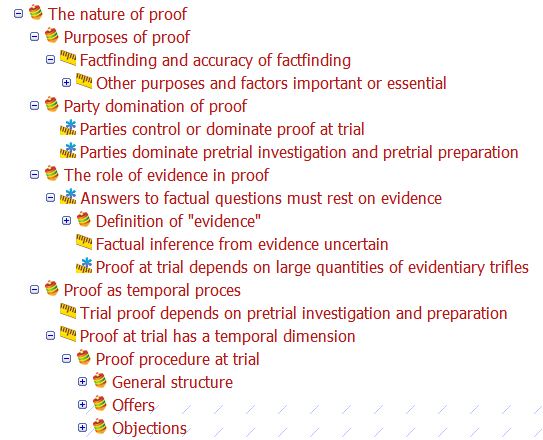
    I have tentatively redone the outline of the first part of Spindle Law's evidence module. The major sections of the the first part of my taxonomy of the law of evidence now look like this:

    Do you approve? Disapprove?

    &&&

    The dynamic evidence page

    It's here: the law of evidence on Spindle Law. See also this post and this post.

    Disappearing and Moving Corpses, Statistical Analysis, and Causal Explanation

    In an earlier post I mentioned Stanislaw Lem's The Investigation, which was originally published in Polish in 1959. As I reported earlier, in Lem's novel "corpses mysteriously begin disappearing from mortuaries in and near London. A statistician is brought in to help with the investigation." I have not yet read the whole book. However, I skimmed ahead this morning and I found that the statistician has reappeared. In the interim, corpses have apparently been moving about. The question is, perhaps, who or what has been moving them or making them move. However, the statistician -- Dr. Sciss -- believes that is the wrong question:
    "This isn't a criminal investigation, it's a scientific study." He [Sciss] stood up and continued. "What do you want--an explanation? You'll get it, don't worry."

    "... This case has nothing at all in common with criminology. No offense of any kind was committed, no more than when someone is killed by a meteor."

    "You mean that the operative causes are ... forces of nature," Gregory [a police detective, the novel's hero] asked....

    "... Can you define those 'forces of nature' you mention so glibly? The problem in this case is strictly methodological. ..."

    ...

    "Please look over here." [Sciss points at a map of England. The map is covered with red speckling in different degrees of density.]

    ... "Do you recognize the lightest area over here?"

    "Yes. That's the area of Norfolk where the bodies were stolen."

    "Wrong. This map shows the distribution of deaths from cancer in England for the last nineteen years. The region with the lowest death rate--that is, less than thirty percent...--falls within the boundaries of the area in which the corpses disappeared. In other words, there is an inverse proportion; I have formulated an equation to express it, but I won't go into that because you wouldn't understand it." ...

    "It is your primary duty to respect the facts. Some corpses disappeared. How? The evidence suggests they walked away by themselves. Of course, you, as a policeman, want to know if anyone helped them. The answer is yes: they were helped by whatever causes shells to be dextrorotatory. But one in every ten million snail shells is sinistrorsal. This is a fact that can be verified statistically. I was assigned to determine the connection between one phenomenon and other phenomena. That's all science ever does, and all that it will ever do--until the end. Resurrection? Don't be ridiculous. The term is used much too loosely. ...[T]he corpses moved around, changed their positions in space. I agree, but the things you're talking about are nothing but facts--I have explanations!"

    ...

    "A phenomenon is subject to analysis only if the structure of its events, as in this case, conforms to a regular pattern. ... If I were to ask why a rock falls, you would reply that it is due to the actions of gravity. Yet if I asked what gravity is, there would be no answer. But even though we don't know what gravity is, we can determine its regular pattern of action."

    I wonder how the story unwinds. I will have to find out. It appears that a motive force underlying the plot is a struggle between statistical explanation and causal explanation! Which one prevails? Or is the victor an entirely different type of explanation? If so, what?

    &&&

    The dynamic evidence page

    It's here: the law of evidence on Spindle Law. See also this post and this post.

    The True Origin of Holistic Theories of Evidence and Inference?

    See Douglas Adams, Dirk Gently's Holistic Detective Agency (Pocket Books 1987).

    A very belated hat tip to Alex Paykin, investigator extraordinaire!

    &&&

    The dynamic evidence page

    It's here: the law of evidence on Spindle Law. See also this post and this post.

    Tuesday, March 30, 2010

    On Radical Holism

    It has been said I am a holist. And I am -- to some degree. But I am not an unadulterated holist. I am a modulated holist, a quasi-holist, or, as I prefer to think of it, a sophisticated fellow who believes that both synthesis and dissection play an important role in inference.

    A partial proof that what I have just said is true:

    P. Tillers, "Webs of Things in the Mind: A New Science of Evidence," 87 Michigan Law Review 1225, 1251-1252 (1989):

    V. ATOMISM AND HOLISM IN INFERENCE

    [David] Schum sees inference as a network and he believes that networks of inference are extremely intricate. Hence, the webs that Schum weaves around problems of evidence and inference typically consist of many delicate threads, which crisscross in various ways. These threads are sometimes difficult to keep in mind and almost seem to vanish from sight.
    Schum's microscopic analyses of evidence and inference may seem unduly intricate; it is natural to wonder whether an entirely different approach to evidence and inference might work better. There has been discussion (although not quite a debate) about the value of fine-woven analyses of evidence. I myself have sometimes wondered if people might do a better job of drawing inferences if, instead of analyzing or dissecting evidence, they would just look at a mass of evidence ‘as a whole,’ try not to think too much about it, and then grunt out a response from somewhere within themselves to the undifferentiated mass of stuff they see in front of them.
    This kind of ‘holistic’ alternative to microscopic analysis is practically its own refutation. It is hard even to imagine what it means to take evidence ‘as a whole.’ We perceive slices and various features in almost everything we see—and if we don't, perhaps we can't see anything at all. Moreover, it is hard to imagine how we can imbibe the evidence we ‘see’ without performing some sort of mental analysis, which by definition seems to involve some sort of dissection. In short, it is hard to imagine how we can think holistically even if we want to do so. The admonition not to analyze and dissect almost seems tantamount to advice not to think too carefully about the way you think. One might as well advise you not to think about elephants. You may not have been thinking about elephants before, but once you are told not to do so, you cannot stop thinking about them. Hence, if we are to believe that holistic assessments play a part in inference, we must have a more subtle concept of ‘holism.’ Any theory that assumes an absolute dichotomy between holistic thinking and nonholistic thinking is thoroughly implausible and any theory that admonishes people to think globally rather than locally is vacuous.

    &&&
    Cf. P. Tillers, Are There Universal Principles or Forms of Evidential Inference?, in J. Jackson, M. Langer & P. Tillers, eds., Crime, Procedure, and Evidence in a Comparative and International Context (2008).

    &&&

    The dynamic evidence page

    It's here: the law of evidence on Spindle Law. See also this post and this post.

    My 1983 Thoughts on the Tension between Freedom of Contract and the Search for the Truth

    In 1983 I wrote:

    1 Wigmore on Evidence Section 7a (P. Tillers rev. 1983) (footnotes -- long footnotes -- omitted):

    General remarks of reviser on scope of freedom under modern law to vary rules of evidence by agreement. Modern decisions generally do recognize the general principle that parties may vary rules of evidence by prelitigation agreements, but courts still do not seem to embrace the notion that parties have practically unlimited contractual autonomy to regulate evidentiary processes at trial. What accounts for this judicial ambivalence?

    Several factors have a probable bearing on the judicial churlishness towards agreements to vary evidentiary rules. First, part of the explanation is surely attributable to changes in the general law of contract, which tend to restrict the scope of any party's ability to order his affairs through private contractual arrangements. Doctrines such as those relating to unconscionability and adhesion contracts have grown in importance in the last forty or fifty years. Wigmore's views as to the scope of freedom of contract are those of a late nineteenth and early twentieth century orthodox thinker. Recent developments in the law of contracts have eroded some of the premises that underlay his analysis of agreements to vary rules of evidence. But some of the judicial reticence to give full scope to agreements to vary evidentiary rules may reflect the fact that a great many of the decisions involve insurance contracts, and as we have remarked elsewhere (see note 10 supra), courts are particularly likely to construe insurance contracts against the insurer and otherwise place substantial limitations on the contractual freedom of insurance companies. To the extent that this factor dominates, the general implications of these decisions in regard to the validity and enforceability of agreements to vary evidentiary rules may be limited.

    Second, and perhaps most important, we believe it is probable that many courts, notwithstanding the criticisms made by Wigmore, retain a vestigial sense that evidentiary rules are in some sense inappropriate "commodities" for bargaining between private parties and that in some sense rules of evidence involve fundamental aspects of justice that may not be bargained away. For our own part, we are not convinced that this view is wrong or that it is properly regarded as primitive and irrational. Rules of evidence have a special claim to our respect and attention since it is widely believed that their use, at least in the course of a jury trial, is necessary to maintain the reliability of the factfinding process. It is evident, of course, that the aim of reasonably accurate factfinding offers no ground for objection to agreements to vary evidentiary rules when those agreements do not undermine this objective and perhaps even further it by authorizing the admission of a wider range of evidence than would be normally admitted; after all, one may reasonably take the view, as many observers have (see § 37 infra), that a liberal attitude towards the admissibility of evidence is generally likely to promote accurate factfinding. (It is also possible, notwithstanding our conventional explanations, that many exclusionary rules do not in fact rest primarily on a concern for factual accuracy and truth. (See § 37.1 infra.) But of course any such agreements do not present the problem considered here. (Although, of course, there may be other reasons we might not wish to give effect, for example, to agreements that void the privilege against self-incrimination. See note 14 supra.) The problem we pose arises when we face agreements that authorize evidentiary practices and requirements that seem likely to make the judicial factfinding process substantially unreliable and arbitrary. A possible example here is the common attempt by insurers to require that proof of accidental death be evidenced by "visible contusions" or, less frequently, that the fact of death or injury be shown by "conclusive" evidence. If we believe that such evidentiary requirements promote arbitrariness and unreliability in judicial factfinding processes, is it any answer that the parties agreed that they should apply? We believe that a credible case can be made that the answer is no. And we believe that strong support for a negative answer is afforded by decisions that establish the principle that a court is neither required nor permitted to admit evidence that the court deems unreliable and worthless merely because the parties to the controversy have stipulated that such evidence shall be admitted.[fn35] Although we do not know whether God plays dice with the universe, a trial is not a crapshoot and the parties should not be permitted to demean the dignity and rationality of the judicial factfinding process merely because they agree to do so. It is one thing to say that a factual controversy shall not be submitted to a court for decision; it is another thing to say that the parties may force a court to resolve a factual controversy submitted to it for decision by methods that the court (and, perhaps, the public) regards as unreliable and arbitrary.

    It is not self-evident that the limitation we believe should be imposed on the parties' ability to vary rules of evidence is consistent with the latitude that the law generally gives parties to make private arrangements for the disposition and adjudication of disputes that arise between them. After all, as Wigmore observed (see text supra), the law generally does permit parties to make agreements to arbitrate, and these agreements are today generally enforceable (see § 4e supra). Similarly, forum-selection clauses are generally enforceable, and these clauses, like arbitration submission agreements, permit the parties to bypass altogether the use of a particular system of judicial machinery. It may of course happen that a choice to bypass a particular forum is motivated by a desire to avoid the application of particular procedural and evidentiary rules that are applicable within a particular judicial system. In addition, the law generally permits parties to enter into stipulations by which selected factual issues involved in a controversy are eliminated. Finally, and perhaps most incongruously, the law generally allows lawyers to plead their clients into penitentiaries without the benefit of any formal adjudication of guilt or innocence.

    We are not fully persuaded that all of these contractual rights are inconsistent with the denial of the right to parties to make agreements that destroy or significantly impair the reliability of factfinding in a judicial trial. Thus, for example, the choice of another forum, though it may avoid procedural and evidentiary matters that one of the parties finds undesirable, still involves the choice of a procedural system that has been deemed adequate by a societal judgment for the pursuit of truth, and the variations in evidentiary practices in different forums cannot be considered in isolation from the different procedural context in which those variations exist and operate. Nevertheless, not all procedural and evidentiary variations can be reconciled on this basis. Thus, for example, the ability of a party to make a plea bargain cannot be explained on this basis. And neither is it possible to reconcile in this fashion the right of parties to make arbitration agreements, for the parties to an arbitration proceeding generally have the right to adopt whatever procedural and evidentiary rules they please in the proceeding[fn36] (see § 4e supra). Nonetheless, these facts fall short of demonstrating that it is anomalous to deny parties the right to select whatever procedural and evidentiary rules they may please for use in a judicial trial. It is arguable that the proceedings in courts are not there solely for the convenience of the parties and that it is important for social reasons to maintain the solemnity and dignity of judicial proceedings regardless of the wishes of the parties. It is immaterial, in this view, that the parties have the ability to choose other types of adjudicative proceedings, such as arbitration, which they may structure in any fashion they deem appropriate. If pressed, we might concede that it is more difficult to explain away the form of plea bargaining proceedings since these proceedings ultimately do occur in the courtroom and the court does engage in certain limited findings of fact to assure itself that there is a "factual basis" for the plea entered. Driven to this point, we would not attempt to reconcile the irreconcilable; we would instead argue that plea bargaining proceedings are illegitimate creatures that should be driven from the courts of justice of our land and would further argue that in a criminal case every defendant should be given a trial that society deems sufficiently fair and adequate to ensure that facts are found reliably.

    &&&

    The dynamic evidence page

    It's here: the law of evidence on Spindle Law. See also this post and this post.

    Freedom of Contract versus Pursuit of the Truth

    Courts and judges often proclaim that the central function of proof is to establish the truth about (legally-material) factual questions. See The determination of facts and the accurate determination of facts are central or important purposes of the process of proof in litigation and the law of evidence respectively. But (i) if parties are free to opt out of society's "standard" legal mechanisms for resolving disputes and resolving disputes about facts and (ii) if parties regularly do so and agree to the use of rules and procedures (e..g., in arbitration, mediation, and so on) that are ill-designed to advance the search for the truth about facts, are judges' pronouncements about the purpose of proof anything more than vacuous pieties? It is as if the judges were saying to us, "If our society had a regularly-used system of factual adjudication, the primary purpose of that system would be the ascertainment of truth. The fact that parties to disputes don't actually use this truth-oriented system of adjudication very often is immaterial. Truth is important to our society!"

    Cf. Robert Burns, The Death of the American Trial (2009); 1 Wigmore on Evidence Section 7a at pp. 599 (very bottom of page)-605 (P. Tillers rev. 1983) (reviser's comments, not John Henry Wigmore's).

    &&&

    The dynamic evidence page

    It's here: the law of evidence on Spindle Law. See also this post and this post.