Evidence marshaling software MarshalPlan
Tuesday, July 24, 2012
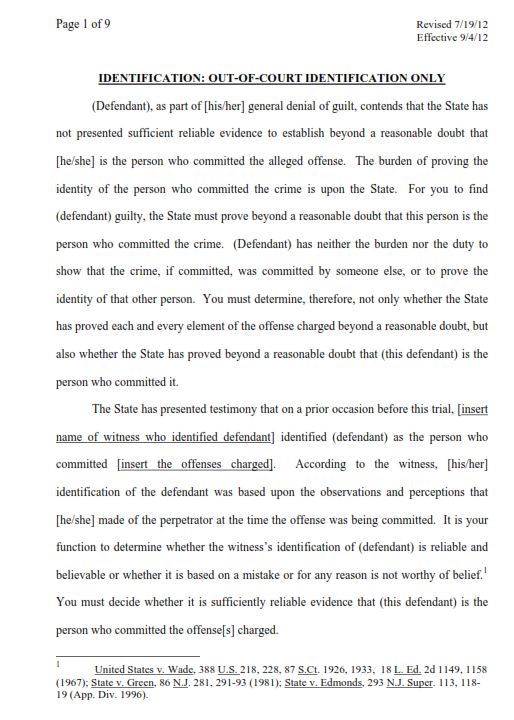
NJ Chief Justice Comments on Eyewitness Identification Guidelines
Mary Ann Spoto N.J. Supreme Court imposing sweeping changes in crime witness testimony Star-Ledger (July 23, 2012).
Snippets from the article:
After Labor Day, judges will be required to give jurors plenty of precautions before they consider the testimony they heard during trials.
For example, jurors will be told: "Human memory is not foolproof. Research has revealed that human memory is not like a video recording that a witness need only replay to remember what happened. Memory is far more complex ... Eyewitness identification must be scrutinized carefully."
Chief Justice Stuart Rabner said the new instructions to jurors will discourage actions that could help put the wrong person behind bars.
"These charges will deter practices that can lead to misidentification," Rabner told The Star-Ledger. "The charges are critically important to the eyewitness identification process and give detailed guidance to juries that will allow them to assess the evidence and decide how much weight to give the evidence they heard."
The dynamic evidence page
Evidence marshaling software MarshalPlan
Monday, July 23, 2012
Eyewitness Identification
There have been interesting developments in the legal treatment of eyewitness identification evidence and I hope to discuss them here shortly. In the meantime keep several things in mind:
1. Although bad news is more striking than good news, keep in mind that eyewitness identifications are sometimes correct. In fancier parlance: the frequency of "hits" as well as of false positives is germane to the question of the appropriate legal treatment of eyewitness identifications.
2. A generation or two ago Dean McCormick said that a brick is not a wall. As far as I know, this remains true. Hence, to make a case for exclusion of eyewitness identification evidence in a specific case it is not sufficient to say or show that the challenged evidence has little probative value. There may be other evidence in the case and the other evidence may have probative value; and when the eyewitness identification evidence is added to the other evidence in the case about identity, all of the evidence taken together it may amount to quite a lot.
3. Some of the ailments of the criminal process may be traced to the usual lack of financial resources of the defense. One question to consider -- a difficult question -- is whether and to what extent the flaws generated by this lack of resources can be compensated for by rules of evidence requiring exclusion of evidence at trial or other trial remedies such as jury instructions.
4. We generally do not identify people only by their facial appearance. We also rely on matters such as gait.
5. Is it possible to empirically verify all of the factors that affect the accuracy of eyewitness identifications and the magnitude of the effect of such factors? If not, so what? What follows?
&&&
The dynamic evidence page
Evidence marshaling software MarshalPlan
The dynamic evidence page
Evidence marshaling software MarshalPlan
Perlovsky on Music and Knowledge (and More)
Knowledge instinct. The term knowledge instinct is used by Leonid Perlovsky in his book Neural Networks and Intellect: Using Model-Based Concepts and other publications. In his works the knowle...
Me speaking:
Ya just gotta love a guy who believes -- who may believe -- that the aesthetic instinct - something like the desire for things such as harmonious music -- is the most fundamental instinct or close to the most fundamental instinct, or yearning, of the human animal. Perhaps LP sees the Knowledge Instinct as essentially an aesthetic instinct? I don't yet know if that's where LP wants to take us -- but I intend to find out. (LP appeals to my neo-Aristotelian inclinations. I think it may be time for academic legal folk and folk in related fields -- decision theorists, choice theorists, fans of heuristics, etc. -- to become acquainted with this fellow. I think I may end up launching one of my mini-campaigns. Stay tuned.)
Some luscious tidbits from Leonid Perlovsky's EMOTIONAL COGNITIVE NEURAL ALGORITHMS WITH ENGINEERING APPLICATIONS (2011):
p. 142: "Here we present a theory or hypothesis based on previous arguments in this chapter suggesting that music serves the most important and concrete function in [the] evolution of the mind and cultures. We discuss this function, neural mechanisms, and suggest experimental verification of this hypothesis."
pp. 152-156: LP repeats and amplifies an earlier claim about the critical role of differentiation and synthesis. p. 153: "Here [Section 4.12.6] we discuss the main hypothesis in this section: what constitutes the fundamental role of musical emotions in [the] evolution of consciousness, cognition, and culture. [Par.] As discussed, the balance between differentiation and synthesis is crucial for the development of cultures and for [the] emergence of contemporary consciousness."
p. 156: "The referenced literature suggests that music has two interrelated purposes fundamental to the functioning of individual minds and to evolution of the mind and culture. The first purpose is to differentiate aesthetic emotions. Music creates differentiated emotions required to reconcile conceptual contradictions. [!] The second purpose is to connect concepts to conceptual needs (including KI [the Knowledge Instinct].) Whereas language separates conceptual knowledge from instincts and emotions, music reconnects these ties."
The dynamic evidence page
Evidence marshaling software MarshalPlan
Subscribe to:
Posts (Atom)