Thursday, March 23, 2006
The Pajama Hearsay Game?


Thursday, March 16, 2006
Conference Announcement: Graphic and Visual Representations of Evidence and Inference in Legal Settings
Dates: January 28-29, 2007.
Venue: Cardozo Law School, Yeshiva University, 55 Fifth Avenue (5th Ave. & 12th St.), New York (Manhattan), New York
Description of conference:
One of the largest problems faced by crime investigators, litigators, paralegals, judges, triers of fact, and other actors interested in disputes about factual questions in legal settings is the sheer mass of available evidence in many cases. It is often difficult to remember, retrieve, and interpret evidential information, so that patterns, relations, and inconsistencies often go unnoticed. Tools that support the storage, retrieval, and interpretation of masses of evidence could therefore be of great use.
Psychological studies have shown that people's ability to remember, retrieve,
and interpret information is greatly enhanced if they organize information
in a way that is meaningful to them. Scholars of the law of evidence have
long suggested that graphical representations of evidential arguments and
inferences could support humans in making sense of masses of evidence. As
early as 1913, John Henry Wigmore claimed that his charting method promoted rational thinking about legal evidence. While Wigmore had only pencil and paper to draw his cumbersome graphs, today the computer could make his ideas practically feasible for everyone. Software could be used to draw graphical representations of arguments and inferences about masses of evidence. Moreover, such software could be combined with existing database, document management, and search technology so that collections of evidentiary documents could be stored and retrieved in terms of the user's thinking about a case. Such software would also facilitate transfer of case files to others by increasing the transparency of the files, so that subsequent investigators, prosecutors, and fact finders could gain a quicker and better understanding of the case.
Such software is currently being investigated for use in various domains.
Argument visualization software has been designed, for instance, to support
the teaching of scientific reasoning or critical thinking skills (Belvedere,
Reasonable, Araucaria, Convince Me), to support intelligence analysis, and
to facilitate individual or collaborative problem solving (Questmap, SEAS).
Moreover, current artificial intelligence research offers precise accounts
of evidential reasoning and thus provides a clear semantics of graphical
notations as well as ways to compute with them.
In the legal domain, fact investigators and litigators increasingly use software that supports the storage and retrieval of information in terms of conceptual and relational networks (Holmes 2, Analyst's Notebook). However, as yet, such tools offer little or no support for the structuring of human thinking about thus stored information. This software allows users to store evidentiary data in terms of events, objects, actors, and the relations among these things, but it does not allow users to represent how such data support or undermine hypotheses about what has happened.
This interdisciplinary conference brings together scholars and practitioners from such fields as law, philosophy, computer science, artificial intelligence, cognitive psychology, and linguistics who are interested in the graphic visualization of legal evidentiary inference and its support by software tools. The following issues will be addressed:
Current and new graphical means to visualize factual inference and proof
Semantics of such graphical notations: what are the underlying theories of evidential reasoning? (jurisprudential, philosophical, psychological, rhetorical, logical, or mathematical)
Which software tools for graphical representations of factual inference and proof are currently available or being developed?
What are the potential contexts for the use of such software and what are the potential benefits of such software? (crime investigation, litigation, trial, law teaching, etc.)
To what extent can graphic representation of evidential arguments support the automatic evaluation of hypotheses?
How can current insights about human-computer interaction be exploited to increase the usefulness of such software? (e.g., how can visual complexity created by the size of the available mass of evidence be managed?)
Are empirical results available on usability and effects of use of charting methods (whether manual or digital) in legal or other contexts?
What are the practical constraints faced by crime investigators or legal professionals who want to use such software?
Conference officials:
Peter Tillers (Cardozo Law School): Conference chair e-mail address: peter@tillers.net
Henry Prakken (Universiteit Utrecht / University of Groningen): Program
chair e-mail address: henry@cs.uu.nl
Thomas D. Cobb (University of Washington, Seattle): Deputy program chair
e-mail address: tomcobb@u.washington.edu
Panelists:
The public is invited. There is no registration fee. (However, there will be a modest charge for any lunches or dinners that attendees elect to take at the site of the conference, at Cardozo Law School.)
Program details will be provided later.
Sunday, March 12, 2006
Connecting the Dots -- Literally
 Networks have reached the big time: the The New York Times! See Patrick Radden Keefe, Can Network Theory Thwart Terrorists?, NYTimes Online (March 12, 2006).
Granted, the NYTimes did not mention Wigmore charts or directed acyclic inference networks; it focused instead on social nets, which are often neither directed nor acyclic. Nonetheless, surely the glare of mass publicity will soon shine on directed acyclic inference networks as well!
Saturday, March 11, 2006
The Danger of Living and Working in the Wrong Place: Rough Justice?
From the transcript of the testimony of Mohammed Hussein Abdallah before the Combatant Status Review Tribunal:
First of all, you classified me as a terrorist or associated with this organization; that has no founding or no truth to it at all. I am just a teacher. I teach orphans, seven or eight year old orphans. They came and picked me up at 2 AM from my house. I have no relations or no connections with anybody. All that I used to do was go to work and come back. I stayed with my children and my family. I did not have any relations with any organizations whatsoever. So if teaching orphan children who lost their father how to read and write it a terrorist act, therefore I am a terrorist. If teaching the Koran to children is a terrorist act, then I am a terrorist. Besides this, I have nothing else. I don't know how they classified me as a terrorist.A bit further in the transcript:***
[charge in italics:]3.a.7. Militants associated with Osama bin Laden's Al Qaida organization were traveling through the Jolazai refugee camp in [sic] route to India.
Detainee: I don't know about that. This is the first time I hear this thing. ... I thought that Al Qaida was a secret organization. I just know about it through the media, radio and newspapers and things like that but as people or as a person, I don't know.
... If I may, I would like to read from my notes about some of the organizations that were qualified or categorized as terrorist organizations. ... I never worked before in any terrorist organization. I worked only in humanitarian organizations. [He names one Saudi government organization.] And I also have Al-Ighata (ph), which is another organization that belongs to the Saudi government also. The office of construction that is for Maktab Attaamir (ph), which means the Office of Rebuilding. The person that was in charge or head of this organization was King Fahd of Syria. So I have no relation to this thing, talk to King Fahd; he is still alive. And this organization I just mentioned is a recognized organization and the Pakistani government recognized it. It was funded; it was created in Saudi Arabia. So if this organization in the United States government's view is a terrorist organization, what is my crime? What do I have to do with it? So the people who should answer for this organization are the people who founded this organization or the people who are in charge of it. You didn't detain the founders ... So I am wondering, you could find my house and you couldn't find the Saudi government, the Pakistani government and the Kuwaiti government? ... They took me in the middle of the night. It's almost been two and a half years and I don't know anything about my children and wife. And I always wonder all the time, I keep asking them: What is my crime? What did I do? And no one answers me.
Tribunal Members' questionsQ. Sir, how old are you?
A. I am about 60.
***
Q. This camp that is being referred to as the Jolazai refuge camp, do you have an estimate of how many people were there when you stayed there?
A. What do you mean? Do you mean the population?
Q. Right.
A. ... [I]t is a big number. It is around 50,000 or maybe more. ... The people that were in charge of this camp were government officials ....
Q. At this camp, were people allowed to come and go freely?
A. As I said it was like a city. People leave and come and travel and go. It was like any normal city.
Wednesday, March 08, 2006
NewSpeak
 Craven lobbyists are lobbyists. Good lobbyists are activists.
Greedy advertisers are advertisers. Noble advertisers are underwriters.
Thursday, March 02, 2006
Forgotten Constitutional History
The outcry had an effect: In the last two or three decades the Supreme Court has dramatically limited the scope of nontruthseeking constitutional exclusionary rules.
But guess what? When almost no one was looking, the Supreme Court also limited the reach of constitutional exclusionary rules whose primary purpose is the enhancement of the priority of truth -- factfinding accuracy -- in the criminal process.
So the upshot for the Warren Court's critics was this: Heads we win, tails you lose. Justice Marshall, dissenting in Manson v. Brathwaite, 432 U.S. 98 (1976), noticed this irony as long ago as 1976. Complaining of the Court's relaxation of its rules against the use of unduly suggestive eyewitness identifications, he wrote:
[O]ther exclusionary rules have been criticized for preventing jury consideration of relevant and usually reliable evidence in order to serve interests unrelated to guilt or innocence, such as discouraging illegal searches or denial of counsel. Suggestively obtained eyewitness testimony is excluded, in contrast, precisely because of its unreliability and concomitant irrelevance. Its exclusion both protects the integrity of the truthseeking function of the trial and discourages police use of needlessly accurate and ineffective investigatory methods.It is time for the Court to reverse course once again. This time the Court should focus on developing due process principles that protect the integrity of factfinding in the criminal process.
Truth and Fairness
The aim of the requirement of due process is not to exclude presumptively false evidence, but to prevent fundamental unfairness in the use of evidence.But what could be more unfair than the use of "false evidence"? What could be more unfair than readily avoidable conviction of the innocent?
The dichotomy the Court poses -- avoidance of inaccurate factual adjudication in criminal cases and avoidance of unfairness in criminal cases -- is a false one. Recognition that the disjunction is spurious is essential if the Court is to use the Due Process Clause -- as it should -- to ensure that the criminal justice system achieves some tolerable degree of accuracy in the adjudication of factual questions on which conviction or acquittal hangs.
There is more than a little bit of irony in the fact that in Connelly the Court approvingly quoted its own prior statement that "[t]he central purpose of a criminal trial is to decide the factual question of the defendant's guilt or innocence."
Tuesday, February 21, 2006
Dennett Demolition Derby
For a delicious example of a biting attack on a contemporary religiously-zealous but "scientific" tract in favor of irreligion, see Leon Wieseltier, Review of Daniel C. Dennett, BREAKING THE SPELL: RELIGION AS A NATURAL PHENOMENON, NYTimes Online (Feb. 19, 2006). A sample of the critique:
In his own opinion, Dennett is a hero. He is in the business of emancipation, and he reveres himself for it. "By asking for an accounting of the pros and cons of religion, I risk getting poked in the nose or worse," he declares, "and yet I persist." Giordano Bruno, with tenure at Tufts!Wieseltier also offers less catty critiques. For example:
There are a number of things that must be said about this story. The first is that it is only a story. It is not based, in any strict sense, on empirical research. Dennett is "extrapolating back to human prehistory with the aid of biological thinking," nothing more. "Breaking the Spell" is a fairy tale told by evolutionary biology. There is no scientific foundation for its scientistic narrative. Even Dennett admits as much: "I am not at all claiming that this is what science has established about religion. . . . We don't yet know." So all of Dennett's splashy allegiance to evidence and experiment and "generating further testable hypotheses" notwithstanding, what he has written is just an extravagant speculation based upon his hope for what is the case, a pious account of his own atheistic longing.And:
It will be plain that Dennett's approach to religion is contrived to evade religion's substance. He thinks that an inquiry into belief is made superfluous by an inquiry into the belief in belief. This is a very revealing mistake. You cannot disprove a belief unless you disprove its content. If you believe that you can disprove it any other way, by describing its origins or by describing its consequences, then you do not believe in reason. In this profound sense, Dennett does not believe in reason.An important part of the story of the emergence of modern probability theory involves the study of the evidentiary value of Biblical miracles. See, e.g., Lorraine Daston's Classical Probability in the Enlightenment (Princeton: 1995). See also Oscar Kenshur, Bayle's Probabilistic Fideism and the Rhetoric of Ideology.
Kenshur discusses John Craige's Theologiae Christinae Principia Mathematica (1699). This book, regarded by Ian Hacking as the work of a crackpot, "begins with the notions about the credibility of marvelous historical events that we have encountered in our discussion of Browne. If we assume that extraordinary or miraculous events counted as knowledge to those who witnessed them, but lose their credibility progressively as time goes on, then it follows that we can say that the miraculous events associated with the origins of Christianity are less credible now than they were shortly after the events occurred, and will be even less credible in the future. What Craige did was to try to express this notion in mathematical terms, by computing the degree of probability for each point in time. Once the probability of belief is quantified, then we can predict precisely when the credibility of Christianity will disappear altogether, namely, in the year 3150, and hence that the second coming of Christ will occur before that date."
Saturday, February 18, 2006
Death of a Good Blog
 Cooped Up has given up the ghost. It pains me to hear the author of that blog say that his blogging has damaged rather than enhanced both his "scholarly profile" and his "scholarly productivity." I pray that other law professor bloggers will not suffer the same fate.
My aims are somewhat different from the aims of the author of Cooped Up. This may be partly or largely because I am older. I view my blogging mainly as a source of entertainment and as a source of inspiration. I have no delusions that most of my colleagues at my law school or in wider legal circles think that blogging is a worthwhile activity. But in general I am not trying to reach them, my peers in the legal world. I do want to reach and hear from people outside of the circle of my professional peers. (I hasten to add that it is also always a genuine pleasure to hear from my peers in the legal profession.)
Yes, blogging sometimes is a time-consuming activity (though much depends on how -- how often etc. -- it is done). Withal, the true question is whether the rewards are worth the investment; and that is a question that each blogger must weigh and answer individually.
I am happy to report to my blog has generated some very interesting e-mail. And I have always enjoyed blogging. (This is surely because I have always followed the rule that I blog only when I want to do so.) So I will keep at this blogging business a while longer -- but, as before, only sporadically.
Wednesday, February 15, 2006
U.S. Olympic Hockey Team Ties Powerful Latvian Team
Mercenary Thinking in the Boardroom -- and in the Jury Box?
An executive at Genentech explained the high price of the drug this way:
Dr. Susan Desmond-Hellmann, the president of product development of Genentech, which is based in South San Francisco, Calif., said that Genentech had set Avastin's price based on "the value of innovation, and the value of new therapies."Id.
Perhaps when product liability claims against Genentech end up in the courtroom, jurors will take Genentech's calculus into account when they compute the damages that Genentech must pay? Will the jurors' motto be: Live by the value of your drugs -- and die by the lack of value of your (defective) drugs?
P.S. It is evident why I could never bring myself to join the Federalist Society or turn myself into a law and economics law teacher. I will say in advance: I take little solace in the thought that the marketplace may or will eventually generate products that compete with Avastin and lower its price.
N.B. The same newspaper article also states:
With Avastin's expanded use, analysts expect the drug's sales to soar to $7 billion in the United States alone by 2009, compared with $1.1 billion last year. Over the same period, Genentech's overall profits are forecast to triple, to $4 billion in 2009, as sales, $6.6 billion last year, climb to $18 billion.
Thursday, February 09, 2006
Hearsay Logic
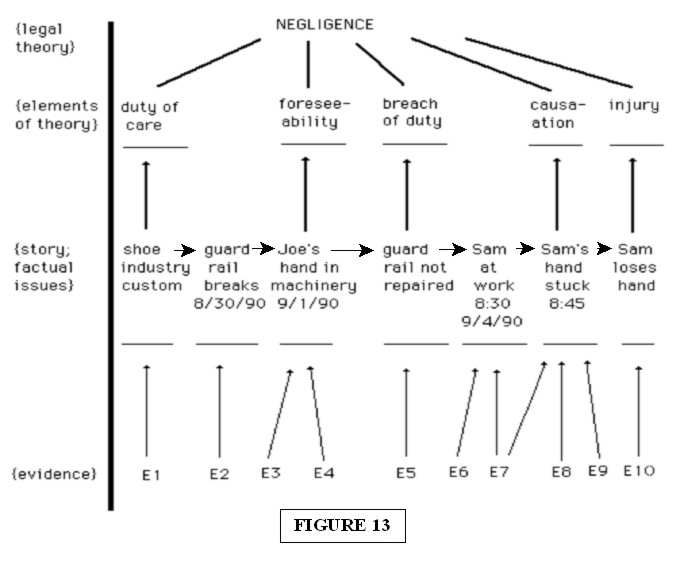
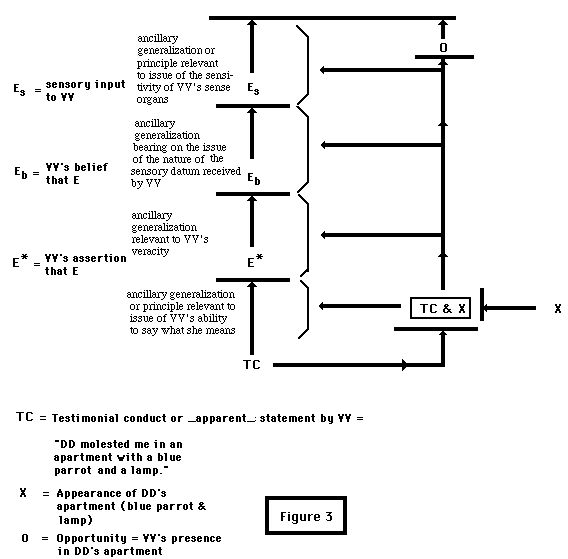 The paper "Hearsay Logic" (8.5 MB) by Peter Tillers & David Schum is now available here.
A Pilgrim's Tale: Bayesian Dragons and Other Illusions
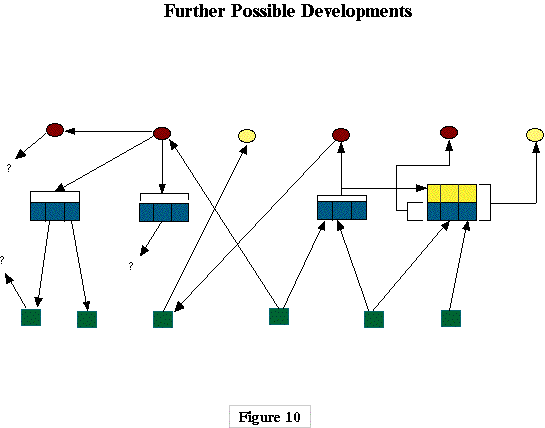
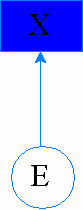 I recently decided to post on the web some of my older papers that either are not available on LEXIS or WESTLAW or are available only in an imperfect form (because of the inability of the LEXIS and WESTLAW databases to reproduce diagrams, charts, and similar matter). Hence, Dear Reader, you can now peruse my disquisition about the "New [sic; see below] Evidence Scholarship," a disquisition that takes the form of a homily or parable about Bayesian dragons and other illusions.
The new evidence scholarship is no longer as new as it once was: this new type of scholarship has been in existence for more than 30 years. A few curmudgeons have asserted that there never was anything really new about the New Evidence Scholarship. Some meticulous observers see precursors in 17th century and 18th century literature on probability, and other observers trace the origins of NES to Classical Antiquity. These curmudgeons are, of course, correct -- to some degree. The New Evidence Scholarship is not wholly original. But it is significantly different from its ancestors. For example, some tools used by some New Evidence Scholars -- e.g., fuzzy sets, computer-generated images, certain statistical methods, probabilistic inference networks -- did not even exist until the second half of the twentieth century.
Monday, February 06, 2006
A New Science of Evidence
The version of the essay available at SSRN, unlike the version available from the LEXIS and WESTLAW databases, accurately reproduces various diagrams that are central to the argument of the essay.
Sunday, February 05, 2006
Unnatural Lie Detectors
Do you have a better alternative?
Some people think they are on the verge of developing a better lie detector. And some people apparently even think that they have already acquired a high-tech key to the truth. See the entertaining and nuanced article, "Looking for the Lie," by Robin Marantz Henig in today's issue of the NYTimes Sunday Magazine (Feb. 5, 2006).
Henig recognizes, as many students of lie detector devices do not, that the accuracy of a testimonial report does not depend solely on the extent to which the testimonial source seeks to report the belief that he or she actually has. Many people genuinely hold foolish and false beliefs, and people sometimes inadvertently make assertions that they do not mean to make.
Ah, were it only possible to devise a machine that could "detect" all possible causes of errors in testimonial reports! Then we really would have a shortcut to proof and we could dispense with these complicated, expensive, and ridiculous proceedings called trials.
But it appears that a sucker is still born at least every minute or so. Consider, for example, Henig's account of the "holistic" lie detection method that Paul Ekman apparently peddles to law enforcement agencies. Ekman uses a lie detection procedure that employs a system of classification that he calls the "Facial Action Coding System." I have no doubt that Ekman has empirically verified the diagnostic power of all of the 10,000 or so significantly distinct facial expressions that he believes are generated by combinations of 43 independent muscles. (The article explains that Ekman also identifies other putative signs of credibility or incredibility.) In the NYTimes article Henig reports that Ekman stated that he has a "a rule that prohibits him from commenting on any elected official currently in office, no matter how tempting a target." The implication is that Ekman's sense of ethics leads him to adhere to this rule. One wonders if another motivation for Ekman's rule might be Ekman's fear that the use of his method to diagnose the veracity of contemporary public figures might cast some doubt on the degree of the accuracy -- 95% or so, no less -- that Ekman claims that his system of lie detection achieves. (Of course, the 95% statistic needs to be refined. I have a foolproof method for catching all lies. My method amounts to this: Declare that all testimonial reports -- except my own -- are lies.)
Thursday, February 02, 2006
Startling Statistics about Law Review Subscriptions
Yale:
4462 and 2579Harvard:
9064 and 3451Stanford:
1546 and 1112Columbia:
4014 and 1875NYU:
2105 and 1209Chicago:
2068 and 1845Pennsylvania:
2250 and 1180Michigan:
2950 and 1419Virginia:
2506 and 644Northwestern:
1826 and *
The above asterisk [*] means that "data is missing for this year." Circulation figures for Northwestern's law review were missing from 1995-96 through 2004-05, for ten years. The last reported circulation figure for that journal was 723, in 1994-95, which was then the lowest of the "top ten."Do the above statistics mean that major US law journals are being consigned to history's dustbin? Or does it merely mean that readers are accessing the journals with LEXIS or WESTLAW?
The second hypothesis is not clearly supported by the statistics collected at p. 260: subscriptions began declining sharply before the internet became a standard method of doing legal research.
It would be interesting to see if "major U.S. courts" now cite law the "major law journals" less than they did in 1979-80.
The circulation for Stanford Law Review spiked to 8850 in 2000-01. Does anyone know why?
The figures show that Chicago's circulation declined less than that of other law journals. Of course the figures also show that few people ever subscribed to Chicago's law journal.
Practice Makes Perfect
 Police Constable Mark Milton, of the UK, was acquitted of dangerous driving. The district judge who acquitted Milton said that the good constable had been "driving for police purposes." The district judge said that the good constable was driving for police purposes because the good constable drove a police car in excess of the police limit to "hon[e] his driving skills." In fact, the good and diligent constable drove a police car at 159 miles per hour. The High Court ordered a retrial. (Double jeopardy means something different in the UK than it does in the US; i.e., the principle of no double jeopardy now seems to mean very little in the UK.) Lady Justice Hallett, sitting with Mr Justice Owen, noted that Police Constable Milton had reached "eye watering speeds." See Independent Online Edition (Feb 2, 2006). All is once again well in those sceptr'd isles.
Saturday, January 28, 2006
Industrial-Style Scholarship; and, "Richard Posner, sub silentio, on Performance Measures and Scholarly Creativity"
Quality of research is readily measurable by grants, prizes, and above all by citations to the professor's scholarly publications, weighted by the quality of the journal in which the citations appear.A Relatively Trivial Question:
Do citations in judicial opinions count?
A Less Trivial Question (Set of Questions):
What determines the "quality of the journal"? Common scholarly consensus?
This benchmark for the quality or standing of a journal presents problems of circularity that famously dog Frye, which attempts to measure scientific validity for forensic purposes by scientific consensus.There are deep problems here.One unavoidable question about the Frye and Posner measures of quality: Which scientists' or legal scholars' consensus counts? For example, is the validity of astrology to be determined by referring to the opinions of astrologers? Astronomers? Amateur astronomers? Reputable astronomers? Astronomers employed by universities or observatories? Astronomers employed by reputable universities or reputable observatories? Astronomers employed by wealthy universities or large observatories? Isaac Newton? Similarly (and more seriously), for example, whose opinions about fingerprint identification count for purposes of determining the scholarly or scientific standing of a scholarly or scientific journal in which a paper about fingerprint identification is published?Or are we to say that the scholarly standing of a journal is to be determined by the wealth and influence of the academic institution (if any) with which it is affiliated?Or is the scholarly standing of a journal determined only by circulation figures? If so, do Slate, Legal Affairs, and, indeed, the New York Daily News have (much) greater scholarly standing than the Harvard Law Review?
Is Posner's use of "quality of the journal" benchmark closely analogous to "short-term-winners' history"? Question: Do you predict that the Journal of Legal Studies will be widely read -- by reputable scholars :-) -- in, say, 50 years -- viz., do you predict that it will be more widely read than some other possible benchmarks of scholarly quality from our era? Another question: In some future generation will we measure the quality and originality of a scientist's or scholar's work by examining journals from the (alleged) scholar's era or from our own? But: If future generations will look to the opinions of their era to measure our originality, how shall we, in our own time, assess the quality and the originality of our contemporaries' (allegedly) scientific or scholarly work; i.e., what are we to do in the meantime, while we await the verdict of history on our work and the work of our colleagues? Living a long life is a partial solution to this problem. But it is only a partial solution -- because what happens in the meantime matters.
Wednesday, January 25, 2006
Old-Fashioned Scholarly Virtues
Peace, time and trust. These three words sum up what research really needs. The demands of day-to-day research are just the opposite: haste, immediate results and accepting mistrustful controls. What counts is the quantity. You have to see to it that you publish as much as you can and get cited as often as possible. At the end of the day, publications and citations are simply lumped together and counted. Whether the work is of low quality or even insignificant is of no interest. ...Scientific progress, whether it be in the humanities or the natural sciences, often evolves from originality, from turbulences in the calm flow of routine. But originality is not recognised and accepted. It takes time for new and unusual ideas to establish themselves. If a citation index or an impact factor (i.e., the principle of "let's see how often I'm cited"), both of which are being applied more and more nowadays, had been used to assess the value of young Albert Einstein's or Kurt Goedel's work, a research proposed by either of them would never have attained a position in the academic world.
