Sunday, September 18, 2011

Juristerei (Legal Rigamarole)

In Goethe's Faust Dr. Faust speaks the following lines when he first appears:
Habe nun, ach! Philosophie,
Juristerei und Medizin,
Und leider auch Theologie
Durchaus studiert, mit heißem Bemühn.
Da steh ich nun, ich armer Tor!
Und bin so klug als wie zuvor;
Heiße Magister, heiße Doktor gar
Und ziehe schon an die zehen Jahr
Herauf, herab und quer und krumm
Meine Schüler an der Nase herum-
Und sehe, daß wir nichts wissen können!
...
Bilde mir nicht ein, was Rechts zu wissen,
Bilde mir nicht ein, ich könnte was lehren,
Die Menschen zu bessern und zu bekehren.
A crude prose translation perhaps best conveys Faust's mood and sentiments:
Oh, I've thoroughly and passionately studied
Philosophy, law, and medicine
And also, I'm sorry to say, even theology.
Now here I am, poor fool.
And I'm just as smart as I was before.
I'm called "master" and -- would you believe it -- even "doctor."
For ten years I've led my students around by their noses, up and down, this way and that.
And in the end I see that it is impossible to know anything.
...
I don't fool myself that I know what's right.
I don't fool myself that I could teach anything that would improve or reform mankind.


&&&&
 

So the fellow turns to magic. Hmmm...

Confronting a Forgetful Witness

In  United States v. Owens, 448 U.S. 554 (1988), the United States Supreme Court appeared to hold that the mere presence of a prosecution witness in a criminal trial satisfies accused's Sixth Amendment right to confront that witness -- even if the witness has or feigns no memory of a hearsay statement that the prosecution offers against accused. However, as Colin Miller noted in a blog today, the Supreme Court of Mississippi recently held that this reading of Owens is incorrect and that the mere presence of the witness whose pretrial hearsay statement is used against accused does not satisfy the Sixth Amendment Confrontation Right. Goforth v. State, 2011 WL 4089967 (Miss. 2011). The Mississippi Supreme Court acknowledged that its reading of Owens is a minority view.

Will the prosecution seek review in the United States Supreme Court? If so, will the U.S. Supreme Court grant review? If so, will the U.S. Supreme Court slap down the Mississippi Supreme Court or will it say that its holding in Owens was a mistake -- or will it say, unconvincingly, that Crawford v. Washington, 541 U.S. 36 (2004), impliedly overruled or "undermined" Owens?
  • If the Court wishes to take this third tack, it faces the task of explaining why its "plain language" cum history approach in Crawford should not extend to the question of whether a witness can be said to "testify" against a criminal defendant merely by taking the witness stand. (But, having the last word, the Court does not always feel obliged to explain itself. The Court sometimes finds it is more convenient  simply to ignore the plain language and meaning of a prior decision.)


&&&

The dynamic evidence page

Evidence marshaling software MarshalPlan

It's here: the law of evidence on Spindle Law. See also this post and this post.

Saturday, September 17, 2011

A Petition for More Transparency about Employment Prospects of Law School Graduates


See this post.

&&&


The dynamic evidence page

Evidence marshaling software MarshalPlan

It's here: the law of evidence on Spindle Law. See also this post and this post.

Charges and Evidence of Lax Screening Practices at Logan Airport on 9/11

Ever since hearing (long ago) that one or more of the 9/11 hijackers had been asked to go through a weapon-detecting device at Boston's Logan Airport a second time after the initial pass-through had triggered an alarm, I had wondered about the claim that the 9/11 hijackings were unforeseeable and unpreventable. I had once lived in the Boston area and on 9/11/2001 (i) I recalled Logan Airport's reputation as a "patronage dump" for superannuated Massachusetts politicians, and (ii) I recalled earlier newspaper reports that some months or a year before 9/11 there had been government tests of the screening process at Logan and that these tests had revealed serious deficiencies in those procedures. Now -- with a trial impending -- we may finally learn more about the screening process at Logan and whether some part of it -- the part run by United Airlines -- was badly run. The lawyer in me, however, cannot resist also asking whether United Airline's prior screening practices at Logan will be admissible at trial.

The upcoming trial in (I gather) the United States District Court for the Southern District of New York concerns the death of "Mark Bavis, a 31-year-old passenger on Flight 175, in the only remaining wrongful-death lawsuit out of nearly 100 filed after the attacks." Benjamin Wesier, Court Filing Details Shortcomings of Airport Screeners on 9/11 NYTimes (September 16, 2011). The NYTimes claims that "documents" filed in this civil action show that "[t]he five terrorists who boarded United Airlines Flight 175 in Boston on the morning of Sept. 11, 2001, passed through a security checkpoint that was staffed by some screeners who could not speak or understand English, did not know who Osama bin Laden or Al Qaeda were, and, in one case, could not identify what Mace was...." Id.

The following passage in the newspaper article is the one that piqued the lawyer's side of this blogger's curiosity:
The Bavis lawyers, in their filing, contended that United had “a long history of failing to substantially comply with the federal aviation security regulations.” They cited a former United security executive retained as an expert by the plaintiffs, who contended that the airline had failed to heed warnings in the years before Sept. 11 about the need for greater staffing and training.
Will evidence of United's prior screening practices be admissible at trial? Or does such evidence fail to pass muster under Federal Rule of Evidence 406, the federal habit and routine practices rule?

The passage quoted above suggests that counsel for plaintiff plan to try to take advantage of one standard avenue for the admissibility of prior conduct that falls short of being a "habit" or a routine business practice: the other conduct is offered to show notice. This avenue is open in cases in which the law applicable to the case allows notice or foreseeability to be an issue at trial.

A more esoteric argument for admissibility would be that before the enactment of the Federal Rules of Evidence and Rule 406, federal law  did not bar admission of evidence of non-routine or non-habitual other conduct of "unnatural" persons such as corporations and that, hence, on the question of the admissibility of United's pre-9/11 screening practices and failures, it is quite immaterial whether those failures were or were not "routine." Cf. 1A Wigmore on Evidence Section 98.1 (P. Tillers rev. 1983) (focusing on question of whether evidence of an organization's practices, routine or not, amounts to evidence of "character," which under some circumstances is barred by the "character evidence rule").


&&&

The dynamic evidence page

Evidence marshaling software MarshalPlan

It's here: the law of evidence on Spindle Law. See also this post and this post.

Tuesday, September 13, 2011

Another Reminder of the Porousness of the Prohibition against Character Evidence

In this prosecution for a variety of crimes, including securities fraud and obstruction of justice, United States v. Polusen, Nos. 08-4218; 09-3658, 2011 U.S. App. Lexis 17715; 2011 Fed App. 0235P (6th Cir. August 25, 2011), the Sixth Circuit Court of Appeals rejected a character rule challenge to the trial court's admission of defendant's acts amounting to spoliation on the ground that the spoliation evidence, the Court of Appeals held, was admissible to show "consciousness of guilt," which, the Court of Appeals held, is not the same as the sort of "character" barred  by Federal Rule of Evidence 404:
In March 2008, Poulsen was convicted in the Obstruction Case of conspiracy, witness tampering, and obstruction of justice. Prior to his sentencing in that case, Poulsen filed a motion in limine in his Securities Case to exclude certain types of evidence, including his conviction in and the facts underlying the Obstruction Case. The district court denied this motion, holding that the "obstruction conviction and its underlying facts are admissible under Rule 404(b)."
...
Other bad acts are probative and admissible if relevant to prove "motive, opportunity, intent, preparation, plan, knowledge, identity, or absence of mistake or accident." Id. (citing Fed. R. Evid. 404(b)). This list is "neither exhaustive nor conclusive." United States v. Mendez-Ortiz, 810 F.2d 76, 79 (6th Cir. 1986). Our courts admit "spoliation evidence, including evidence that a defendant attempted to bribe . . . a witness," because such spoliation evidence shows "consciousness of guilt." Id.; see also United States v. Anderson, 333 F. App'x 17, 24 (6th Cir. 2009). Poulsen's conviction in the Obstruction Case was supported by evidence of his attempts to pay Sherry Gibson to give favorable testimony. This evidence was not offered to prove Poulsen's character in conformity with this prior bad act but rather was offered as evidence of his consciousness of guilt. The district court was aware of this distinction and clearly stated how Poulsen's "prior acts" were admissible under Rule 404(b): "Evidence of witness tampering was admissible as an 'other purpose' under Rule 404(b) because it 'tends to establish consciousness of guilt without any inference as to the character of the spoliator.'" Because, as the district court recognized, evidence of Poulsen's "attempts to bribe Gibson to testify favorably at his fraud trial is probative of his consciousness of guilt," the evidence was admissible. We take no issue with this finding, and move on to the question of whether the district court abused its discretion in determining that the evidence was not impermissibly prejudicial.
Note that although defendant attempted to raise an entrapment defense, the Court of Appeals did not rely on Federal Rule of Evidence 405(b), which allows the admission of character evidence when character is an element of a claim, charge, or defense. Earlier in its opinion the Court of Appeals  had held that the trial court had properly rejected a request for an entrapment jury instruction because defendant had not presented sufficient evidence at the trial to make his claim of entrapment a triable issue.


&&&
 

The dynamic evidence page

Evidence marshaling software MarshalPlan

It's here: the law of evidence on Spindle Law. See also this post and this post.
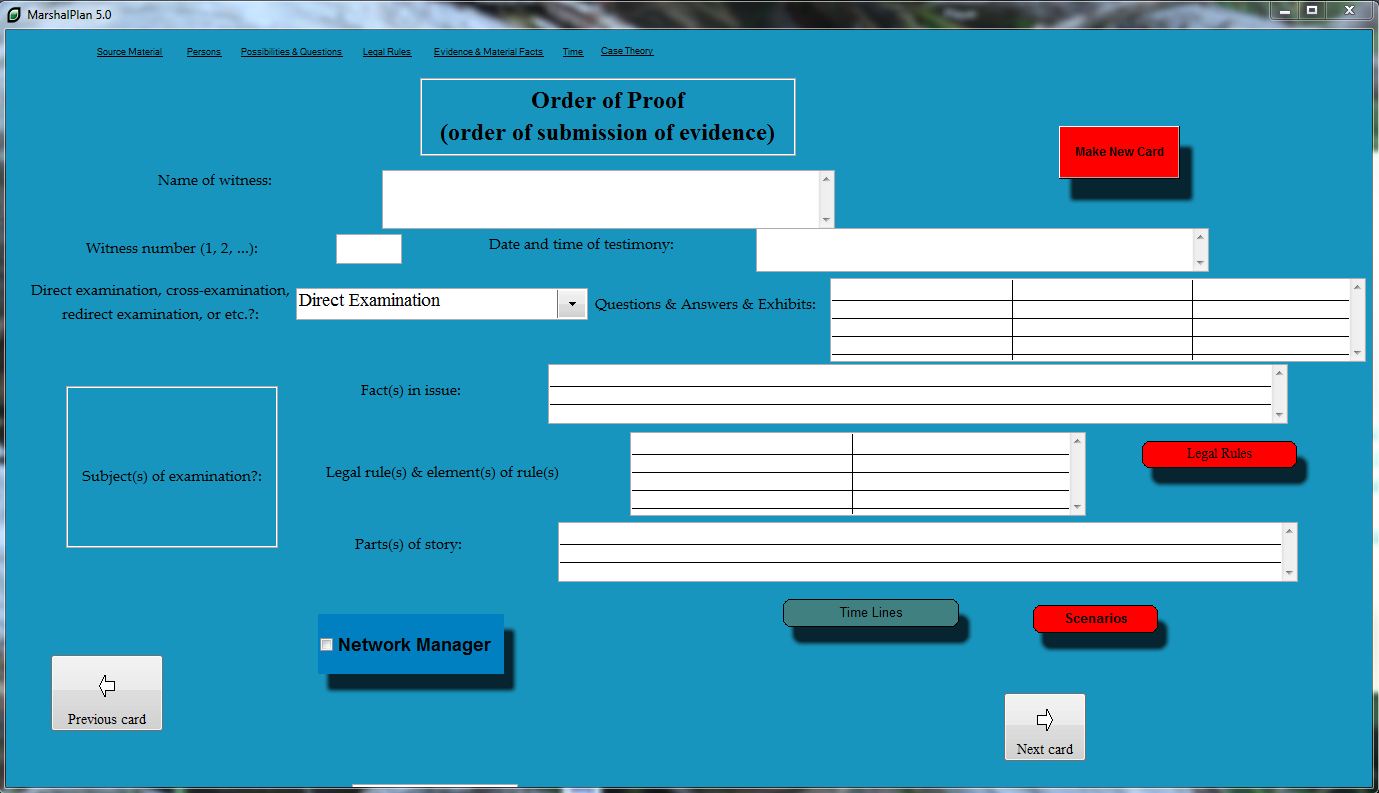
Run MarshalPlan 5.0 with Firefox 3.x


Use Firefox 3.x and run MarshalPlan 5.0 in your web browser:http://tillers.net/MarshalPlan.5.0/Web/MarshalPlan.html

This will NOT work with Chrome. And it may or may not work with Internet Explorer.

The browser version of MarshalPlan 5.0 produces spoken versions of some of my explanatory notes.

  • The second card in my new order of proof stack does not wish to appear in my Firefox 3.x browser. If this happens to you as well, just click the arrow on this card to go to the next card. I will try to remedy the problem of the missing image on the second card in this stack sometime soon.


&&&


The dynamic evidence page

It's here: the law of evidence on Spindle Law. See also this post and this post.

MarshalPlan 5.0

Go to this folder and download and run, from the sub-folders you see there, the version of MarshalPlan that works with your computer's operating system (Windows, MacOSX [Apple], or Linux).


MarshalPlan 5.0 has the beginnings of a stack (file) that you can use to plan the order of proof at a trial or evidentiary hearing, the order of submission of evidence at a trial or hearing.

&&&


The dynamic evidence page

It's here: the law of evidence on Spindle Law. See also this post and this post.

Wednesday, September 07, 2011

MarshalPlan Stack to Plan Order of Proof at Trial


I am developing a new MarshalPlan stack.


This new stack is meant to ease the job of figuring out the order in which witnesses will or should testify and the order of the questioning of each witness. This my initial draft of the heart of such a stack:


The following diagram illustrates schematically how planning for the order of proof at trial might work out in a particular case:


Tuesday, September 06, 2011

Student Misery at Harvard Law School -- Now in the Past?


"For most of the past fifty years, attending Harvard Law School was a miserable experience for the majority of its students." Kevin K. Washburn, "Elana Kagan and the Miracle at Harvard," 61 Journal of Legal Education 67, 67 (August, 2011).

&&&


The dynamic evidence page

Evidence marshaling software MarshalPlan

It's here: the law of evidence on Spindle Law. See also this post and this post.

Saturday, September 03, 2011

Editor's Choice

 Law, Probability and Risk


EDITOR'S CHOICE

The following articles have been selected by the editor are available FREE online. Click on the article titles below to read them.
Discussion paper: The structure and the logic of proof in trials 
Peter Tillers 
Volume 10, Issue 1, March 2011 

Irreversibility 
Cass R. Sunstein 
Volume 9 Issue 3-4 September-December 2010

 
&&&
 

The dynamic evidence page

Evidence marshaling software MarshalPlan

It's here: the law of evidence on Spindle Law. See also this post and this post.

Proportionality and Quantitative Justice

  • SPECIAL ISSUE: Proportionality and Quantitative Justice
Volume 10 Issue 3 September 2011

Articles


&&&

The dynamic evidence page

Evidence marshaling software MarshalPlan

It's here: the law of evidence on Spindle Law. See also this post and this post.