Monday, October 29, 2012

A Hypothetical Question of pro se Defendant = Not Evidence


From State v. Selecky, 2012 WL 75088 (Jan. 11, 2012) (unpublished opinion):

Lorraine M. Selecky "drove with her thirteen-year-old daughter to a 7–Eleven store in Roselle Park to rent a video from an automated Redbox video vending machine located outside the store. As they approached the Redbox, defendant and the daughter were engaged in an intense argument. Once there, they encountered off-duty police officer James Cantrell, who was renting a video with his children. At this point, a heated argument occurred between defendant and Cantrell, either because defendant thought Cantrell's children were taking too long in making their choice or because Cantrell interjected himself in defendant's mother-daughter dispute. In any case, the exchange escalated to the point that defendant threatened to call the police, but she did not do so, nor did Cantrell disclose that he was a police officer. Two days later, defendant received in the mail a summons, issued by Cantrell, for parking in the handicapped parking spot located next to the Redbox vending machine.
"[Lorraine M. Selecky], appearing pro se, contested the ticket in municipal court. At the trial held in the matter, Cantrell testified that he had observed defendant parking illegally and that he notified dispatch of the violation. However, he did not personally raise the subject of defendant's allegedly illegal conduct with her at the time."
"On cross-examination, [Ms. Selecky] asked Cantrell why, if she had parked in a handicapped spot, Cantrell did not ask her to move her vehicle. Her question was as follows:
Officer, since you took an oath that it is your honor to[,] you know [,] protect the public and dispatch anything that you see [as] wrongdoing, why would you not have approached me at that time if you in fact say this is what I did, parked in the handicapped spot right next to this red box, having seen I made this violation, why would you not interject and say to me, Ma‘am, why are you parking there, you don't have the handicapped sticker?
"When directed to rephrase her question, defendant asked:
Let's say I'm parked in the handicap spot such as Officer Cantrell is saying here that I'm parked there, and you see me coming out of the car and I approach the red box, why would you not stop me then and say, Ma‘am, you shouldn't park there, move your car. Why would you not do that if that were the case as you're suggesting?
"Cantrell responded that defendant was deemed to know the law, so there was no need on his part to inform her of her violation. In the circumstances presented, he could nonetheless do so, or he could issue a summons. He chose the latter course."
In a bench trial in a municipal court, Ms. Lorraine M. Selecky was convicted. "In reaching his decision on the matter, the municipal judge observed that, in this case, he was required to determine that “somebody's facts are right and somebody's facts are wrong.” He then held: 'Based upon the inferences that are to be given to the State and to the police, I find Officer Cantrell's testimony to be credible.' The judge continued by stating:
The one thing that I did find interesting to your [defendant's] detriment is when you asked the officer, I guess it was a hypothetical, but you asked him, well even if a person had parked in that spot, would you not interject with the person and ask him to simply pull—basically pull out of that spot rather than issue them a summons.
My—it made me think a little bit what would trigger that question and it made me think possibly, possibly that you were in that spot and that you were hurt or offended by the fact that a simple courtesy would have been to say hey, why don't you back out of the handicapped spot.
I don't know if that happened or not. But it made me have a thought process of why you would ask that particular question.
"Following some additional musings on the import of defendant's question, the judge determined to accept Cantrell's testimony regarding the episode, and he ruled that the State had met its burden of proving a statutory violation.

"Defendant retained counsel and appealed to the Law Division. On appeal, counsel argued that no deference should be given to the municipal judge's credibility finding, which was based upon his erroneous conclusion that deference had to be accorded to the State and its police witness.

"...

"Following issuance of an order stating that defendant's appeal was “denied,” defense counsel moved for an order granting defendant a new trial or permitting defendant to supplement the record with the testimony of her daughter. In a written opinion denying counsel's motion, the judge addressed an argument by counsel, set forth in a certification accompanying the motion, that neither judge had made a credibility finding with respect to defendant. The judge stated:
On the merits of defendant's claim, I, along with [the municipal court judge] did, in fact, take into account her testimony. Both courts took note of the surprising hypothetical that defendant posed when she asked Officer Cantrell why, in lieu of issuing a ticket, he would not have just asked an individual parked in a handicapped spot if they would simply move from the spot. [The municipal court judge] found the hypothetical suspect, as if she 'were hurt or offended by the fact that a simple courtesy would have been to say hey, why don't you back out of the handicapped spot.' I adopted [the judge's] concerns.
... I properly took the testimony of both the defendant and Officer Cantrell into account in coming to the determination that the State properly met its burden in proving that defendant illegally parked the vehicle in a handicapped spot."

Defendant appealed to the Appellate Division of the New Jersey Superior Court. The Appellate Division reversed Ms. Selecky's conviction for parking in a hnadicapped parking spot. The Appellate Division explained:
"[W]e are particularly concerned by statements by the judge in his opinion denying defendant's motion for a new trial or supplementation of the record, indicating that in determining credibility he, like the municipal judge, considered defendant's hypothetical questions as an admission that she, in fact, had parked illegally. We know of no precedent that would permit a hypothetical question posed by a pro se party during cross-examination of a witness at trial to be considered as substantive evidence in the proceeding. Indeed, for it to be so construed would present an unlawful trap to a defendant, untutored in the law, representing his or herself in a legal proceeding. Moreover, evidence has been defined as:
Any knowable fact or group of facts, not a legal or a logical principle, considered with a view to its being offered before a legal tribunal for the purpose of producing a persuasion, positive or negative, on the part of the tribunal, as to the truth of a proposition, not of law or of logic, on which the determination of the tribunal is to be asked.
[1 Wigmore on Evidence § 1 at 8 (Tillers Revision 1983).]
"Defendant's hypothetical question cannot be considered a 'fact' as that concept has been defined. Moreover, we do not regard defendant's hypothetical question either 'suspect' or 'surprising .' Rather, it constituted an entirely logical inquiry designed to test the officer's credibility.
"We thus conclude that, because a basis for the judge's credibility determination was plainly improper, the determination thus reached was sufficiently lacking in foundation as to warrant judicial intervention and correction. State v. Johnson, 43 N.J. 146, 162 (1964). Retrial is therefore required.
"Given the well-recognized importance of a municipal judge's evaluation of witness credibility, and out of concern that the evidentiary mistakes occurring in that regard in the initial municipal trial in this case would infect future proceedings if held before the same municipal judge, we direct that a different judge be assigned to the retrial of this matter."

....

Of course, probably the real reason for Ms. Selecky's victory was that the Appellate Division felt that Officer Cantrell abused his authority by punishing Ms. Selecky for getting into an argument with him in the Redbox store. This is, in any event, a completely reasonable conjecture. And Officer Cantrell will think twice before doing again what he did to Ms. Selecky. And Ms. Selecky had reason to be gratified with the outcome in the Appellate Division. We should all be grateful to have citizens who  have as much grit as Ms. Selecky did.


&&&

The dynamic evidence page

Evidence marshaling software MarshalPlan


Sunday, October 28, 2012

Evidence and "The Shift Toward Law School Specialization"


Victor Fleischer, The Shift Toward Law School Specialization (blog post), Dealbook (Oct. 26, 2012):

In the traditional model of legal education, schools offer a general professional degree in law. No majors or concentrations. Schools provide a strong foundation of legal analysis and grounding in the common law, on the assumption that law firms will teach new associates the specifics of what they need to practice law, whether that means drafting deal documents or taking a deposition.
In the emerging model, law students must add on a degree, certificate or other indication of readiness to engage in a particular practice area or industry. N.Y.U.’s strategy committee described this goal as providing “professional pathways that prepare students to operate in a world that demands increasing specialization.” (Full disclosure: I was a visiting professor of law at N.Y.U. in 2010.)

Comment by Tillers: But if the new N.Y.U. program does not attempt to teach evidential analysis (statistical analysis is a subset of evidential analysis), N.Y.U.'s new program may turn out to be a retrogade step. Evidence mediates between legal principles and real-world conditions.


&&&
The dynamic evidence page

Evidence marshaling software MarshalPlan


Saturday, October 20, 2012

If not trees, then rivers?

Four decades ago Professor Christoper Stone asked what he called an "unthinkable" question: "Should trees have standing? See Christopher Stone,  Should Trees Have Standing? - Toward Legal Rights for Natural Objects? 45 Southern California Law Review 450 (1972). I don't know if trees have standing in New Zealand. But it seems that one river now does. Tree Hugger [sic], New Zealand Grants a River the Rights of Personhood care2 make a difference [sic] (September 8, 2012). See also Kate Shuttleworth, Agreement entitles Whanganui River to legal identity New Zealand Herald (August 30, 2012).


It must be nice to live in a country that can afford to take such questions seriously.
. 
&&&
The dynamic evidence page

Evidence marshaling software MarshalPlan

Thursday, October 18, 2012

A Sokal-Like Hoax in the Field of Mathematics

Some people in the hard sciences can be hoodwinked as well. See


Paul Taylor, Stochastically Orthogonal (October 17, 2012) (blog post)


Extract:

When Alan Sokal tricked Social Text into publishing a nonsensical parody of postmodernist criticism, he thought the journal’s failure to spot that the article was a hoax revealed a shocking lack of intellectual rigour. John Sturrock, writing about it in the LRB, noted that Social Text exists in a different realm of discourse from Nature and that Sokal’s contribution, for all its faults, was a ‘jauntily expressed’ piece of ‘extreme provocation’, and as Sokal knew, the kind of thing that Social Text existed to promote. Well yes, but, as legions of letter writers responded, don’t things you publish sort of have to make sense?
Last month That’s Mathematics! reported another landmark event in the history of academic publishing. A paper by Marcie Rathke of the University of Southern North Dakota at Hoople had been provisionally accepted for publication in Advances in Pure Mathematics. ‘Independent, Negative, Canonically Turing Arrows of Equations and Problems in Applied Formal PDE’ concludes:
Now unfortunately, we cannot assume that


It is difficult, as a non-specialist, to judge the weight of that ‘unfortunately’. 

[END OF QUOTATION]

Hint by Tillers: The equations and expressions found above are gibberish.

Tuesday, October 16, 2012

The Place of Evidence in the Reform of U.S. Legal Education

New York University Law School is apparently undertaking an interesting reform of its 3L educational program. See Peter Lattman, N.Y.U. Law Plans Overhaul of Students’ Third Year, Dealbook (October 16, 2012).  NYU's new 3L programs look enchanting, they are practically "sexy." For example, students can opt to "study[] in Shanghai or Buenos Aires." But, based on the information in the article, it appears that none of NYU's new programs will force or invite 3L students to tackle in a serious way (except through trial and error) how evidence is or might be gathered and assessed. This is most unfortunate.

I can't help wondering whether NYU Law suffers from the mistaken assumption that fact investigation is lower-class work. It might be noted that in the sexy field of international arbitration, the exotic arena of foreign law practice, and the important field of human rights, evidence and facts are quite important.
 
 
&&&
 
The dynamic evidence page

Evidence marshaling software MarshalPlan


Sunday, September 30, 2012

The Eternal Problem of the Relationship between Logic and Convention

One of the great benefits of the blog is said to be that it allows and encourages scholars and theorists to speculate in "sophomoric" ways that would never be tolerated in a "serious" scholarly journal. I am going to test this proposition. I want to make some broad and sophomoric remarks and conjectures about the relationship between logic and convention. In the course of doing that, I will brazenly ignore numerous subtleties and refinements.

This is what I have to say: 

Ludwig Wittgenstein was initially preoccupied with (deductive) formal logic. He eventually came to think that such logic (by itself) could say nothing -- that such logic was necessarily caught in vacuous tautology. Wittgenstein then made his linguistic turn; he decided (roughly) that what really counts is how language is used. Many of us were captivated by this linguistic turn. But eventually some or many of us came to be uncomfortable with it -- because some of us we were uncomfortable with its seemingly relativistic implications. But then fuzzy logic and fuzzy set theory made their appearance. In recent years this theoretical direction, which perhaps emphasizes the centrality of conventional language and folk concepts, has also fallen into disfavor. (In the eyes of some theorists -- e.g., those strongly enamored of the standard probability calculus -- fuzzy logic never became even temporarily reputable.)

I wonder whether it is time to stop oscillating between extremes -- whether it is long past time to stop thinking that common language and concepts tell us nothing or that common language and concepts tell us everything. Is it perhaps the case that much of our knowledge of the world is encapsulated and embedded in (some of) the common language and concepts we inherit from (some of) our fellow human beings -- and that this is true even if such "folk language" and "folk concepts" will not (by themselves) unravel mysteries such as the Higgs Boson, the workings of AIDs, string theory, and other such matters? Is it not the case -- is it the case? -- that much of the knowledge that we use in our daily lives is "superficial" -- not based on our individual understanding of the causes of things or on our individual understanding of the underlying nature or structure of events -- but on words and concepts that we accept and use and believe (for the most part) somehow express or describe how the world works? If that is the case, is it possible to construct a formal language that describes the workings of ordinary (facial, "superficial") knowledge and concepts, a language that, despite its "superficiality," manages to capture the genuine knowledge that may, almost willy-nilly, be embedded in our conventional language and concepts?

I do not know if it is possible to do this. But I think the undeniable successes of fuzzy logic and fuzzy set theory (think: Japanese train schedules, automatically focusing Japanese cameras, the famous Dutch kiln, Google's search engine, etc., etc.) suggest that we need to investigate the power of ordinary language and thought and the sources of that power.
  • Without a theory such as fuzzy and rough logic and set theory it may not be possible -- I suspect it may be impossible in principle -- to explain how human beings manage to classify many matters and events in a useful and productive way, in a way that does not always end in disaster or catastrophe.
I am quite sure that I am not qualified to unravel this great riddle. But I very much hope that more serious thinkers in the West will occupy themselves more seriously (or more transparently) with the question the question of the relationship between logic (formal argument) and conventional language, concepts, and thinking.

It seems that many of us in the West are largely ignorant of the intense and broad interest in fuzzy logic in the "far East," in countries such as India, China, and Japan. I have the sense that a transformation in the understanding of logic and human thought is gradually taking place but that we in the West are largely (but not entirely) oblivious to this transformation, or theoretical revolution.
  • If fuzzy logic is an "error," I suspect it is an "error" of enormous theoretical importance. I suspect most of us do not yet understand fuzzy logic well enough to even begin to explain how and why current formulations and interpretations of fuzzy logic "go wrong." If fuzzy logic does go wrong, it may go wrong roughly in the way that classical Newtonian mechanics goes wrong in comparison with relativistic mechanics.

&&&

The dynamic evidence page

Evidence marshaling software MarshalPlan


Saturday, September 29, 2012

Accident or Non-Accident? A Dummy May Tell

Two (former) wives of a philandering pastor died "accidentally." The second wife died in 2008 in an automobile crash that may or may not have been an accident.

The first wife was found dead in 1999 at bottom of the basement steps in her home. At the time the coroner did not decide whether this second death was an accident or a homicide.

After the pastor -- Schirmer -- was charged with the murder of his second wife -- the prosecutors claim that Mr. Schirmer staged the 2008 automobile "accident" --, prosecutors in Lebanon County, Pennsylvania, re-examined the death of the first wife, Jewel Schirmer.  Jewel's "body [had been found] in a pool of blood at the bottom of the basement steps" and "she had suffered a fractured skull as well as injuries to her face, body, arms and legs."
[Government?] [i]nvestigators hired a biomechanical engineering firm to recreate Jewel Schirmer’s supposed fall down the stairs. The firm used a test dummy fitted with various instruments to collect data on the forces to which her tumbling body would have been subjected.
"We found the ’crash dummy’ evidence to be particularly compelling, as it indicated to us that Jewel could not have suffered all of her injuries by accidentally falling down a flight of stairs," the grand jury wrote.
The grand jury cited medical testimony that revealed Schirmer likely used blunt objects to kill both his wives.
"We find it particularly disturbing and difficult to believe that both of A.B. Schirmer’s wives could have suffered such horrific injuries by accident. To the contrary, we believe probable cause exists to believe that neither woman died from an accident," the report said.
Source: Authorities: Retired pastor killed both wives, Boston Herald (A.P. story; Sept. 29, 2012)
 
&&&
The dynamic evidence page

Evidence marshaling software MarshalPlan

Tuesday, September 25, 2012

The Popularity of the Problem of Drawing Inferences about a Tree


What you make of the fact that one of my most popular posts ever is my post Drawing Inferences about a Tree (August 8, 2010)?


Scott Brewer's Tree

One thing seems reasonably apparent: Readers are more interested in inferences about trees than in inferences in legal settings.

Did I miss my true calling?

N.B. Perhaps the post attracts attention because of the nice image of a leaf (from the tree in question) that I put in the post?


P.S. I highly recommend the book I consulted.


&&&
The dynamic evidence page

Evidence marshaling software MarshalPlan


What Is Bayesianism?


In a post today on the BISC [Berkeley Initiative in Soft Computing] discussion list, Lotfi Zadeh addressed the question, "What is Bayesianism?" Professor Zadeh wrote:

Dear members of the BISC Group: 

    Bayesianism has been an object of discussion in the past
. The issue is sufficiently important to warrant a  revisit. In recent years, Bayesianism has been growing in popularity and visibility. Outside of the probability community, there are many misconceptions about Bayesianism. In many cases,  Bayesian X merely means that probability theory is used in X. Within the probability community, Bayesianism has a much narrower meaning. In this perspective, Bayesian networks is a misnomer. Bayesian networks are simply probabilistic networks. Note that there are possibilistic networks.

    So what is Bayesianism? The answer is rooted in the difference between can and should. Let me elaborate on this statement. Traditionally, probability theory has been associated with randomness and repeated events. Example. What is the probability that a fair coin will fall heads m times in n tosses? However, consider the statement, p: It is likely that Robert is rich. In this case, no repetition of trials is involved and there is no overt randomness. What is involved in this case is lack of knowledge. This simple example suggests that probability theory can be applied when there is uncertainty, but no repetition of trials and no overt randomness. This is the principal tenet of Bayesianism. So far there is nothing that is controversial. A problem arises when "can" is replaced with "should," as in the following dictum of a noted Bayesian, Professor E. Lindley.


The only satisfactory description of uncertainty is probability. By this I mean that every uncertainty statement must be in the form of a probability; that several uncertainties must be combined using the rules of probability; and that the calculus of probabilities is adequate to handle all situations involving uncertainty…probability is the only sensible description of uncertainty and is adequate for all problems involving uncertainty. All other methods are inadequate…anything that can be done with fuzzy logic, belief functions, upper and lower probabilities, or any other alternative to probability can better be done with probability (Lindley 1987).

Professor Lindley's dictum is challenged by fuzzy logic. In the perspective of fuzzy logic there are many different kinds of  uncertainty. The Bayesian "One size fits all" approach is misdirected. This view is the point of departure in my 2002, 2005 and 2006 papers. Here are two deceptively simple problems which are a challenge to Bayesians. The second problem is less simple than the first. A box contains twenty balls of various sizes. Most are large. How many are small? A box contains approximately twenty balls of various sizes. There are many more large balls than small balls. What is the number of small balls? Note that interval interpretation of fuzzy terms is not acceptable. Comments are welcome. 

                                Regards,

                                Lotfi


&&&

The dynamic evidence page

Evidence marshaling software MarshalPlan


Wednesday, September 19, 2012

A Litigious Fellow, He Is


Serial litigator Andy Martin is self-proclaimed corruption fighter and crusader against Obama, Washington Post (September 19, 2012) (AP Story):


CONCORD, N.H. — Andy Martin, a.k.a. Anthony Martin-Trigona, is a legend in his own mind.

He is a self-proclaimed “corruption fighter,” ‘’Internet powerhouse” and “Republican foreign policy expert.”
He is currently trying to get a New Hampshire judge to undo the sale of The Balsams grand hotel and appoint a receiver to reopen it immediately. He has volunteered his services to be that receiver.
[snip, snip]
The 66-year-old Martin has twice run for president of the United States and earlier this month apologized to GOP presidential nominee Mitt Romney for not endorsing him sooner.
[snip, snip]
Martin graduated from the University of Illinois Law School in 1973 but was denied admission to the bar because he “lacks the qualities of responsibility, candor, fairness, self-restraint, objectivity and respect for the judicial system,” according to one federal court ruling.
The Chicago Tribune, in a profile of Martin three years ago, said the Illinois Supreme Court — in denying his admission to the bar — also cited a Selective Service report that stated Martin has a “moderately severe character defect manifested by well-documented ideation with a paranoid flavor and grandiose character.” That profile was triggered by a radio ad by Martin — then running in Illinois for U.S. Senate — in which Martin said he had it on “solid rumor” that his opponent was gay.
[snip, snip]
In Connecticut in 1984, U.S. District Court Judge Jose Cabranes issued an order barring Martin from filing any more lawsuits. The 2nd Circuit Court of Appeals — which covers Connecticut, Vermont and New York — upheld the order, calling Martin “perhaps the most prolific litigator in this circuit’s history.”


&&&


Evidence marshaling software MarshalPlan


Monday, September 17, 2012

Some SNAP E-Mails Handed Over, Others Withheld

Laurie Goodstein, Missouri: [Some] Documents Turned Over in Priest’s Abuse Case, NYTimes (Sept. 14, 2012):

After losing its appeals, the Survivors Network of those Abused by Priests has turned over about 180 documents that were subpoenaed by lawyers for a Roman Catholic priest accused of sexual abuse. The Survivors Network had argued that the documents, mostly e-mails, should remain confidential because they contained information about victims. ... Among the documents it withheld were those pertaining to the Rev. Shawn Ratigan, a Kansas City priest who pleaded guilty last month to child pornography charges and is still the target of civil lawsuits. ...

&&&

I wonder what is in those withheld e-mails. (SNAP "encourages" [alleged] victims of clerical sex abuse to come forward. SNAP cooperates with tort lawyers.)


&&&
 
The dynamic evidence page
Evidence marshaling software MarshalPlan


Friday, September 14, 2012

MarshalPlan 5.5

I have created - with the critical but now long-past inspirational and technical contribution of David A. Schum - a prototype, or an interactive sketch, of an evidence marshaling app for evidential discovery and proof in legal settings.


I call the current iteration of this app "MarshalPlan 5.5" You can download this app for use on a Windows computer by  going to http://tillers.net/MarshalPlan.5.5/ and opening the subfolder "Windows" and then clicking on MarshalPlan 5.5exe (NOT MarshalPlan.5.5exe).
  • Apple Corporation seems to strip this exe file of its ability to run on Apple computers. Sorry!
 I think that one of of my most interesting MarshalPlan stacks (files) is "Legal Argument."


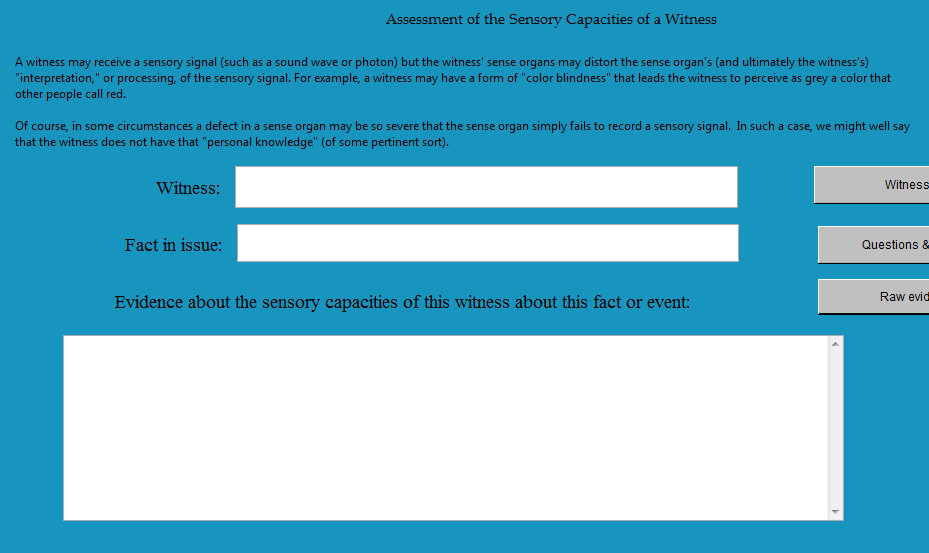
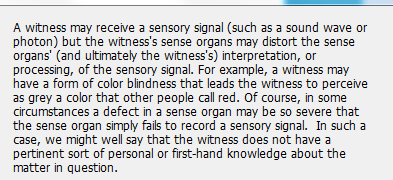
The following "cards" in the Legal Argument "stack" (file) illustrate how a traditional legal treatise writer might think (in part) about legal interpretation:


&&&
The dynamic evidence page

Evidence marshaling software MarshalPlan


fMRI & Neurobabble


Steven Poole, Your brain on pseudoscience: the rise of popular neurobollocks, New Statesman (Sept. 6, 2012):

The human brain, it is said, is the most complex object in the known universe. That a part of it “lights up” on an fMRI scan does not mean the rest is inactive; nor is it obvious what any such lighting-up indicates; nor is it straightforward to infer general lessons about life from experiments conducted under highly artificial conditions. Nor do we have the faintest clue about the biggest mystery of all – how does a lump of wet grey matter produce the conscious experience you are having right now, reading this paragraph? How come the brain gives rise to the mind? No one knows.

&&&&&&

Read the rest of this article. It is hilarious -- and incisive.

&&&
The dynamic evidence page

Evidence marshaling software MarshalPlan


Saturday, September 08, 2012

Human Rights, Crepes, and Caviar


"She [Ms. Clinton] raised the issue of human rights and recent moves by Russia to restrict nongovernmental organizations during a private breakfast of crepes and red caviar with Foreign Minister Sergey V. Lavrov, a senior State Department official said." Myers & Herszenhorn, Clinton Tells Russia Sanctions Will End, but Congress May Disagree (September 8, 2012):
 
&&&
 
The dynamic evidence page

Evidence marshaling software MarshalPlan


Thursday, September 06, 2012

AI & Evidential Inference


&&&
The dynamic evidence page

Evidence marshaling software MarshalPlan


Spindle Law Interview: Carlyn McCaffrey


Spindle Law Interviews: Carlyn McCaffrey

August 8th, 2012 by Nicholas Diamand
Carlyn McCaffreyCarlyn S. McCaffrey is a partner at the law firm of McDermott Will & Emery LLP and is co-head of the firm’s private client practice in New York.  She focuses her practice on tax and estate planning for high net worth individuals.
Carlyn frequently lectures and writes on subjects relating to tax law, trusts and estates, foreign trusts and matrimonial law. She is also an adjunct professor of law at New York University School of Law and the Miami Law School. She received her J.D. and LL.M. from New York University School of Law and her B.A. from George Washington University.
Carlyn is a fellow and a past president of the American College of Trust & Estate Counsel, a fellow of the American College of Tax Counsel, a member of the International Academy of Trust & Estate Counsel and a member of the Joint Editorial Board for Uniform Trust and Estate Act of the National Conference of Commissioners on Uniform Laws.  She serves on a number of boards and advisory boards, including the Board of Directors of the Catholic Communal Fund, the Board of Directors of the Breast Cancer Research Fund, The Metropolitan Museum of Art’s Professional Advisory Council, The Museum of Modern Art’s Planned Giving Advisory Committee and the Professional Advisors Council Committee of Lincoln Center for the Performing Arts, Inc.

Spindle Law: Who inspired you to become a lawyer?
Carlyn McCaffrey: I didn’t know any lawyers when I was young.  But I loved the Perry Mason television show; he made the law look like a very exciting way to make a living.  Of course, when I became a lawyer my practice turned out to be nothing like Perry Mason’s.
Early in my career, my mentor was Len Schmolka who, at the time, was a partner in the trust and estates department at Weil, Gotshal & Manges.  After clerking and after I obtained my LLM in tax at NYU, I taught for six years, the last four in NYU’s tax masters program.  At that point, I decided it would be a good idea to get more practical legal experience.  Len was an adjunct on the NYU faculty and he persuaded me to come to Weil where he was a partner.  I took a leave of absence from teaching to join Weil.  He made it such a wonderful experience that I never went back to full-time teaching.
SL:  What first attracted you to this type of practice?
CM:  I started out wanting to be a tax lawyer. What attracted me to tax law as a student was the intellectual challenge of working through code provisions and finding solutions to problems.  When I started to teach at NYU Law School, the school asked me to teach the basic trust and estate course in addition to tax.  The course introduced me to that field.  I liked the intellectual challenge and the personal interest aspects of the field.  When I joined Weil, I went into its trust and estate department which gave me the opportunity to combine tax and trust and estate work.   Over the years, what I’ve enjoyed the most about it is working with people as people.  Most big firm lawyers work with people, of course, but usually in their representative capacity as officers of  huge enterprises.  But, in the “private client practice” as we call it, we work with individuals on individual problems while, at the same time, working through the intellectual challenge of the tax law.  That’s what I like about it.
SL:  And how has that practice changed in the course of your career?
CM:  In some ways, it’s easier and, in some, it’s harder.  The technology has been amazing.  When I started practicing, wills were done on paper with carbon paper.  If you made a mistake, you had to do the whole page over again.  Now, every associate I work with basically does his or her own document production on a computer so it’s become a lot easier.  The actual putting together of the documents, once you’ve figured out what you want to do, is a lot easier.  On the other hand, the law itself has become enormously more complicated in the more than thirty years that I’ve been practicing.  Every year, the complexity increases.  We can no longer rely on the law remaining the same in my area from one year to the next.  For example, as you probably read, 2010 was a bizarre year when there was no estate tax.  And last year and this year, while everybody has the possibility of giving away $5 million without any gift tax, unless Congress changes its mind again, the limit will go back to $1 million next year.  So, there’s a lot of change and a lot of complexity.
SL:  Are there aspects or elements of the tax policy that you would change if you could?
CM:  It’s essentially the converse of what I said before.  If there were more stability and a lot less complexity that would be a good thing.  It doesn’t look like it’s going to happen though because the trend has been in the opposite direction.  When I first started studying tax law, in the late ‘60s and early ‘70s, we had one volume for the tax code and two volumes of regulations.  We now have two bigger volumes for the tax code and the regulations go all the way up to six good-sized volumes.
Second, the legislative process clearly doesn’t work very efficiently.  A substantial number of the people who vote for these bills don’t really know what they’re doing.  They’re advised by members of their staff and some of them listen to people who want particular exceptions built in to encourage particular kinds of industry or to discourage other kinds of activities.
SL:  In Commissioner of Internal Revenue v. Newman, 159 F.2d 848, 850-51 (2d Cir. 1947), Judge Learned Hand wrote:  “Over and over again, the courts have said that there is nothing sinister in so arranging one’s affairs as to keep taxes as low as possible. Everyone does so, rich or poor; and all do right, for nobody owes any public duty to pay more than the law demands:  taxes are enforced exactions, not voluntary contributions.  To demand more in the name of morals is mere cant.”  Is this as true today as it was in 1947?
CM:  That kind of sentiment is familiar.   Congress has encouraged people to set up structures that exist for the principal reason of reducing income taxes.  However, a couple years ago, back in 2010, Congress codified a rule called the Economic Substance Doctrine.  This rule says that, in order to be considered valid, any transaction that you put together has to have an economic purpose aside from the reduction of tax liability.  There are certain standards you have to comply with to show that there is an economic purpose in the transaction besides the reduction of tax.
On one level, it’s a good thing because it’s discouraging some of the abusive tax shelters.  On the other hand, because the statutory standard is so vague, people are uncertain as to exactly what kind of transactions it’s going to encompass.
SL:  In a recent New York Times article, A Family’s Billions Artfully Sheltered, it reported that “[t]he tax burden on the nation’s superelite has steadily declined in recent decades, according to a sliver of data released annually by the I.R.S.  The effective federal income tax rate for the 400 wealthiest taxpayers, representing the top 0.000258 percent, fell from about 30 percent in 1995 to 18 percent in 2008, the most recent data available.”  Is this consistent with your experience?  And, how do you explain it?
CM:  It’s not particularly surprising because the tax rates have gone down.  When I first started to practice, they were 50%, now they’re 35% and, most importantly, capital gains rates which used to be at least half of the top tax bracket, are now down to 15%.  And the dividend rate is down from 50% to 15% so the truly wealthy people, those who make their money through investments rather than salaries, are more likely to pay capital gains rates or dividend rates than people who work for a living.
The statistics are somewhat misleading because, when you’re looking at the 15% rate on dividend income, you should keep in mind the fact that, before the corporation can give its shareholders dividends on which they pay a 15% tax rate, the corporation has already paid a 34-35% federal tax.  In other words, the effective tax rate on corporate earnings that are available to individual taxpayers has gone through two tax systems before it gets there.
SL:  What do you think the most important development in the legal profession has been in the last 25 or 30 years?
CM:  One of the things that has changed between then and now is the increased diversity among members of the profession, particularly in the case of women. When I went to law school, there were only four of us in my class and it was very hard for women to get jobs in a major law firm.  Now women are accepted on a fairly equal basis.  In addition, people of different racial and ethnic backgrounds, different religions, and different gender orientations have entered the profession in increasing numbers.  The big firms make an effort to put together a diverse group of associates and, ultimately, partners.  This has made a huge difference in the way law firms look than the way they looked in the late ‘60s.
SL:  Other than the increased number of women in the profession, have you seen changes as to the role of women in the law?
CM:  Because of technological advances and an increasing emphasis on the need for diversity, many big firms now provide career paths for women and others with flexible work hours.  For young people, particularly women, who want careers and a family, this is obviously an important development.  When I first started, you had to have what they called ‘face time.’  You had to be at your desk or in your office eight to ten or more hours a day.  Now, it’s much more flexible; there’s not as much problem in having people work at home because the technology makes it possible for you to work at home without inconveniencing your partners or your clients.  There’s a lot more telecommuting which makes it easier for men and women who have family responsibilities to put in a full schedule, but just not every day in the office.  It has created more opportunities for people.
SL:  Are there issues that you anticipate to be hot ones in trusts and estates in the coming months or years?
CM:  There are a lot of hot tax issues.  For example, there will be tremendous pressure on the part of wealthy people to give away at least $5 million or $10 million this year with the fear that that’s going to disappear next year.  There’s the prospect that many of the techniques that have developed over the years to help people make gifts during their lifetime, as opposed to dying with all their wealth, are being looked at very hard by Congress and may be shut down.  They would include things like valuation discounts for minority interests in companies.  So, it’s a constant process of trying to anticipate what Congress is going to do next.
If President Obama wins and if the House becomes Democratic, we probably are going to see a significant decrease in the gift tax credit.  On the other hand, if the Republicans gain control, we might actually see a repeal of the gift tax because in the last 10-12 years they’ve been trying to achieve that.
SL:  Do you have advice for law students and new lawyers?
CM:  For those young professionals who are interested in a law career that has a lot of exposure to individuals and individual issues and, at the same time want the challenge of working with a complex body of law to solve interesting problems, trust and estates or private client work is a good choice.  Those who are interested in this field should give some thought to working for a Masters in tax law or in estate planning.


Putin as Icarus?


So Putin is flying amid the birds (Siberian cranes)? See 

Putin Pulls Off Latest Feat: Flying With the Birds


That's OK. Let's cut him some slack.

&&&
The dynamic evidence page

Evidence marshaling software MarshalPlan